

Quick Answer: A loud humming pool pump means the motor has power but cannot spin its shaft normally, or the shaft is spinning but starved for water. If it hums with the shaft dead still, suspect a jammed impeller, a failed start capacitor, or seized bearings. Cut power, clear the basket and impeller, then hand-spin the shaft. If it hums with a rattly, gravelly sound while spinning, that is cavitation from a clogged basket, low water, a closed valve, or a suction-side air leak. Never let a humming, non-spinning motor keep running; the stalled current overheats the windings and can ruin the motor in minutes.
A healthy pool pump makes a steady, low hum you can talk over without raising your voice. So, when that hum turns loud or strained, or is paired with weak flow at the returns, the pump is telling you something specific. A loud hum is not a single problem; it is a short list of very different problems, each leaving its own fingerprint. Sorting them out before you touch anything saves you from replacing a part that was never broken, and it keeps a cheap fix from turning into a burned-out motor.
Here is what that humming usually means and how to figure out which cause you are looking at.
What the Hum Is Actually Telling You
The sound comes from two very different places. Either the motor has power but cannot turn its shaft as it should, or the shaft is spinning fine, and the noise is coming from the water it is trying to move. That split is the fastest way to narrow things down.
An electrical or mechanical hum comes from the motor itself: it is energized, buzzing, and either not spinning or fighting friction to do it. A water-related hum (the rattly, gravelly kind) comes from cavitation, where the impeller is spinning but starving for water. Standing at the equipment pad, ask one question first: Is the motor shaft turning at all? If it hums but the shaft is dead still, you are in electrical or seized-motor territory. If it hums, spins, and sounds like it is pumping gravel, you are dealing with a suction or flow problem.
A Failed Start Capacitor
This is the classic "hums but won't spin" failure. The start capacitor is a small cylindrical component, usually tucked under a hump on top of the motor or inside a terminal box on the back. Its job is to give the motor a jolt to break it out of a standstill and get the shaft rotating. When the capacitor fails or dies, the motor draws power and hums loudly, but it never develops enough torque to start turning.
There is a well-known field test for this, and it comes with a hard safety rule. With the breaker off, you can carefully spin the motor shaft or impeller by hand a partial turn, then restore power. If the motor jumps to life and runs normally with that little push, the start winding is not getting its kick, a strong sign the capacitor is the culprit. Never do this with the power on, and never leave a humming motor energized while you poke at it. Capacitors are heat-sensitive electrolytic parts, and the constant heat load a pump lives under wears them down over the years.
Seized or Worn Motor Bearings
Bearings are the wear item inside the motor, front and back sets that let the shaft spin smoothly. As they wear, you first hear a rough, metallic hum that grows into grinding or screeching and gets worse over weeks, not days. If they seize completely, the shaft physically cannot turn, and the motor just hums like a dead capacitor.
The tell here is the hand test again, but with a different result. Kill the breaker and try to turn the shaft. A good motor spins freely and quietly. A bad-bearing motor either resists, feels gritty and notchy as you turn it, or will not budge at all. Bearings fail with age, but the fast track to failure is water intrusion: when the shaft seal behind the impeller fails, water enters the motor and rusts the bearings from the inside. If you find rust weeping from the motor or water pooling under it, plan on the seal and bearings together.
A Jammed or Clogged Impeller
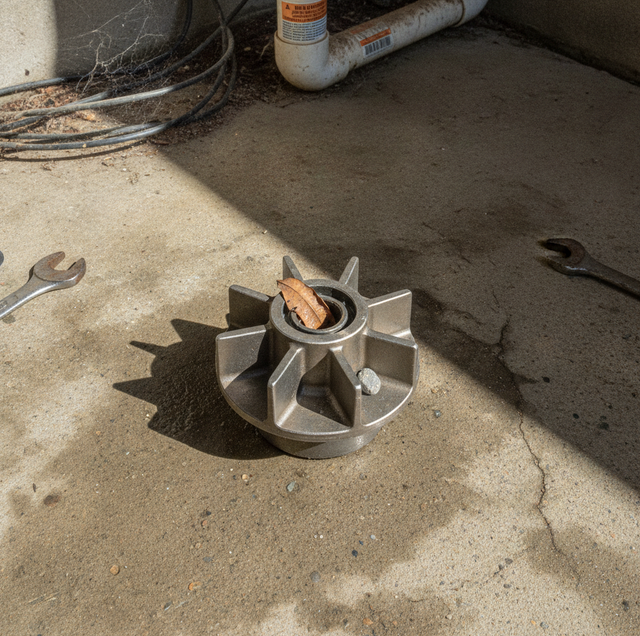
Before you condemn anything electrical, rule out the free fix. The impeller is the small vaned wheel behind the pump basket that actually moves the water. Leaves, acorns, small stones, pebbles, or a broken chunk of the pump basket can wedge into its vanes and stop it cold. The motor tries to turn, cannot, and hums.
Shut off the breaker, pull the pump lid and basket, and look straight down into the impeller eye. Reach in and try to spin it. If you feel debris packed in the vanes, work it out with your fingers or a straightened piece of wire, then spin it clear. A jammed impeller mimics a bad capacitor or seized bearing almost exactly, which is why clearing it is always the first move. It costs nothing and rules out the cheapest cause.
Cavitation and a Suction-Side Air Leak
This is the water-side hum, and it sounds different: rattly, gravelly, like the pump is grinding coffee or moving rocks. Cavitation occurs when the impeller is spinning normally but cannot draw in enough solid water to fill it. It spins in a partial vacuum, tiny vapor bubbles form and collapse violently, and that collapse is the noise. Left running, it pits and erodes the impeller.
The starve comes from anything that restricts water reaching the pump: a full skimmer basket or pump basket, a low water level that lets the skimmer gulp air, a partly closed suction valve, or a filter run so dirty it chokes the whole loop. It also comes from a suction-side air leak, a cracked pump lid, a dried-out lid o-ring, loose drain plugs, or a bad fitting between the pool and the pump. The signature of an air leak is bubbles: air swirling in the clear pump basket lid while it runs, and a stream of bubbles blowing out the pool return jets instead of a smooth push of water.
When the Cause Is Voltage, Not the Pump
Sometimes the pump is fine, and the supply is not. A motor that hums, struggles to start, or starts weakly can be starved of voltage rather than water. Loose, corroded, or burnt wire connections at the motor terminals, an aging contactor, or low incoming voltage all rob the motor of the power it needs to break free and spin up. The symptom overlaps with a bad capacitor, which is why a hum that appeared right after electrical work, or that comes and goes, deserves a look at the wiring before you buy parts. Voltage and connection testing is meter work, and a persistent electrical hum with no obvious mechanical cause is the point to bring in a pro rather than keep guessing.
Matching the Sound to the Cause
Once you know whether the shaft is turning, the specific sound points the rest of the way.
| What you hear and see | Most likely cause | First move |
|---|---|---|
| Loud hum, shaft dead still, spins fine by hand | Failed start capacitor | Hand-spin test with power off; replace capacitor |
| Hum with grinding or screeching, shaft gritty or stuck | Worn or seized bearings | Check for rust and shaft seal; replace bearings or motor |
| Straining hum, shaft won't turn by hand | Jammed impeller | Clear basket and impeller of debris |
| Rattly, gravelly hum, shaft spinning | Cavitation (starved for water) | Check water level, baskets, valves, filter |
| Hum with air in basket and bubbles at returns | Suction-side air leak | Inspect lid o-ring, plugs, fittings |
| Weak or intermittent hum after electrical work | Low voltage or bad connection | Have wiring and voltage checked |
Putting the Clues Together
The order that saves you money is almost always the same: cut power, clear the basket and impeller, then hand-spin the shaft. That one sequence separates the free fixes from the real repairs and tells you whether you are chasing an electrical fault, a worn motor, or a water-starved pump. Match the sound to the shaft's behavior, act on the cheapest likely cause first, and you avoid the trap of throwing a new capacitor at a jammed impeller. What you should not do is let it keep humming while you decide; a stalled, energized motor overheats fast, and a few minutes of that can be the difference between a part swap and a new motor.
Frequently Asked Questions
Often, yes, and they give themselves away in opposite ways. Kill the breaker first, then find the capacitor under its small cover on the back or top of the motor. A failed one usually shows it: the top may be swollen or domed instead of flat, the case can look bulged or split at a seam, and a burst one leaves an oily film or crusty residue where the electrolyte leaked out. A bulged or weeping capacitor is condemned on sight. Bearings hide inside the motor and give you nothing to look at, so you diagnose them by feel with the power off: grip the shaft or impeller, rock it side to side, then rotate it. A good bearing set holds the shaft snug and turns smoothly; a failing one shows loose side-to-side play, a gritty drag, or a catch partway around.
Watch for air, not water leaks; a suction leak pulls air in, so it rarely drips. With the pump running, look for air swirling under the clear pump lid and bubbles blowing from the return jets. To pin the spot, run a bead of shaving cream or a few drops of thick liquid soap around each suction fitting, the lid seal, and the drain plugs; where the pump sucks it inward, that is your leak. Underground pipe leaks that never surface above ground usually need a pro to pressure-test the line.
When a pump sits idle for weeks or a full off-season, the shaft seal and any residual moisture inside can let light surface rust form on the shaft and bearing surfaces, and the mechanical seal faces can stick together. The shaft binds just enough that the motor cannot break it loose on its own, so it hums. Gently rocking the shaft by hand with the power off will often free a lightly stuck shaft; one that will not release points to seized bearings or a rusted seal.
No. A humming motor that is not spinning is stalled while still drawing heavy current, and that current has nowhere to go but into heat. Within a short stretch, that heat can cook the motor windings and turn a cheap capacitor or basket-clearing job into a full motor replacement. Shut it off at the breaker as soon as you hear a sustained hum with no flow, then diagnose. The same goes for cavitation; running a starved pump chews up the impeller.
Variable-speed motors are quieter overall, but a low-speed hum can flag a couple of things a single-speed pump would not. At the lowest RPM, the motor has the least torque, so a start capacitor or bearing that is starting to fail shows up there first, humming or straining before the pump reaches a speed where it can muscle through. A faint electronic hum from the drive itself can be normal, but a mechanical hum plus reduced flow at low speed is worth a look at the wet end and the drive board.
It contributes. Capacitors and bearings are both heat-sensitive, and a pump that runs for long daily hours during hot, humid stretches is under a heavier thermal load that wears those parts faster. But heat is not only a summer stressor, a pump baking on a poorly shaded pad, poor ventilation around the motor, or simply years of long run cycles stress it in any season. Keeping the motor's cooling vents clear of debris and giving it airflow helps it shed heat year-round, not just in July.
When It Is Time to Call for Help
Some causes are homeowner-friendly: clearing a basket, replacing an O-ring, and checking the water level. Others, replacing bearings and a shaft seal, swapping a capacitor, or testing voltage at the terminals, cross into work where the wrong move can damage the motor or the person doing it. A useful rule of thumb on the bigger repairs: if the wet end of the pump is sound and the motor is the newer half of an aging unit, replacing just the motor and keeping the housing is often the better value; if the whole pump is well up in years and problems keep stacking, a full replacement usually makes more sense than repairing one failure after another. When the diagnosis is not obvious, or the fix is electrical, that is the moment to hand it to someone with a meter and the right parts.
Have a pump that hums, rattles, or barely moves water? Get it diagnosed and fixed right the first time. Dog Days Pools serves Clearwater and Pinellas County. CPC1460480. Call (727) 205-0566.