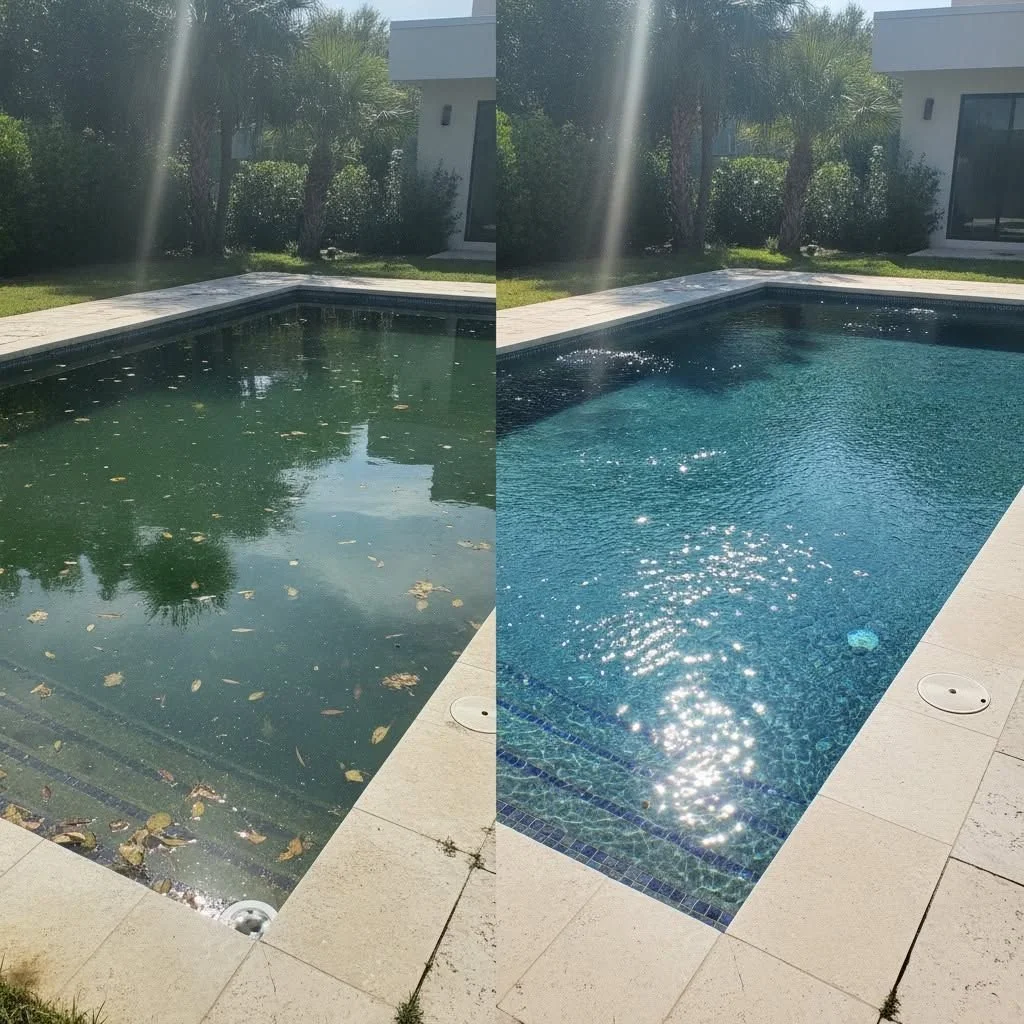
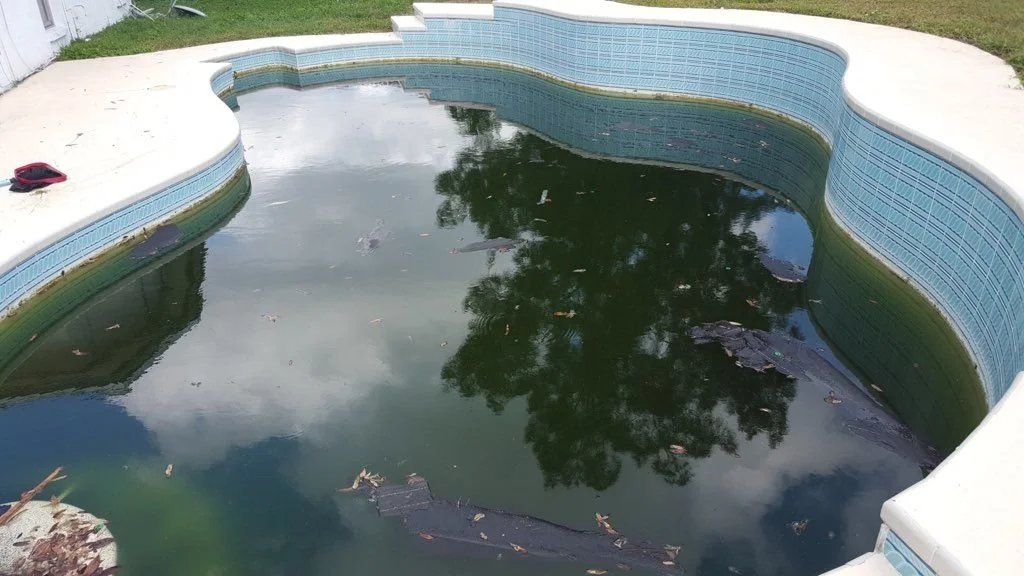
A green pool in Florida isn't just an eyesore. It's a health hazard — algae harbors bacteria, including E. coli, provides breeding habitat for mosquitoes, and makes the pool completely unusable. And in Clearwater's heat and humidity, a pool that goes green can go from lightly teal to completely black within 1–2 weeks without treatment.
Dog Days Pools treats green pools across Clearwater, Safety Harbor, Dunedin, Palm Harbor, Oldsmar, Countryside, East Lake Woodlands, and Lakeridge. We assess the algae level on arrival, apply the right treatment for that severity — not a one-size-fits-all shock dump — and get the pool back to clear water as quickly as possible. Same-day and next-day service available. No trip fee. No obligation to sign up for ongoing service.
Why Pools Turn Green — The 5 Real Causes
Algae is always present in pool water as spores — the question is whether conditions allow it to bloom. When they do, a clear pool can turn green in as little as 24–48 hours. Here are the five conditions that cause green pools in Clearwater:
The most common cause. Free chlorine below 1 ppm means algae has no barrier to growth. Florida's UV destroys unstabilized chlorine in hours — a pool without adequate stabilizer (CYA) can lose all its chlorine in a single hot day. Missed service visits, equipment failures, or heavy rain diluting chemistry all cause chlorine crashes.
CYA (cyanuric acid / stabilizer) prevents Florida's UV from destroying chlorine. Without it, chlorine that looks fine in the morning is gone by noon. Stabilizer needs to be in the 40–80 ppm range (higher for salt pools). A pool with zero CYA will burn through 5x the chlorine and still go green.
Chlorine's effectiveness drops dramatically as pH rises above 7.8. At pH 8.0, chlorine is only about 20% as effective as at pH 7.4 — so even a pool with 'adequate' chlorine on paper is functionally under-sanitized if pH is high. Salt pools are particularly prone to high pH because the electrolysis process raises pH naturally.
Pool water needs to turn over through the filter multiple times per day to stay clear. A pump running only 4 hours per day in Florida's summer is far too little — 8–12 hours is the minimum for most residential pools during peak heat. Insufficient filtration allows algae to establish faster than the chemistry can suppress them.
For salt pool owners: a salt cell coated in calcium scale, undersized for the pool, or nearing the end of its life, can fail to produce enough chlorine — even when the control panel shows it running at 100%. The pool appears to be chlorinated, but it isn't. This silent failure commonly causes green pools that baffle owners who think 'the salt system is running fine.'
Green pools don't fix themselves. In Florida's heat, algae doubles in as little as 24 hours under ideal conditions. A pool that's light teal today can be dark green tomorrow and completely black in a week. The earlier the treatment starts, the simpler and less expensive the recovery.
Any of these sound familiar? Don't wait — call (727) 205-0566 now for a same-day assessment.
Green Pool Severity Levels — What Yours Has and What It Takes to Fix It
Not all green pools are treated the same way. The right approach depends entirely on how far the algae have progressed. Treating a Level 4 pool like a Level 1 wastes chemicals and time — and doesn't work. Here's how we assess and treat each level:
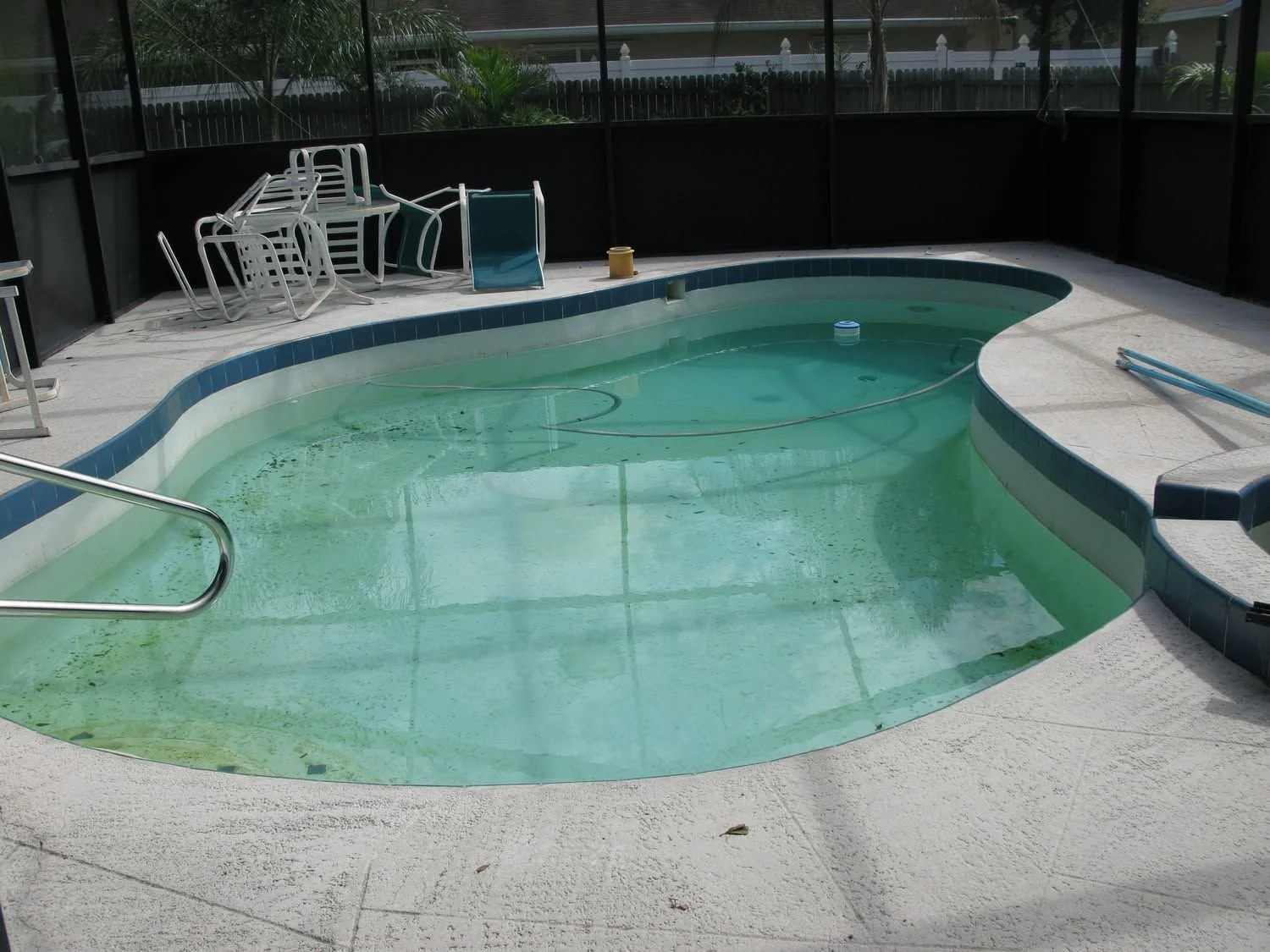
Signs: Water is light teal or hazy green. The pool floor is fully visible. Walls may have a slight greenish tint. Typically caught within 1–3 days of a chlorine crash.
- Full chemistry test — identify root cause (low CYA, high pH, low chlorine, salt cell failure)
- Correct pH first — chlorine effectiveness restored before shock applied
- Heavy shock treatment — liquid chlorine (not granular) for fastest distribution
- Brushing all surfaces — breaks algae colonies off walls and floor so chlorine can reach them
- Run filter continuously for 24–48 hours — filter out dead algae
- Backwash or clean filter after first 24 hours — heavy algae load clogs filter quickly
- Address root cause — CYA correction, salt cell cleaning, timer adjustment as needed
Typical Timeframe: 24–48 hours to clear water. Usually 1 service visit + follow-up check.
Signs: Water is clearly green. The pool floor is visible but murky, with colors washed out. Walls have visible algae coating on surfaces. 3–10 days of unchecked growth.
- Full chemistry test and root cause diagnosis
- pH correction before any shock — critical at this stage
- Double shock treatment — significantly higher chlorine dose than Level 1
- Thorough wall and floor brushing — multiple brush passes on all surfaces
- Algaecide treatment to supplement chlorine — addresses algae, but chlorine has not yet reached
- Continuous filter runtime — 48–72 hours minimum
- Filter backwash or clean every 24 hours during treatment — algae die-off overwhelms the filter
- Day 2 follow-up: retest chemistry, repeat brushing, assess clarity progress
- Full chemistry rebalance at completion — after algae clearance, chlorine demand drops sharply
Typical Timeframe: 48–72 hours to clear water. 2 service visits typically required.
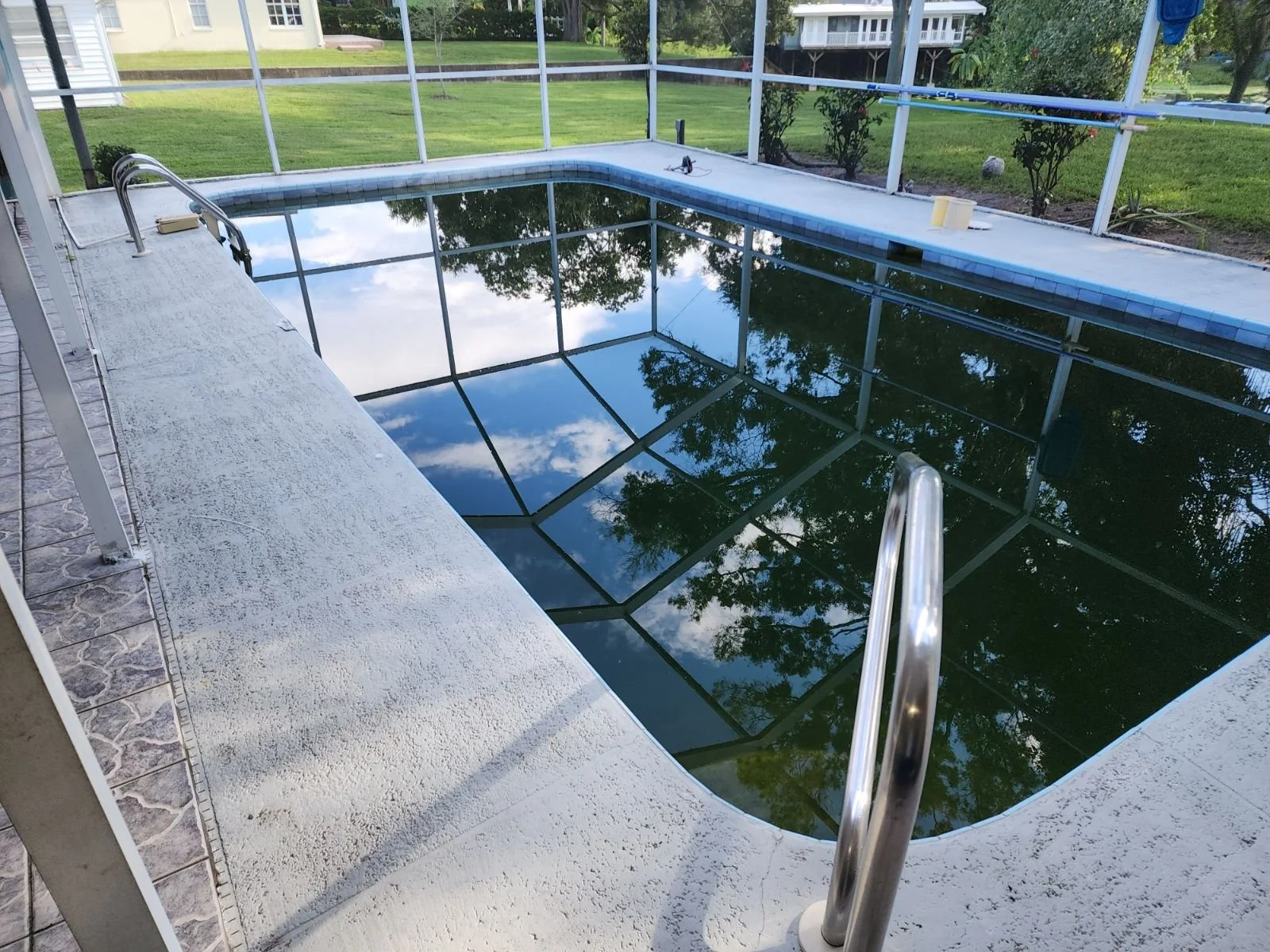
Signs: Water is dark green — pool floor completely invisible. Heavy algae coating on all surfaces. Possible filter clogging from algae load. 1–3 weeks of unchecked growth.
- Root cause assessment — often, equipment failure (pump, salt cell) caused the crash
- Triple shock treatment — very high chlorine dose across multiple applications
- Aggressive multi-pass brushing of all surfaces before and after each shock
- Algaecide treatment — necessary at this severity level
- Continuous filter run with daily backwash or cartridge cleaning — filter may need professional deep cleaning
- Day 2 and Day 3 follow-up visits — progressive chemistry checks and brushing
- DE filter grids or cartridges may need replacement if the algae load is severe
- Partial water exchange is considered if chemistry is severely compromised
- Full chemistry rebalance and stabilizer check at completion
Typical Timeframe: 3–5 days to clear water. 3+ service visits. May include filter service.
Signs: Water is black, brown-black, or so dark green it appears black. The pool floor is invisible. Heavy algae on all surfaces. Black algae (Cladophora) may be present, rooted into plaster. 3+ weeks of unchecked growth, or long-standing black algae infestation.
- Assessment: determine if black algae is present (brushing test — black spots don't brush off easily)
- For standard severe green: drain and refill is often faster and more effective than extended chemical treatment
- For black algae specifically: black algae has roots that penetrate plaster — requires acid washing of surfaces after draining
- Partial drain (for chemistry dilution) vs. full drain (for acid washing) — determined on assessment
- Pressure wash pool surfaces after draining — removes algae from the surface before acid wash
- Acid wash — dilute muriatic acid applied to plaster surfaces, scrubbed and rinsed — removes embedded algae and staining
- Full plumbing flush — algae spores present in plumbing lines; flush before refilling
- Refill and full chemistry baseline from scratch
- Post-refill chemistry calibration — new water requires a full balance before the pool can be used
Typical Timeframe: 5–10 days, including drain, acid wash, and refill. Multiple visits.
How We Treat a Green Pool — Step by Step
Every green pool treatment follows the same diagnostic-first process. We never just dump shock in a green pool and hope for the best — the root cause has to be identified and corrected, or the pool will go green again within days of treatment.
On-Arrival Assessment
We observe the pool's color, water transparency (can we see the floor?), wall algae coverage, and equipment status. This determines the severity level and treatment approach before we open a chemical container.
Full Chemistry Panel Test
Test all parameters: free chlorine, pH, total alkalinity, calcium hardness, stabilizer (CYA), and salt level if applicable. We need to know exactly what we're working with — pH correction must happen before shocking, and CYA level determines how much shock is actually needed.
Root Cause Identification
Before treating, we identify why the pool went green: low CYA? High pH? Pump runtime too short? Salt cell failing? Equipment malfunction? Treating green without fixing the root cause means the pool will go green again. We address the cause as part of the treatment — not as a follow-up recommendation.
pH Correction First
If pH is above 7.6, we bring it to the target range before shocking. This is the step most DIY treatments skip — and it's why many homeowner shock treatments don't work. Chlorine at pH 8.0 is barely effective. Chlorine at pH 7.4 is 10x more effective than at pH 8.0. pH correction is not optional.
Brushing — Before and After Shock
We brush all pool surfaces before applying shock — this breaks algae colonies off walls and floor, exposing them to the chemical treatment. Algae that's still attached to surfaces is partially protected. After brushing, we apply shock to the disturbed algae mass in the water, where it can be fully reached.
Shock Treatment — Calibrated to Severity
We calculate the correct shock dose based on pool volume, current free chlorine, and algae severity level — not a standard dose applied to every pool. Liquid chlorine is used over granular for green pool treatment because it distributes immediately and doesn't risk bleaching surfaces.
Filter Runtime & Backwash Schedule
We set the pump to run continuously and advise on the backwash schedule — typically every 24 hours during active treatment, because the filter is removing dead algae from the water at a much higher rate than normal. An unbackwashed filter full of dead algae recirculates debris and slows clearing significantly.
Follow-Up Visits to Confirm Resolution
We return at 24–48 hour intervals to re-test chemistry, brush again (dead algae on surfaces needs a second pass), add any additional treatment needed, and track clarity progress. Green pool treatment is not a single visit — the follow-up is as important as the initial treatment.
Final Chemistry Rebalance & Prevention Assessment
Once the water is clear, we do a complete final chemistry test and full rebalance. Chlorine demand drops significantly after algae is eliminated — what was needed during treatment is now too high. We also review the root cause with you and make recommendations to prevent recurrence.
Why Clearwater Pool Owners Choose Dog Days for Green Pool Treatment
Aqua Wizard's Green Pool Page Is 4 Sentences
Aqua Wizard Pool Service has the only dedicated green pool cleanup page among Dog Days' local competitors — and it's 4 short sentences: drain, bleach, wash, and refill. Three possible causes are listed (algae, improper filtration, low pH, and metals). No severity levels, no treatment process, no root cause discussion, no distinction between chemical treatment and drain-and-refill. Dog Days Pools is the only Clearwater company with a complete, detailed green pool resource that actually helps a pool owner understand what they're dealing with.
We Determine the Root Cause — Not Just the Symptom
Shock treatment kills the algae. But if the pool goes green because the salt cell is producing half the chlorine it should, or because the pump is only running 4 hours a day, or because the CYA level is zero, shock treatment is temporary. The pool will go green again within a week of treatment if the underlying cause isn't addressed. Dog Days Pools identifies and corrects the root cause as part of every green pool treatment. We don't leave you with a clear pool that will be green again by next Tuesday.
pH Correction Before Shock — Most DIY Treatments Skip This
The most common reason homeowner shock treatments fail is that the pH is too high when the chlorine goes in. At pH 8.0, chlorine is about 20% as effective as at pH 7.4. A pool owner who dumps three bags of shock into a pH 8.2 pool and wonders why it's still green three days later has experienced this firsthand. Dog Days Pools always correct pH before applying shock. This single step is the difference between a treatment that works in 48 hours and one that appears to work for a day, and then the pool stays green.
Florida's heat accelerates everything
Florida's heat accelerates everything. A pool that's lightly teal on Monday morning can be dark green by Wednesday and opaque by Friday. Every day of delay moves the pool into the next severity level — which means more chemicals, more visits, more cost, and more time without a usable pool. Dog Days Pools is open seven days a week, 9am to 9pm, with same-day and next-day availability for green pool calls. When you call on Monday morning about a green pool, we can often be there on Monday.
Level 4 / Drain & Refill Capability — Handled Start to Finish
Most pool cleaning companies handle chemical treatments. Drain-and-refill for severe green pools and acid washing for black algae are less common capabilities — they require pool contractor licensing, the ability to safely manage the drain and refill process, and knowledge of acid wash procedures. Dog Days Pools (License #CPC1460480) handles Level 4 green pool treatment, including drain, pressure washing, acid washing, and refill as a complete service — you don't need to find separate contractors for each step.
DIY Green Pool Treatment vs. Professional Service — What You're Actually Comparing
Many pool owners try to treat a green pool themselves before calling a professional. Here's an honest comparison of what typically happens:
| DIY Treatment | Dog Days Pools Professional Treatment |
|---|---|
| Buy shock at pool store without testing water first | Test all 7 chemistry parameters before applying anything |
| Apply shock at incorrect pH — treatment partially effective | Correct pH first — 10x chlorine effectiveness at pH 7.4 vs 8.0 |
| Apply granular shock — risk of bleaching pool surface | Use liquid chlorine — immediate distribution, no surface risk |
| Skip brushing — shock doesn't reach attached algae | Brush all surfaces before and after shock application |
| Run pump normally — filter overwhelmed with dead algae | Set to continuous run, backwash every 24 hours during treatment |
| Pool clears partially, then algae returns in 5–7 days | Root cause identified and corrected during treatment |
| No follow-up — assume one application is enough | Follow-up visits at 24–48 hour intervals until fully clear |
| Total cost: $80–$150 in chemicals + 2 weeks of a green pool | Professional treatment with root cause fix — pool clear in 2–5 days |
Green Pool Clean-Up Service Area — Clearwater & Pinellas County
Same-day and next-day green pool treatment across all service areas. The earlier you call, the sooner the pool is clear.
Our Primary Service Areas:
📍 Clearwater —Our home base — we know every neighborhood
📍Safety Harbor —Full-service pool care for Safety Harbor residents
📍Dunedin — Reliable weekly and repair service in Dunedin
📍Palm Harbor —Trusted pool pros throughout Palm Harbor
Also Serving:
📍 Oldsmar — Our home base — we know every neighborhood
📍Countryside — Experienced pool care for Countryside homeowners
📍East Lake Woodlands — Expert pool maintenance in East Lake Woodlands
📍Lansbrook — Regular service and repairs throughout Lansbrook
Not sure if we cover your area? Call (727) 205-0566 — we'll confirm coverage and give you a free estimate on the same call.
Call now to get a Free Estimate.
Call or Text
(727) 205-0566Hours
Monday – Sunday: 9am to 9pmServing all of Pinellas County
Green Pool FAQs — Clearwater, FL
Straight answers to the questions we hear most from Clearwater homeowners about green pool treatment.
In Florida's heat, green pools get worse every day. Call or text us now and we'll tell you your severity level, what it will take to fix it, and when we can be there.