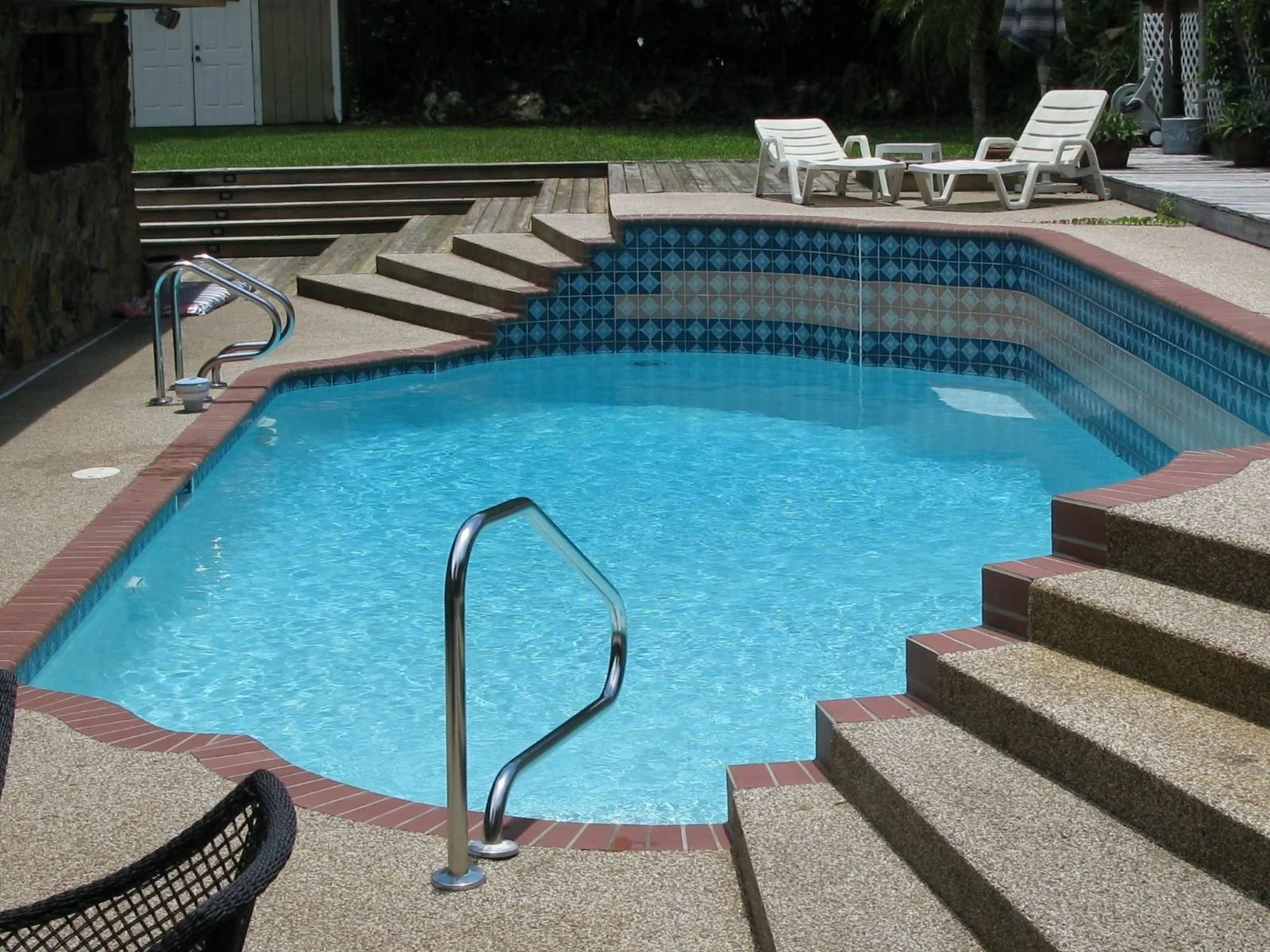
Your pool's plumbing is the circulatory system of the entire setup. Suction lines pull water in from the skimmer and main drain. Return lines push filtered water back. A web of valves controls the flow — deciding what gets filtered, what gets backwashed, which direction water travels, and whether your spa fills or drains. When any part of that system develops a leak, a crack, or a stuck or failed valve, the effects ripple outward: air in the pump, loss of prime, poor circulation, cloudy water, unexplained water loss, or wet spots appearing in your yard around the equipment pad.
Dog Days Pools diagnoses and repairs pool plumbing problems across Clearwater, Safety Harbor, Dunedin, Palm Harbor, Oldsmar, Countryside, East Lake Woodlands, and Lansbrook. We repair PVC supply and return lines, underground plumbing, suction-side leaks, equipment pad plumbing, and all types of pool valves — check valves, 3-way diverter valves, gate valves, and actuator-controlled valves. No trip fee. No diagnostic charge. A straight assessment and a clear quote before any work starts.
Clearwater's Pool Plumbing Specialists
All Valve Types Serviced
Check, diverter, gate, multiport & actuator valves
PVC Pipe Repair & Replacement
Suction lines, return lines, equipment pad plumbing
No Trip Fee. Free Estimates.
Quote before any work begins — always
20+ Years Florida Pool Plumbing
#1 in Clearwater & Safety Harbor, 6 years running
Open 7 Days, 9am–9pm
Including weekends and evenings — no overtime charge
Licensed & Insured
License #CPC1460480 — State of Florida
Signs Your Pool Has a Pipe or Valve Problem
Pool plumbing problems rarely announce themselves loudly. Most show up as something that seems like a different issue — low flow, poor water quality, unexplained water loss, or a pump that keeps losing prime. Here are the warning signs that typically point to a pipe, fitting, or valve problem:
- Pump basket not filling with water — pump running dry
- Pump repeatedly loses prime and needs re-priming
- Air bubbles streaming continuously from the return jets
- The pump is running loudly with reduced flow output
- The pump strainer lid has a visible air pocket at startup
- The suction side of the pump is vibrating or surging
- The pool water level is dropping more than 1/4 inch per day
- Water bill increased without explanation
- Soil is perpetually soft, soggy, or wet near the equipment pad or pool edge
- Pavers or concrete shifting or sinking around the pool deck
- Visible water pooling around pump, filter, or heater connections
- Return jets have noticeably weaker flow than normal
- Spa drains back into pool when pump shuts off (failed check valve)
- Solar heater drains into pool overnight (failed check valve)
- The diverter valve is stuck, hard to turn, or the handle has broken off
- Water leaking from the valve body or the valve handle collar
- Can't stop the water flow to one section of the system
- Automation actuator not moving the valve when commanded
- Pool water is persistently cloudy despite correct chemistry
- Algae returning quickly after treatment — poor circulation
- One end of the pool stays murky while the other clears
- Chemistry is constantly out of balance despite regular dosing
Noticing any of these? Call (727) 205-0566 — no trip fee, honest diagnosis, 7 days a week.
Your Pool's Pipe System — What We Work On
A Florida inground pool's plumbing typically runs underground between the pool shell and the equipment pad, and then above-ground through PVC connections between the pump, filter, heater, salt system, and returns. Here's a plain-language overview of the plumbing systems Dog Days Pools services:
Suction Lines — From Pool to Pump
Suction lines carry water from the pool to the pump. They originate at the skimmer(s) and the main drain, run underground, and connect to the suction inlet on the pump. Any crack, loose fitting, or deteriorated union on the suction side of the pump introduces air into the system — the pump pulls in air instead of water, loses prime, runs inefficiently, and can burn out the motor seal if left unaddressed. Suction-side leaks are the most common source of persistent air bubbles in return jets and repeated pump priming loss. They're usually above-ground at fittings, unions, or the pump lid — but can also occur underground where the pipe has shifted or aged.
Return Lines — From Filter Back to Pool
Return lines carry filtered, treated water from the equipment pad back to the pool through the return fittings (jets) in the pool wall. Damage to return lines can cause water loss, reduced flow from specific jets, or uneven circulation that leaves parts of the pool poorly filtered. Underground return line failures are less immediately obvious than suction-side failures but often show up as soft or wet ground along the pipe's path, or pools that slowly lose water without any visible surface leak.
Equipment Pad Plumbing
The above-ground PVC network connecting the pump, filter, heater, salt chlorinator, and any other equipment is the most frequently serviced plumbing in a pool system. Unions, elbows, reducers, and straight runs all use threaded or slip-fit PVC connections that can develop leaks over time — from UV degradation, vibration, thermal expansion, or improper original installation. We repair and re-plumb equipment pad connections using properly rated PVC, schedule-appropriate pipe, correct union sizes, and Teflon or thread sealant appropriate to each fitting type.
Underground Pipe
Underground pool plumbing in Florida faces additional stress from ground movement, root intrusion, and long-term chemical exposure in sandy soil. When an underground line develops a crack or joint failure, it can be difficult to locate without pressure testing. We perform suction and return line pressure testing to isolate which lines are losing pressure, use that data to narrow down the leak location, and perform targeted excavation and repair rather than digging up the entire run. For line failures where the pipe can be rerouted above ground or through accessible chase routes, we offer that as an alternative to excavation where practical.
Skimmer Fittings & Main Drain Connections
The connection between the skimmer throat and the underground suction pipe, and the connection between the main drain fitting and its underground line, are common leak points in older Florida pools. Skimmer-to-pipe collar failures are often gradual — the skimmer may look structurally sound while its underground connection has separated or degraded. We inspect, pressure-test, and repair skimmer fittings and main drain connections as standalone services or as part of a broader plumbing assessment.
Pool Valve Repair & Replacement — All Types
Pool valves are among the most frequently overlooked components until they fail. Here are the five main valve types found in Clearwater pools and what we do when they need attention:
Check Valves — Prevents water from flowing backward when pump is off
Check valves allow water to flow in only one direction and spring closed when the pump shuts off. They're critical for preventing spa drain-back (spa water flooding into the pool overnight when the pump turns off), preventing solar heater panels from draining back into the pool between heating cycles, and keeping salt cell systems properly primed. The internal flapper or spring mechanism inside a check valve degrades over time — especially in Florida's heat and UV environment. A failed check valve that doesn't seal completely allows water to quietly drain backward through the system every time the pump cycles off. We replace check valves on suction lines, return lines, solar loops, and any other application where backflow prevention is needed.
- Spa drain-back into pool: most common check valve failure symptom
- Solar heater draining into pool overnight: check valve on solar return loop
- Clear-lid check valves allow you to visually confirm the flapper is seated
- We carry common sizes for same-day replacement in most cases
- Internal links: /leak-detection-and-repair for water loss assessment
3-Way Diverter Valves — Controls which direction water flows in split-line configurations
Three-way diverter valves allow one pump to serve multiple plumbing paths — directing water to the pool or the spa, switching between skimmer and main drain suction, or routing water to different return zones. They're one of the most commonly repaired valves in Florida pools. The internal diverter (a teardrop-shaped plug that rotates to open or close each port) wears against its seat over time and can develop bypass leaks — water flowing to both directions simultaneously instead of just one. The external handle assembly can also crack, break, or seize up, particularly on valves that are rarely adjusted. We replace diverter inserts, handles, handle flanges, and complete valve bodies across all major brands and sizes.
- Valve hard to turn: diverter plug worn against seat — common in Florida heat
- Water flowing to spa and pool simultaneously: worn diverter not sealing
- Handle broken or snapped: housing crack or over-torquing — straightforward replacement
- Valve leaking from stem or body: o-ring or seat failure
- Size matching is critical: 1.5-inch and 2-inch valves are not interchangeable
Gate Valves & Ball Valves — Manual on/off and partial-throttle flow control
Gate valves and ball valves are the simple on/off control valves used to isolate sections of the plumbing system for servicing — shutting off flow to the heater for bypassing, isolating the pump for seal replacement, or closing down a return line for leak testing. Gate valves use a threaded stem that raises or lowers a disc to open or close the pipe. Over time, the stem o-ring wears, and the valve begins leaking from the handle area even when fully open or closed. Ball valves are more reliable for complete shutoff, but their internal ball and seats also wear. We replace gate valves and ball valves, sourcing correctly schedule-rated PVC valves for the operating pressure of your specific system.
- Leaking from the handle or stem collar: stem o-ring failure — common repair
- Valve won't fully close: internal seat wear or debris obstructing the gate
- Valve handle cracked or broken: standard replacement, usually on the same visit
- Always replace with a correct pressure-rated valve for the line's position
- Gate valves in high-cycle positions often benefit from a ball valve upgrade
Actuator Valves (Motorized) — Automation-controlled valves for spa, water features & multi-zone systems
Valve actuators are the motorized drives that automatically turn diverter valves on command from an automation controller or smartphone app. They're what allow your pool automation system to switch between pool and spa mode, activate water features, or change return flow zones without manual valve turning. When an actuator fails — which happens due to moisture intrusion, motor wear, or gear failure — the automation system can no longer control that valve. You may notice the spa won't heat (pump not switched to spa mode), water features won't activate, or the automation system shows an error for that zone. We diagnose actuator failures, replace failed actuator motors, and resync replacements to existing Pentair, Hayward, and Jandy automation systems.
- Spa won't switch on from the app or panel: actuator not moving valve to spa position
- Water feature won't activate: actuator on that zone's valve has failed
- Actuator making a grinding or clicking noise: internal gear failure
- Automation panel error for a specific valve zone: first check the actuator
- Replacement actuators must be brand-matched to your automation system
Unions & Threaded Fittings — The connection points between equipment and plumbing
Pool unions are the quick-disconnect fittings that allow equipment to be removed for servicing without cutting the pipe. They're found at both ends of every piece of equipment on the pad — pump inlet and outlet, filter inlet and outlet, heater connections, and salt system connections. The threaded nut and o-ring inside each union create the pressure seal. When a union o-ring degrades or the union nut cracks (both common in Florida's UV and chemical environment), water leaks from the connection under operating pressure. We replace union o-rings, union bodies, and complete union assemblies, and inspect all equipment pad unions during any plumbing service call — a loose or weeping union at the heater is easily missed but can cause slow water loss that's hard to trace.
- Water dripping or spraying from the connection point when the pump runs: union o-ring
- Wet stain or mineral deposit ring around fitting: slow union leak
- Visible crack in union nut or body: UV degradation — replace entire union
- Whistling or spraying at startup, then sealing: o-ring seated incorrectly
- We carry common 1.5-inch and 2-inch union sets for same-visit replacement
Our Pipe & Valve Repair Process
Pool plumbing problems are diagnosed by working through the system systematically — not by guessing and replacing parts until something works. Here's how Dog Days Pools approaches a plumbing repair call:
Step 1: Listen First
When you call, describe what you're experiencing — air in the pump, water loss, a stuck valve, a wet spot in the yard. In 20+ years of Clearwater pool plumbing work, a lot can be narrowed down from symptoms before we even arrive. We come to your pool knowing what to look for rather than starting cold.
Step 3: Suction-Side Air Leak Isolation
If air in the system is the presenting problem, we isolate the suction side. We inspect the pump lid o-ring, pump basket housing, skimmer basket and lid, suction line unions, and any suction-side valves. We can use the pump itself to help identify which section is pulling air — isolating valve positions and watching the pump basket for bubbles to pinpoint the entry point.
Step 2: Full Equipment Pad Inspection
We start above ground. We inspect every union, fitting, and valve on the equipment pad for weeping, mineral deposits (a telltale sign of slow leaks), cracking, or misalignment. We check the pump lid, pump basket, strainer housing, filter connections, and any salt, heater, or automation equipment connections. Many plumbing problems — including persistent air leaks and slow water loss — originate at above-ground connections that are easily overlooked in a casual walk-by.
Step 4: Pressure Testing for Underground Leaks
If above-ground inspection doesn't locate the problem — or if the water loss numbers suggest underground plumbing is involved — we pressure-test the suction and return lines independently. This involves isolating each line, capping it, pressurizing it with air or water, and monitoring for pressure drop. Lines that hold pressure are intact; lines that lose pressure have a crack or joint failure. Pressure testing tells us which line is at fault and, combined with the pool's plumbing layout, helps us identify the most likely excavation point for targeted repair.
Step 6: System Verification Before We Leave
After any plumbing repair, we run the system and verify it's operating correctly — no air in the pump basket, no leaks at repair points, correct flow from all jets, proper pressure, and valves operating through their full range of motion. For valve actuator replacements, we test the automation commands and confirm the valve is responding correctly to each mode. You won't be left wondering if the fix held.
Step 5: Clear Quote, Then Repair
Once we know what's wrong, we give you a specific quote: what needs to be fixed, what parts are involved, and the total cost. No work starts without your approval. For above-ground repairs — unions, check valves, diverter valves, actuators, equipment pad PVC — we typically carry common parts and can complete the work on the same visit. For underground repairs, we discuss the excavation approach, provide a clear scope, and schedule the work so you know exactly what to expect.
Why Clearwater Pool Owners Choose Dog Days Pools for Pipe & Valve Work
No Trip Fee — Leak Wizard and Blue Science Both Charge to Show Up
Leak Wizard — a pool plumbing specialist operating in Clearwater — and Blue Science both charge service call or diagnostic fees before any work begins. Dog Days Pools does not. We come to your pool, diagnose the plumbing issue, and give you a quote at no charge. You only pay when you approve actual repair work. On a $120 check valve replacement, the difference between paying and not paying a $75–$99 trip fee is significant.
We Handle Valves and Pipes Together — One Call
Leak Wizard focuses primarily on underground pipe and leak detection. They don't prominently service valves, actuators, or above-ground equipment pad plumbing. Blue Science mentions valves as one item in a general equipment list. Dog Days Pools services the complete plumbing system — above-ground PVC, unions, all valve types, actuators, skimmer connections, and underground lines — so you don't need to call two different companies when your diverter valve fails, and your suction line needs repair on the same job.
Open Evenings and Weekends
Pool plumbing problems don't wait for weekday office hours. A pump losing prime on a Saturday morning or a spa draining into the pool before Friday evening guests arrive are real-world emergencies. Dog Days Pools is open seven days a week from 9am to 9pm, including weekends and evenings. We answer the phone when most pool companies don't.
We Carry Common Parts in the Truck
Check valves, union o-rings, common diverter valve bodies, PVC fittings, and union assemblies in the most common 1.5-inch and 2-inch sizes are standard stock in our service vehicles. For above-ground plumbing repairs and most valve replacements, we don't need to order parts and schedule a second visit — we fix it the same day we diagnose it, whenever parts are in stock.
Honest Diagnosis First
Pool plumbing can be intimidating — it feels technical, the pipes run underground, and a pool owner has no easy way to know if a problem is a $90 union o-ring or a $600 underground line repair. We walk you through what we find, show you the specific failure point, and explain why the repair approach we're recommending is the right one. If the issue is a $12 o-ring swap, that's what you pay for. We don't manufacture complexity to run up the bill.
20+ Years of Clearwater Pool Plumbing
Florida pool plumbing has its own set of failure patterns — UV-degraded fittings, thermally stressed PVC in direct sun exposure, soil movement around underground lines, and the specific check valve failures that come from year-round pump cycling. We've seen all of it, across thousands of Clearwater pools. That pattern recognition means faster, more accurate diagnoses and repairs that don't come back.
Pool Pipe & Valve Repair Service Area
Dog Days Pools provides pipe and valve repair across Clearwater and surrounding Pinellas County communities:
Our Primary Service Areas:
📍 Clearwater —Our home base — we know every neighborhood
📍Safety Harbor —Full-service pool care for Safety Harbor residents
📍Dunedin — Reliable weekly and repair service in Dunedin
📍Palm Harbor —Trusted pool pros throughout Palm Harbor
Also Serving:
📍 Oldsmar — Our home base — we know every neighborhood
📍Countryside — Experienced pool care for Countryside homeowners
📍East Lake Woodlands — Expert pool maintenance in East Lake Woodlands
📍Lansbrook — Regular service and repairs throughout Lansbrook
Not sure if we cover your street? Call (727) 205-0566 — we confirm coverage and give you a free estimate on the same call.
Call now to get a Free Estimate.
Call or Text
(727) 205-0566Hours
Monday – Sunday: 9am to 9pmServing all of Pinellas County
Pool FAQs — Clearwater, FL
Straight answers to the questions Clearwater pool owners ask most about pool timer repair, plumbing, and valve issues.
Plumbing Problem? Let's Find It and Fix It — No Trip Fee
Whether you're dealing with air bubbles in the return jets, a spa that drains overnight, a stuck or leaking valve, water loss you can't explain, or a soggy patch in your yard near the pool — Dog Days Pools is ready to help. We service pool pipes, fittings, and all valve types across Clearwater and Pinellas County, seven days a week from 9am to 9pm.
Call Larry directly. No trip fee. No runaround. A straight diagnosis and a clear quote before any work starts.