Pool Chemical Balancing & Maintenance in Clearwater, FL

Professional Water Chemistry Testing, Adjustment & Balancing. All 9 Parameters Tested Every Visit. Chlorine, pH, Alkalinity, CYA, Calcium, Salt & More. No Trip Fee. Open 7 Days, 9am–9pm.

Pool chemistry in Clearwater is not a 'set it and forget it' situation. Florida's intense UV, year-round heat, heavy bather loads, hard municipal water, and persistent algae pressure mean that every chemical parameter in your pool is drifting — continuously — between every service visit. pH rises as pool equipment runs. Chlorine gets consumed and UV-degraded faster than anywhere in the country. Stabilizer depletes. Calcium scale forms on equipment surfaces. Algae can establish in any corner where sanitizer levels have dropped for even a few days.

Dog Days Pools provides professional pool chemical balancing to Clearwater homeowners on a standalone visit or as part of ongoing weekly service. We test all 9 key water chemistry parameters, interpret the results in the context of your specific pool, and adjust every parameter that's out of range — not just the ones that are easy to fix. Written results are left after every visit. No trip fee. No guesswork.

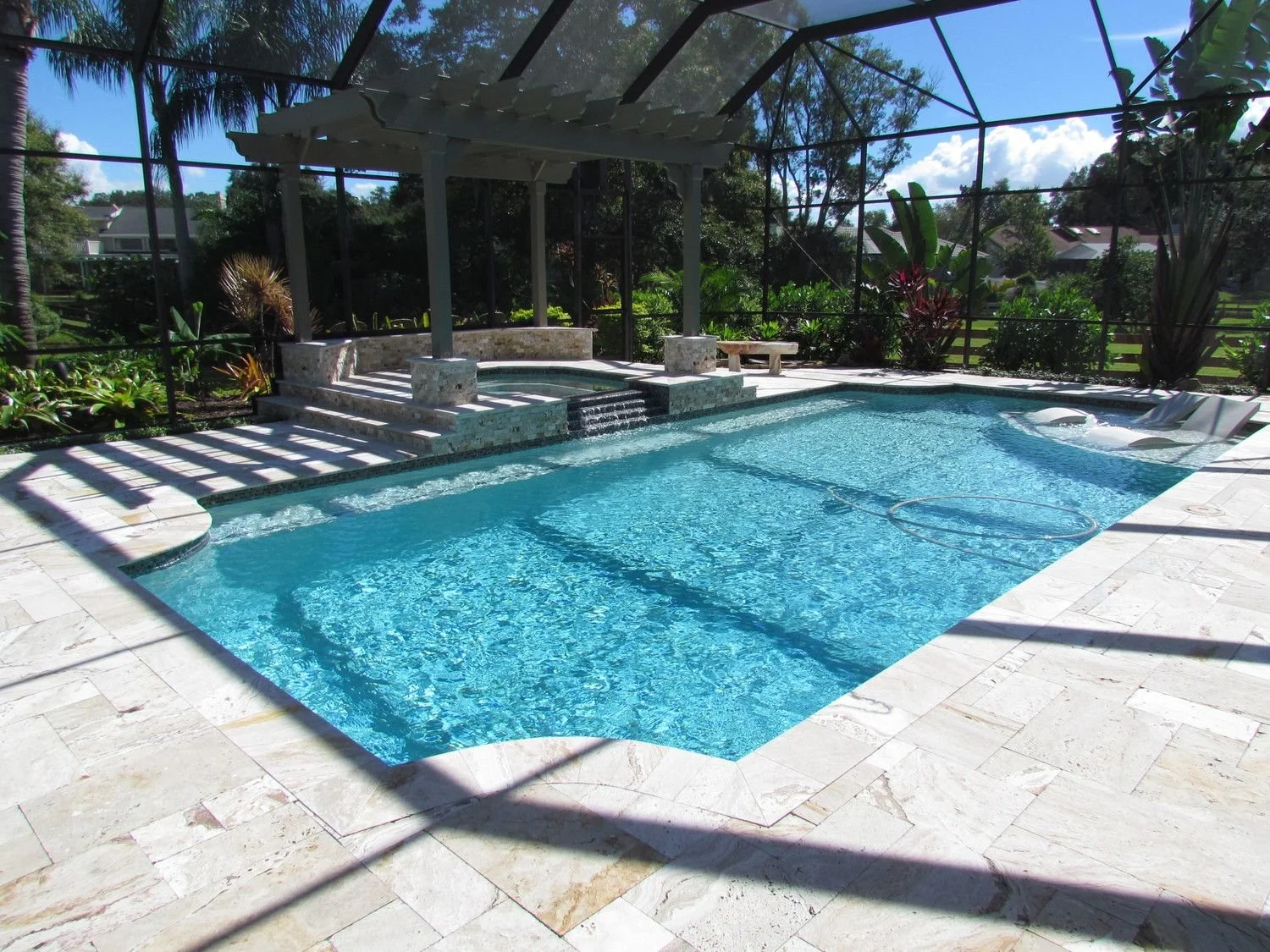
Residential backyard pool area enclosed with a glass and metal screened patio. The pool has a waterfall feature and potted plants nearby. There are outdoor chairs and a table with flowers, with house windows and a door visible in the background.

Why Pool Chemistry Drifts Faster in Clearwater Than Almost Anywhere Else

National pool care guidelines are written for the average American climate — somewhere around 70°F, seasonal use, moderate UV. Clearwater is not that pool. Here's what makes Clearwater water chemistry uniquely challenging:

UV Destroys Chlorine in Hours
Florida's UV index regularly hits 10–11 during summer, the highest category. Without an adequate stabilizer (CYA), direct UV can destroy 90% of a pool's free chlorine in 2 hours of midday sun. National guidelines recommend 20–40 ppm CYA. Florida pools running without a salt system need 50–80 ppm to maintain residual chlorine through the day.
Warm Water Accelerates Everything
Warmer water dramatically accelerates chemical reactions — both the good ones (chlorine sanitizing) and the bad ones (algae growth, chlorine demand, organic breakdown). A pool at 85°F consumes chlorine 2–3× faster than the same pool at 70°F. Summer chemical consumption in Clearwater can be 3× winter consumption.
Hard Municipal Water
Pinellas County municipal water is moderately hard — calcium hardness typically 150–250 ppm from the tap. Every time you add water to compensate for evaporation or splash-out, you're adding more calcium. Over time, calcium hardness creeps up and scale forms on pool surfaces, salt cells, and heat exchangers.
Heavy Summer Rain Dilutes Chemistry
Florida's June–September rainy season brings 6–8 inches of rain per month. Heavy rain dilutes stabilizer, lowers calcium hardness, can drop pH (acidic rainwater), and floods pools with phosphates and organics from runoff — all of which create chemical imbalance and increase algae risk.
Year-Round Bather Load
Clearwater pools are used 12 months a year. Body oils, sunscreen, sweat, and other organics introduced by swimmers create chloramines and drive chlorine demand continuously — unlike northern pools that get a seasonal break.
Salt Electrolysis Raises pH Daily
Salt pools face an additional challenge: the electrolysis process that generates chlorine from salt also raises pH as a byproduct. Without regular acid addition, salt pool pH drifts above 7.8 — making chlorine significantly less effective even when the chlorine level reads fine.

The 9 Pool Chemistry Parameters — What We Test Every Visit

Most pool companies test 3–5 parameters. Dog Days Pools tests all 9 on every visit — because every parameter affects every other one, and fixing one without understanding the full picture often creates a new problem.

Parameter Too Low Florida Target Too High Why It Matters in Clearwater
Free Chlorine (FC) < 1 ppm 1–3 ppm (3–5 ppm salt) 10+ ppm Primary sanitizer. At 0 ppm, algae establishes within 24–48 hours in Florida summer heat. Combined chlorine (chloramines) must be checked separately — high CC with low FC causes odor and poor sanitization.
pH < 7.2 7.4–7.6 7.8+ Below 7.2: eye irritation, metal corrosion, plaster etching. Above 7.8: chlorine becomes 80%+ ineffective regardless of level. Salt electrolysis naturally pushes pH up daily — the most important parameter to monitor in salt pools.
Total Alkalinity (TA) < 60 ppm 80–120 ppm 180+ ppm TA buffers pH. Too low: pH swings wildly with any addition. Too high: pH locks high and resists correction. Florida rain (acidic) depletes TA — needs frequent monitoring during the rainy season.
Calcium Hardness < 150 ppm 200–400 ppm 600+ ppm Too low: soft water attacks plaster, grout, and salt cell plates — etching surfaces to satisfy its mineral demand. Too high: scale deposits on surfaces, equipment, and the heater. Pinellas County water is moderately hard — calcium levels climb with every top-up.
Stabilizer / CYA < 30 ppm 50–80 ppm (60–80 salt) 100+ ppm Critical in Florida — CYA shields chlorine from UV destruction. Without it, chlorine is gone within hours of sunlight. Over-stabilized pools (100+ ppm) have 'chlorine lock' — high readings but ineffective sanitization. Only correctable by partial drain.
Combined Chlorine (CC) < 0.3 ppm 0.5+ ppm CC = chloramines. High CC causes pool odor, eye irritation, and indicates chlorine is being consumed faster than replenished. Requires breakpoint chlorination (shock) to eliminate, not just adding more chlorine.
Salt Level < 2,700 ppm 3,000–3,500 ppm 4,500+ ppm Salt pools only. Below minimum: salt cell shuts down, pool under-sanitized. Above maximum: corrosion risk. Controller readings can be wrong — verify with an independent test. Relevant only for salt system pools.
Phosphates < 100 ppb 500+ ppb Phosphates are algae food. High phosphates don't turn a pool green by themselves, but they allow algae to thrive rapidly when chlorine drops — amplifying any sanitization lapse. Florida pools accumulate phosphates from rain runoff, leaves, fertilizer, and bather waste.
Total Dissolved Solids < 1,500 ppm 3,000+ ppm (non-salt) TDS accumulates as chemicals and organics dissolve in pool water over time. High TDS dulls water clarity, reduces chemical effectiveness, and can cause corrosion. Only corrected by partial water replacement.

Common Chemistry Problems Clearwater Pool Owners See — and What's Actually Causing Them

The symptom you see is often different from the parameter that's causing it. This table maps what you're observing to the most likely chemistry culprit and what needs to happen to fix it:

What You're Seeing Most Likely Cause What Needs to Happen
Cloudy or hazy water High pH (above 7.8), high TA, high calcium precipitating, or high TDS. Also early algae bloom. Test all 9 parameters. Reduce pH with muriatic acid if elevated. Shock if combined chlorine is high. Investigate filtration if parameters are fine.
Strong 'chlorine smell' High combined chlorine (chloramines) — NOT excess chlorine. Counter-intuitive but true. Breakpoint chlorination: shock with enough chlorine to break combined chlorine. The pool often smells worse before it smells better as CC is burned off.
Algae despite normal chlorine reading Stabilizer (CYA) too high ('chlorine lock'), OR phosphates elevated, OR pH too high making chlorine ineffective. Test CYA and pH first. If CYA above 90 ppm, partial drain is required. Adjust pH to 7.4–7.6. Treat phosphates separately if elevated.
Burning / red eyes after swimming pH too low (below 7.2) or too high (above 7.8). Also high combined chlorine. Test pH and adjust to 7.4–7.6. Test for chloramines — if CC above 0.5 ppm, shock treatment needed.
Scale forming on tile & equipment Calcium hardness too high, and/or pH too high, causing calcium carbonate to precipitate out of solution. Lower pH with acid. If calcium hardness is above 500 ppm, partial drain and refill may be needed. Scale on salt cells requires acid wash.
Chlorine reads zero daily CYA too low (UV destroying chlorine), OR chlorine demand too high (high bather load, organics), OR equipment not running enough hours. Test CYA — if below 40 ppm, add stabilizer. Increase pump runtime in summer. Shock weekly during heavy use periods.
Green pool despite chlorine CYA depleted (chlorine ineffective against UV), OR algae type resistant to normal chlorine levels, OR pH too high. Complete chemistry test first — never just add chlorine to a green pool without knowing what's causing it. See /green-pool-cleanup-algae-treatment for full protocol.
Water feels 'rough' or 'harsh' pH too low (acidic water attacking skin and eyes), OR total alkalinity too low causing pH instability. Test pH and TA together — low TA causes pH to swing. Raise TA with sodium bicarbonate first, then fine-tune pH.
Plaster pitting or surface erosion Calcium hardness is too low — soft water attacks pool surfaces to satisfy mineral demand. Also low pH over extended periods. Raise calcium hardness with calcium chloride. Check pH trend — if the pool has been running acidic, plaster damage may already have occurred.
Salt system shutting down or 'low salt' error Actual salt level low, OR salt cell scaled (false reading), OR flow sensor fault. Verify salt level with independent tests (not just controller reading). If salt is fine, clean the cell. See /salt-systems-repair-maintenance.

How We Balance Chemistry Differently for Florida Pools

01

Seasonal Adjustment — Summer vs. Winter Chemistry

Most pool chemical guidelines don't account for Florida's dramatically different seasonal chemistry needs. Dog Days Pools adjusts protocols by season:

Summer Protocol (April–October)

  • Higher chlorine target (2–4 ppm vs 1–3 ppm winter)
  • CYA maintained at upper end of range (70–80 ppm)
  • Weekly shock or algaecide during heavy rain weeks
  • More frequent pH correction (salt pool electrolysis + heat)
  • Phosphate testing monthly — runoff season
  • Pump runtime increased to 10–12 hrs/day minimum

Winter Protocol (November–March)

  • Standard chlorine target (1–3 ppm)
  • CYA at mid-range (50–70 ppm)
  • Algaecide as preventive — algae pressure lower
  • Less frequent acid addition (fewer pool users, less pH push)
  • Calcium monitoring — scale risk lower in cooler water
  • Pump runtime can reduce to 6–8 hrs/day
02

Salt Pool Chemistry — Additional Considerations

Salt pools are still chlorine pools — the salt system generates chlorine on-site rather than requiring manual addition. But salt pools have chemistry nuances that traditional chlorine pool guidelines don't address:

  • pH management is more frequent — electrolysis raises pH as a byproduct; expect to add muriatic acid more often than a traditional pool
  • CYA needs are higher — salt pool chlorine generation doesn't include stabilizer; maintain 60–80 ppm CYA to protect generated chlorine from UV
  • Salt level verification requires an independent test — the salt controller estimates salt by measuring electrical conductivity, which can be thrown off by scale on the cell plates. Always verify with a separate digital meter or reagent test before adding salt
  • Cell scaling affects chemistry — a scaled cell produces less chlorine even at 100% output; chemistry problems in a salt pool often trace back to cell maintenance, not water balance
  • Calcium is especially critical — low calcium causes cell plate pitting; high calcium accelerates scale formation on the cell. Target 200–350 ppm for salt pools specifically
03

Phosphate Management — A Florida-Specific Priority

Phosphates are an underappreciated water chemistry challenge in Florida pools. Phosphates enter the pool from:

  • Fertilizer runoff (landscaping around the pool during Florida's spring and summer growth seasons)
  • Heavy rainfall washes organic material into the pool
  • Leaves, grass clippings, and other organic debris are decomposing in the water
  • Some pool chemicals — certain algaecides and scale inhibitors contribute phosphates
  • Tap water — Pinellas County water contains trace phosphates

Phosphates don't cause algae directly — but they feed algae aggressively when chlorine levels drop even briefly. A pool with 1,000+ ppb phosphates can bloom green within 24 hours of a chlorine lapse. We test phosphates monthly and treat with a phosphate remover when levels exceed 200 ppb.

How to Get Professional Pool Chemical Balancing

Standalone Chemistry Check & Balance Visit

Single visit — we come out, test all 9 parameters, adjust everything that's out of range, and leave a written report. Best for: pool owners who handle their own physical cleaning but want a professional chemistry check, owners preparing for an event, and anyone who suspects their chemistry is off and wants a professional diagnosis.

Includes:
  • All 9 parameter test
  • Chemical adjustment to target ranges
  • All chemicals are included in the visit price
  • Written results report left at pool
  • Recommendations for follow-up if needed

No trip fee. Quote provided before the visit.

Chemistry Included in Weekly Service

All 9 parameters are tested and adjusted every week as part of the full 22-point service. Chemistry is never an add-on or a separate fee — it's the foundation of every weekly visit. Best for: pool owners who want complete hands-off pool management with weekly professional chemistry oversight.

Includes:
  • Weekly 9-parameter chemistry test and adjustment
  • All chemicals always included in flat monthly rate
  • Full physical pool cleaning every visit
  • Equipment inspection on every visit
  • Write a service report for every visit

No contract. Cancel anytime.

Why Clearwater Pool Owners Choose Dog Days for Chemical Balancing

Aqua Wizard's Chemical Balancing Page Is 3 Sentences

Aqua Wizard Pool Service has a page titled 'Pool Chemical Balancing' — it's three sentences that say professional balancing saves you time and is safer than DIY. No parameters listed. No Florida-specific context. No explanation of what's actually being tested. Dog Days Pools publishes the complete 9-parameter guide, Florida-specific seasonal protocols, and the full symptom-to-cause table because an informed pool owner is a better customer — and because the chemistry is genuinely complex.

We Test All 9 — Not Just the 3-Strip Basic

Many pool services test only free chlorine, pH, and alkalinity — the same three parameters that an $8 test strip checks. A pool can look perfectly fine on those three parameters while having dangerously low stabilizer (destroying all that chlorine before it can work), a phosphate level setting up the next algae bloom, or calcium hardness so low it's etching the plaster. Full 9-parameter testing catches what the basics miss.

Florida Chemistry Experience — Not a National Franchise Protocol

Blue Science is a national franchise. Their protocols are designed for the average American pool market. Dog Days Pools has 20+ years of specifically Clearwater and Pinellas County pool chemistry experience — the seasonal patterns, the municipal water characteristics, the phosphate load from Florida landscaping, the aggressive UV, the salt pool pH drift patterns. That local knowledge means adjustments are made for your pool and your climate, not a generic national standard.

Written Report Every Visit — You Always Know What Was Done

Every chemical balancing visit — whether standalone or part of weekly service — ends with a written report left at the pool. Every parameter reading, what was added, how much, and any recommendations. You don't need to be home, and you don't need to guess what happened. If something looked off on Tuesday, you can read the report and see exactly what it was.

Pool Chemical Balancing Service Area

Dog Days Pools provides pool chemical testing, balancing, and maintenance throughout Clearwater, Safety Harbor, Dunedin, Palm Harbor, Oldsmar, Countryside, East Lake Woodlands, and Lansbrook.

Our Primary Service Areas:

📍 Clearwater —Our home base — we know every neighborhood

📍Safety Harbor —Full-service pool care for Safety Harbor residents

📍Dunedin — Reliable weekly and repair service in Dunedin

📍Palm Harbor —Trusted pool pros throughout Palm Harbor

Also Serving:

📍 Oldsmar — Our home base — we know every neighborhood

📍Countryside — Experienced pool care for Countryside homeowners

📍East Lake Woodlands — Expert pool maintenance in East Lake Woodlands

📍Lansbrook — Regular service and repairs throughout Lansbrook

Not sure if we cover your area? Call (727) 205-0566 — we'll confirm coverage and give you a free estimate on the same call.

Call now to get a Free Estimate.

Call or Text

(727) 205-0566

Hours

Monday – Sunday: 9am to 9pm
Clearwater, FL 33761
Serving all of Pinellas County

Pool Chemical Balancing FAQs — Clearwater, FL

Straight answers to the questions Clearwater pool owners ask about water chemistry, testing, and balancing.

How often should pool water chemistry be tested in Clearwater? +
Weekly at minimum for a Clearwater pool that's being actively used — and that's for professional-grade testing, not test strips. Florida's UV, heat, and bather loads drive chemistry changes faster than most of the country. Between professional visits, a basic 3-parameter dip test (chlorine, pH, alkalinity) twice a week helps catch any sudden changes — heavy rain, a large pool party, or equipment downtime can shift chemistry significantly within 24 hours.
What's the right stabilizer (CYA) level for a Florida pool? +
For traditional chlorine pools in Florida: 50–80 ppm. For salt pools: 60–80 ppm. National guidelines often cite 20–50 ppm — those are calibrated for northern climates with less UV intensity. Clearwater's UV index regularly hits 10–11 in summer; at those levels, unstabilized chlorine can be 90% destroyed within 2 hours of midday sun. If your stabilizer is consistently low, your chlorine is disappearing faster than it looks, and algae risk is significantly elevated.
Why does my pool keep turning green even when I'm adding chlorine? +
The three most common causes in Clearwater: (1) Stabilizer too high — 'chlorine lock' where CYA above 90–100 ppm makes chlorine chemically ineffective even when the test reads fine. Requires partial drain and refill. (2) pH too high — chlorine is 80%+ ineffective above pH 7.8. Test pH before adding more chlorine. (3) Phosphates elevated — algae feeding aggressively on phosphates from runoff or organics, outpacing even normal chlorine levels. See /green-pool-cleanup-algae-treatment for the full diagnosis and treatment protocol.
Can I balance my own pool chemistry, or do I need a professional? +
Many pool owners handle their own chemistry successfully with the right test kit (not just test strips) and willingness to learn. The challenges in Florida specifically: the parameters interact with each other (adjusting alkalinity affects pH, adjusting pH affects chlorine effectiveness, CYA changes change how you read chlorine), the Florida-specific ranges differ from national guidelines, and the seasonal variation requires adjusting your approach from month to month. Professional balancing makes most sense when: chemistry is consistently off, a pool has just been refilled or had major water addition, after a green pool treatment, or when you want an expert baseline reading before taking over maintenance yourself.
What's the difference between 'free chlorine' and 'total chlorine,' and why does it matter? +
Free chlorine (FC) is the active, available sanitizer — what's actually killing bacteria and algae. Total chlorine (TC) includes both free chlorine and combined chlorine (chloramines). Combined chlorine is chlorine that has bonded to nitrogen from body waste and other organics — it's no longer an effective sanitizer, but it still shows up as 'chlorine' on a total chlorine test. A pool with FC of 1 ppm and TC of 3 ppm has 2 ppm of combined chlorine (chloramines) — it smells like chlorine, it reads as chlorinated, but it's under-sanitized and needs shock treatment. This is why testing free chlorine and combined chlorine separately matters.
Why is my pool pH always drifting high, even after I add acid? +
The most common cause in Clearwater: you have a salt pool, and the electrolysis process naturally raises pH as a byproduct. This is not a malfunction — it's inherent to how salt chlorination works. The only solution is regular acid addition, more frequently than a traditional pool. If you're adding acid weekly and pH still climbs too fast, check that your total alkalinity isn't too high (above 120 ppm) — high TA locks pH high and makes it resistant to acid correction. Lower the TA first, then the pH will be easier to manage.
Do I need to test for phosphates? +
In Florida, yes, it is more important than in most markets. Clearwater pools accumulate phosphates from fertilizer-rich landscaping runoff, decomposing organic material, and trace phosphates in municipal water. Phosphates by themselves don't turn a pool green, but they provide an abundant food source that allows algae to establish and multiply aggressively the moment chlorine drops — even briefly. Testing phosphates monthly and treating when above 200 ppb removes this amplifier and makes your chlorine much more effective at controlling algae.
My pool water looks clear, but it feels irritating to swim in. What's wrong? +
Clear water with irritating conditions almost always points to pH being out of range. Below 7.2: the water is acidic — eye and skin irritation, the 'burning eyes' feeling. Above 7.8: the water is too alkaline, which makes chlorine ineffective and can cause a different type of irritation. It can also indicate high combined chlorine (chloramines), even with clear water — the chloramine level can be high enough to cause irritation before the water turns cloudy. A full 9-parameter test will identify the cause within minutes.

Pool Chemistry Off? Let's Fix It — No Trip Fee

Whether you've been managing your pool's chemistry yourself and something feels off, you're getting a new pool ready for the season, or you just want a professional baseline reading, call or text Larry. We test all 9 parameters, adjust everything to Clearwater-appropriate target ranges, leave a written report, and tell you exactly what was done and why.