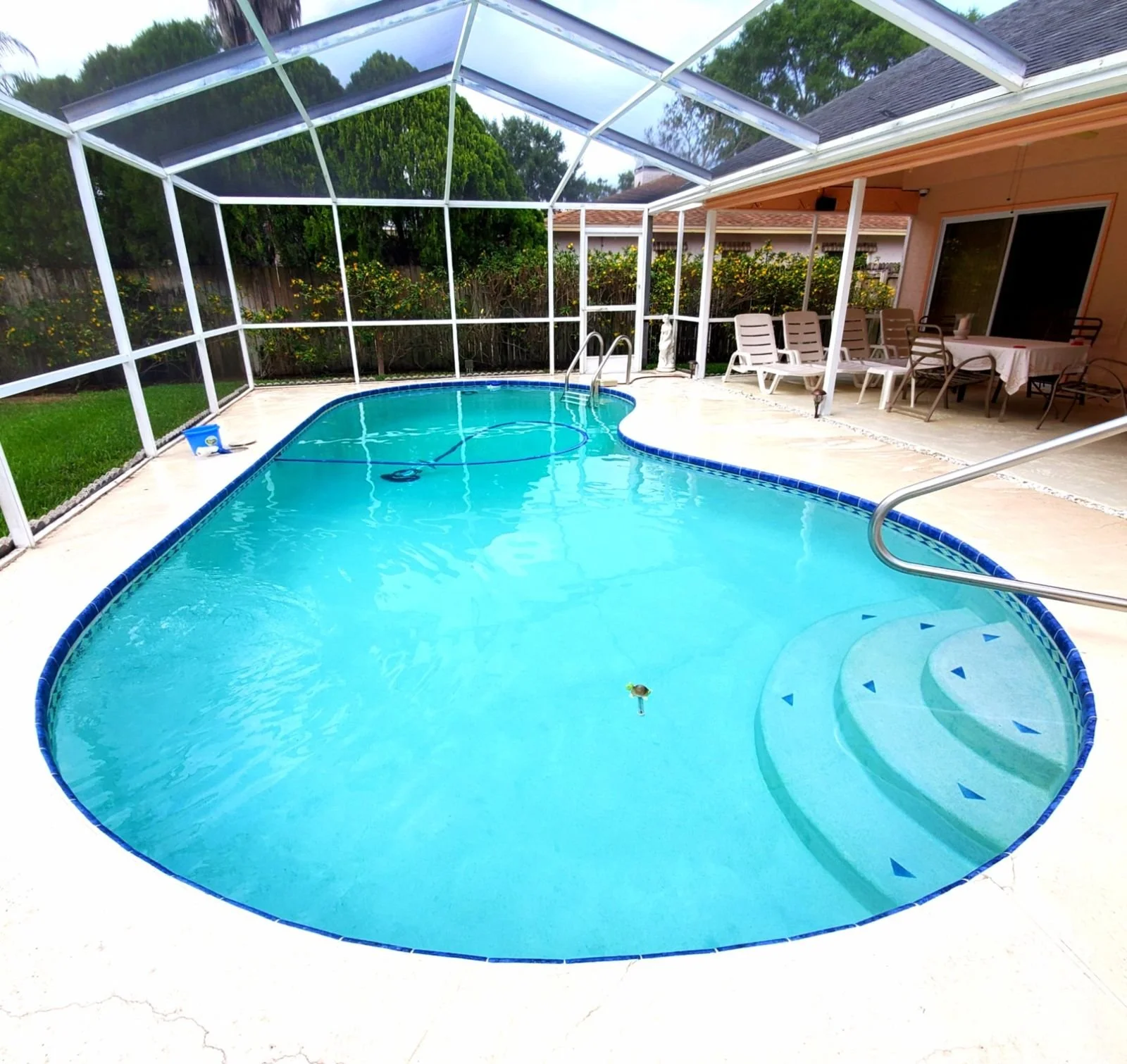
Getting a pool started correctly is one of the most important things that happens to that pool's entire lifespan. The first 28–30 days after a new plaster or pebble pool is filled are called the startup period, and the chemistry decisions made during that window determine whether the surface cures correctly, whether scale forms on equipment, and whether the pool will have chemistry problems for years or months that trace directly back to a bad start.
Whether you've just had a pool built, moved into a home with a pool you know nothing about, finished a replaster or renovation, or have a pool that's been sitting dormant and needs to be brought back to life, Dog Days Pools provides professional new pool start-up service throughout Clearwater and Pinellas County. Equipment commissioning, full chemistry baseline, salt system setup, filter startup, and a complete owner orientation so you understand every piece of equipment on your pad. No trip fee. Written report of every reading taken and every parameter set.
Four Situations That Need a Professional Pool Start-Up
'New pool start-up' covers four different situations — each with different requirements, different chemistry approaches, and different things that can go wrong if done incorrectly:
Your builder just filled the pool for the first time. This is the highest-stakes startup situation — the chemistry decisions made in the first 28–30 days directly affect how the plaster or pebble surface cures and whether it stays beautiful for 15+ years or develops staining, scaling, and surface problems within the first year.
- Plaster and pebble surfaces leach calcium into the water aggressively during curing — chemistry must be managed daily for the first 2 weeks, not weekly
- Startup chemicals must be added in the correct sequence — adding the wrong chemical first can cause immediate surface staining or scale that is permanent
- pH tends to spike above 8.0 initially as new plaster hydrates — must be monitored and corrected multiple times in week 1
- Brushing the pool surface twice daily for the first 2 weeks removes plaster dust and prevents calcium nodules from forming on the surface
- Filtration runtime must be maximum for the first 30 days to remove curing byproducts from the water
- Equipment must be commissioned and primed properly — first fill is when airlocks and plumbing issues reveal themselves.
You just bought a home with a pool. You may have no idea what type of system it is, when it was last serviced, what condition the equipment is in, or what the chemistry looks like. This is the 'blank slate' start-up — assessment first, then correct whatever's been neglected.
- Full equipment audit: identify every piece of equipment, its age, its condition, and whether it's working correctly
- Complete chemistry baseline test — all 9 parameters — to understand what the previous owner left behind
- Identify any deferred maintenance: dirty filter media, scaling on salt cell, equipment nearing end of life, timer programming.
- Owner orientation: walk through every piece of equipment, explain what it does, show you how to operate it, and what to watch for
- Establish chemistry targets appropriate to your specific pool type (plaster, pebble, fiberglass, vinyl) and equipment (traditional chlorine vs. salt)
- Recommendation on whether to transition to weekly service or self-maintain with a clear ongoing protocol
Your pool has just been replastered, pebble-finished, or had a major surface renovation. This is functionally identical to a new construction start-up from a chemistry standpoint — fresh cementitious surfaces leach calcium and raise pH just as aggressively as a brand-new pool, regardless of the pool's age.
- Same 28–30 day startup chemistry protocol as new construction — aggressive pH monitoring and brushing schedule
- First fill after replaster is critical: fill with hose slowly while brushing constantly to prevent 'fill lines' from staining the fresh surface
- Startup chemical sequence matters — improper sequencing on fresh plaster causes permanent staining within 24–48 hours
- New plaster chemistry is often incompatible with leftover salt if the pool is not fully drained before replastering — salt levels are verified and adjusted
- Equipment that was removed or bypassed during renovation must be recommissioned, reprimed, and verified before adding startup chemicals
- Plaster warranty often requires a documented professional startup — written report from Dog Days Pools satisfies this requirement.
The pool has been sitting — possibly for weeks, months, or longer. It may be green, may have low or completely depleted chemistry, or may have equipment that's been off for an extended period. This is a restoration startup: assess condition, treat problems, commission equipment, and establish a chemistry baseline from whatever state the pool is in.
- Drain and refill assessment: Is the water recoverable with treatment, or does it need a partial or full drain to remove accumulated TDS, stabilizer, or algae?
- Equipment inspection after extended dormancy: motor seals dry out, o-rings harden and crack, salt cells scale during non-operation
- Filter media condition assessment: Sand and DE media can develop bacterial growth during dormancy
- Algae treatment if pool is green before startup — see /green-pool-cleanup-algae-treatment for full protocol
- Establish a new chemistry baseline from the current condition — don't just add chemicals on top of unknown existing parameters.
- Safety check: GFCI function, bonding connections, equipment pad condition after sitting
What Your Pool Builder Probably Didn't Tell You About New Pool Chemistry
What Typically Happens
The builder fills the pool, adds a startup chemical kit from the supply house, walks you through the equipment for 15 minutes, and hands you a pamphlet. A startup tech from the builder may come out once or twice in the first week.
What Often Gets Skipped:
- Daily brushing protocol — most homeowners aren't told to brush twice daily for 2 full weeks
- pH monitoring frequency — pH on fresh plaster needs checking every 24–48 hours in week 1, not weekly
- Startup chemical sequencing — adding calcium before adjusting pH, or adding algaecide before chlorine is established, causes problems
- Salt system startup — many builders fill salt system cells and turn them on too early, before chemistry is stable
- Stabilizer timing — adding CYA too early in the startup sequence affects how other chemicals behave
- Filter runtime requirements — most homeowners aren't told to run the filter 24/7 for the first 30 days
Why It Matters
The cementitious surface of a new plaster or pebble pool is porous and chemically active during curing. Every decision made in days 1–28 affects what that surface looks like for the next 15–20 years.
Common Consequences of Poor Startup:
- Calcium nodules on pool floor and walls — white crusty deposits that form from plaster dust that wasn't brushed off and dissolved properly
- Surface staining from metals (copper, iron) precipitating out of water at high pH — often appears as blue/green or rust-colored marks on fresh plaster
- Rough plaster texture — caused by inadequate early brushing, allowing surface calcium to harden in place
- Early scale on the salt cell — high calcium and pH during the startup window deposits scale on the new salt cell plates
- Surface discoloration — improper chemical sequencing causes localized chemistry differences that cure as visible color variation
- Plaster warranty voidance — many manufacturers require documented professional startup; undocumented startup voids coverage
What Dog Days Pools Covers in a New Pool Start-Up — The 20-Point Checklist
Every new pool start-up visit covers all 20 of these items. For new construction and replaster start-ups, additional follow-up visits during the 28-day curing period are scheduled based on the pool's needs — not a fixed calendar.
| # | Task | What We're Doing & Why It Matters |
|---|---|---|
| 1 | Equipment Audit & ID | Identify every piece of equipment on the pad: pump brand/model, filter type and size, heater (if present), salt system brand, automation system (if present), and any additional accessories. Documents what the pool has for future service reference. |
| 2 | Pump Prime & Flow Verification | Prime the pump and verify flow: watch priming behavior, confirm water flow to all returns, check pressure gauge baseline, verify no air in system. The first fill is when plumbing problems reveal themselves. |
| 3 | Filter Startup & Pressure Baseline | For DE filters: charge with fresh DE and record clean operating pressure. For sand: backwash and record clean pressure. For cartridge: inspect cartridges and record clean pressure. Clean pressure becomes the service reference point. |
| 4 | Salt System Commissioning | For salt pools: verify salt level is within operating range before activating the generator cell. New cells are activated at a conservative output percentage during startup — running at 100% on fresh plaster raises pH aggressively. Record control panel settings and baseline readings. |
| 5 | Heater Startup & Test | If a heater is present: test ignition, verify minimum flow rate is met, and confirm temperature ramp. Check for error codes and verify the thermostat setting is appropriate. |
| 6 | Timer / Automation Programming | Verify the timer or automation system is programmed correctly for Florida's seasonal runtime requirements. Set a minimum of 10–12 hours/day for the startup period. |
| 7 | Cleaner / Sweep Startup | If an automatic cleaner is installed, connect, prime, and verify the correct movement pattern throughout the pool. Confirm the cleaner is not running during the first 2 weeks on new plaster. |
| 8 | Safety Systems Check | Test the GFCI function on the pool circuit. Verify pool light operation. Check that all bonding connections are intact. Confirm no exposed wiring. |
| 9 | Fill Water Test | Test the water before adding any startup chemicals — city supply chemistry varies and determines what the pool is starting from. |
| 10 | Alkalinity Adjustment | Establish total alkalinity in the target range (80–100 ppm). TA is adjusted first because it acts as a pH buffer. |
| 11 | pH Baseline Adjustment | Adjust pH to 7.4–7.6 after TA is established. New plaster water often tests at 8.0+ initially — must be corrected. |
| 12 | Calcium Hardness Establishment | Add calcium chloride to bring CH to 200–300 ppm if needed. Prevents soft water damage to plaster. |
| 13 | Chlorine Establishment | Add initial chlorine dose to reach 1–3 ppm free chlorine. Salt pools use manual chlorine first 2–4 weeks. |
| 14 | Stabilizer / CYA Addition | Add CYA stabilizer to 50–70 ppm after chlorine is established. Do not add in week 1 for new plaster. |
| 15 | Algaecide (Startup Dose) | Apply a startup algaecide dose as a preventive measure during unstable startup chemistry. |
| 16 | Salt Addition (Salt Pools) | Add salt to reach 3,000–3,500 ppm after all other chemistry is established. |
| 17 | Surface Brushing Orientation | Demonstrate twice-daily brushing protocol for new plaster (14 days minimum). |
| 18 | Equipment Operation Walkthrough | Walk through pump, filter, salt system, timer, and normal operation vs warning signs. |
| 19 | Follow-Up Chemistry Schedule | Set follow-up visits for 28-day startup period: days 3–5, 10–14, and 28 minimum. |
| 20 | Written Start-Up Report | Provide full report: readings, chemicals added, equipment settings, and follow-up plan. |
New Pool Start-Up Chemistry Targets — Florida-Specific
These are the target ranges Dog Days Pools establishes during a new pool startup in Clearwater. They differ from the generic national guidelines on a few parameters — particularly stabilizer and chlorine — because Florida's UV and year-round heat require different calibration:
| Parameter | Florida Target | Startup Notes |
|---|---|---|
| Free Chlorine | 1–3 ppm | Establish manually with liquid chlorine during the first 2–4 weeks on salt pools — do not run generator cells during the early startup phase. Daily monitoring week 1. |
| pH | 7.4–7.6 | Will spike above 8.0 on new plaster — expect to add acid daily in week 1. Check every 24–48 hours for the first 2 weeks. Salt system electrolysis also drives pH up daily once activated. |
| Total Alkalinity | 80–100 ppm | Adjust first, before pH. The new plaster startup TA target is slightly lower than standard (80–100 vs. 80–120) to help pH stay correctable during the curing window. |
| Calcium Hardness | 200–300 ppm | Critical for new plaster — soft water etches fresh surfaces. Add calcium chloride if fill water is below 150 ppm. Check fill water first — Pinellas County water is typically 150–250 ppm so may not need much addition. |
| Stabilizer / CYA | 50–70 ppm (add after week 2) | Do not add CYA in the first 1–2 weeks of a new plaster startup. CYA affects water clarity during early curing and interferes with accurate early chemistry readings. Add after the surface has had initial cure time. |
| Combined Chlorine | < 0.3 ppm | Monitor from day 1 — new plaster leaches organics that create chloramine demand. If CC rises above 0.5 ppm in the first 2 weeks, shock treatment is needed. |
| Salt Level (salt pools) | 3,000–3,200 ppm | Add salt after all other chemistry is established — last step in the startup sequence. Do not activate the generator cell until salt is within range and other parameters are stable (typically week 2–3 of startup). |
| Phosphates | < 100 ppb (establish at startup) | Test fill water for phosphates — Pinellas County municipal water contains trace phosphates. Treat if above 200 ppb before algaecide addition. Better to start clean than treat later. |
New Construction & Replaster Pool Startup Timeline
Day 1 — Fill Day & Initial Startup Visit
Fill the pool slowly while brushing the surface constantly. Test fill water chemistry. Add alkalinity adjustment first. Add calcium chloride if the water level is low. Adjust pH toward 7.4–7.6 (will drift up — that's normal). Add initial chlorine manually (liquid). Record all readings. Set filters to run 24/7. Commission equipment. Pump and verify all equipment. Leave the written report and the brushing schedule card.
Days 1–14 — Daily Owner Brushing
The owner (or Dog Days if on a startup service plan) brushes all pool surfaces twice daily — morning and evening. This is non-negotiable and is the single most important thing a new pool owner does in the first two weeks. Brushing removes plaster dust before it can harden on the surface.
Days 3–5 — First Follow-Up Chemistry Check
Dog Days returns for its first follow-up. Test all parameters. Expect: pH drift back toward 7.8–8.0 (add acid), TA may need adjustment, calcium hardness verification, and chlorine level check. Adjust as needed. Evaluate whether the startup is proceeding normally or if any surface issues are developing.
Days 10–14 — Mid-Startup Chemistry Check
Second follow-up. By now, the pH should be stabilizing as surface curing progresses. Add CYA/stabilizer at this visit — held until now to allow the early curing phase to complete. Add algaecide startup dose. Evaluate plaster surface for any developing issues. If salt pool: assess salt level and begin discussing generator activation timeline.
Days 14–21 — Salt System Activation (Salt Pools)
If chemistry is stable, activate the salt generator cell at conservative output (50–60%). Continue monitoring pH — electrolysis will now begin pushing pH up daily. Adjust acid addition frequency accordingly. Do not run the generator at full output until full 28-day startup is complete.
Day 28–30 — Final Startup Check & Transition
Third follow-up. Full 9-parameter test. Verify plaster surface condition — no calcium nodules, no staining, surface smooth and consistent. Confirm CYA is established. Confirm all equipment is operating correctly. Transition from startup protocol to normal weekly maintenance chemistry targets. Discuss ongoing weekly service or self-maintenance plan going forward.
Why Clearwater Pool Owners Choose Dog Days for New Pool Start-Up
No Local Competitor Has a New Pool Start-Up Page
Blue Science's Clearwater pages cover weekly service, leak detection, and repairs. Fresh Finish focuses on equipment repair and remodeling. Aqua Wizard covers general pool maintenance. None of them has a dedicated new pool start-up or commissioning page. When a Clearwater homeowner searches for 'new pool startup service Clearwater' or 'pool startup chemicals Clearwater' — Dog Days is the only company that speaks directly to that need.
We've Done Hundreds of Clearwater Pool Startups Over 20+ Years
New pool startup is a specialized service that requires knowing Clearwater's municipal water chemistry (Pinellas County water hardness and phosphate levels directly affect the startup chemical sequence), Florida's UV and heat profile (startup chemistry stabilizes differently in 85°F water than in 65°F northern pool water), and the specific surface chemistry of different plaster and pebble products used by local builders. Twenty years of Clearwater startup experience means we recognize when a startup is going normally and when something is developing that needs early intervention — before a surface problem becomes a permanent one.
Written Documentation for Plaster Warranty
Many plaster and pebble manufacturers (Pebble Tec, SGM, and others) require a documented professional startup to maintain the surface warranty. A Dog Days Pools startup report documents every chemical addition, every reading, and every follow-up visit — satisfying the documentation requirement that a homeowner-run startup typically cannot provide. If your builder's plaster warranty requires professional startup documentation, Dog Days' written report provides it.
Equipment Commissioning + Chemistry — Not Just One or the Other
Some pool companies do a chemical startup. Others do equipment commissioning. Dog Days Pools does both in the same visit — because they're inseparable. Improperly primed equipment affects how startup chemicals distribute. Filter startup pressure establishes the maintenance baseline. Salt system activation timing affects pH management during startup. Every element of the system interacts with every other element, and starting them separately creates gaps.
We Transition Seamlessly Into Ongoing Weekly Service
After a 30-day startup, the pool needs ongoing weekly service. Dog Days Pools starts the relationship at startup and continues into weekly service for customers who want hands-off maintenance. The same person who commissioned your pool and knows its specific chemistry baseline is the same person servicing it every week — no handoff, no knowledge gap, no 'starting over' with a new service company.
Our Primary Service Areas:
📍 Clearwater —Our home base — we know every neighborhood
📍Safety Harbor —Full-service pool care for Safety Harbor residents
📍Dunedin — Reliable weekly and repair service in Dunedin
📍Palm Harbor —Trusted pool pros throughout Palm Harbor
Also Serving:
📍 Oldsmar — Our home base — we know every neighborhood
📍Countryside — Experienced pool care for Countryside homeowners
📍East Lake Woodlands — Expert pool maintenance in East Lake Woodlands
📍Lansbrook — Regular service and repairs throughout Lansbrook
Not sure if we cover your area? Call (727) 205-0566 — we'll confirm coverage and give you a free estimate on the same call.
Call now to get a Free Estimate.
Call or Text
(727) 205-0566Hours
Monday – Sunday: 9am to 9pmServing all of Pinellas County
New Pool Start-Up FAQs — Clearwater, FL
Straight answers about pool startup, chemistry, and long-term surface protection.
New Pool? Just Moved In? Ready to Start Right — Call Larry
Whether you've just had a pool built, moved into a home with an unfamiliar pool, or are bringing a neglected pool back to life, the right time to call is before problems develop, not after. Dog Days Pools starts pools right the first time and stays with them through the entire startup period. No trip fee. Written documentation for every visit.