

UV Rays vs. Pool Chlorine: Why Outdoor Pools Lose Sanitizer So Fast
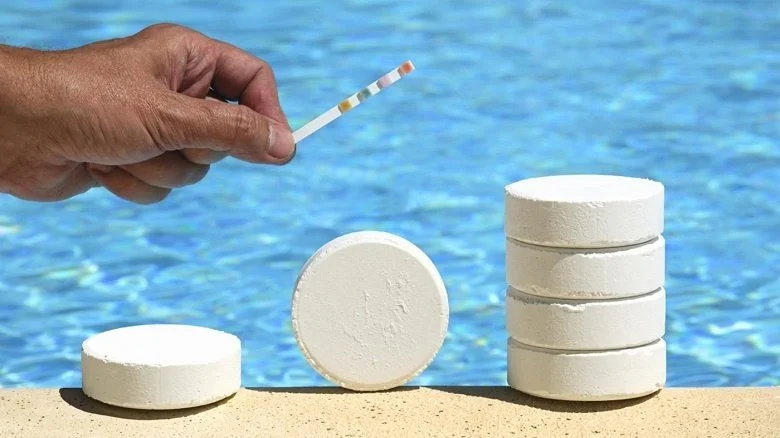
You added a full dose of chlorine yesterday. This morning the test strip barely shows a trace. Nothing happened — no storm, no party, no obvious explanation. You check your skimmer basket, look at the pump pressure, wonder if the tablets are sitting wrong. But the culprit isn't your equipment or your technique. It's been overhead the entire time.
Sunlight is the single most aggressive consumer of pool chlorine. In direct Florida sun, a pool without UV protection can lose more than a third of its free chlorine every hour. By the time your kids climb out at 3 p.m., the sanitizer you added the night before may be functionally gone — not because anything went wrong, but because that's what the chemistry does without the right foundation.
Understanding why this happens, and what actually fixes it, is the difference between chasing chlorine levels all summer and running a pool that holds its chemistry week after week.
What Chlorine Is Actually Doing in Your Water
When you add chlorine to pool water — as tablets, granular shock, liquid, or through a salt cell — it reacts with water to form hypochlorous acid. That's the active sanitizer: an unstable molecule that kills bacteria and oxidizes organic matter by breaking apart cell membranes and disrupting biological processes. The moment it does its job, it's consumed. That's normal and expected. The problem with UV is that it consumes chlorine before it does any useful work at all.
Free chlorine exists in two forms depending on pH: hypochlorous acid (the aggressive, fast-acting sanitizer) and hypochlorite ion (slower, less effective). High pH shifts the balance toward hypochlorite, which is one reason pH management matters. But neither form survives long in direct sunlight. Both are vulnerable to photolysis — the process by which UV radiation breaks molecular bonds.
The Mechanism: How UV Breaks Down Chlorine
UV photons from the sun penetrate the water surface and travel into the pool. When those photons contact free chlorine molecules, they deliver enough energy to sever the chlorine-oxygen bond that holds hypochlorous acid together. The molecule falls apart. The chlorine off-gasses or recombines into chloride ions — neither of which provides any sanitizing capacity. It simply disappears from your water chemistry, silently, without any sign of a problem.
This isn't a slow process. In a pool with no cyanuric acid (pool stabilizer) and full overhead sun, free chlorine drops by roughly one-third per hour. Stretch that across a Florida afternoon and you're looking at near-zero residual by mid-day — even if you added a full dose the night before. Your test kit isn't broken. That's exactly what the chemistry predicts.
Think of it like placing a bag of ice on a black asphalt driveway in July. You can keep supplying more ice, and it will technically be there — for a moment. But the environment destroys it faster than you can replenish it. Unstabilized chlorine in an outdoor Florida pool behaves the same way.
One more thing most pool owners don't know: UV penetrates cloud cover. Research from Orenda Technologies found that 75 to 99% of UV radiation passes through a typical overcast sky. The cloudy Florida afternoon that looks like a reprieve for your pool's chlorine isn't one. The degradation continues, just slightly slower.
Why Florida Pools Lose Chlorine Faster Than Most
Florida's latitude creates solar conditions that are particularly punishing on pool chemistry. The sun angle in Clearwater and throughout Pinellas County is steeper than in the mid-Atlantic or the Carolinas — more UV energy hits each square foot of pool surface throughout the day. UV index regularly reaches 9 to 11 during summer months, which is "very high" to "extreme" on the EPA scale. Northern pool owners simply don't face this combination of intensity, duration, and year-round exposure.
Florida pools also tend to be in peak use at the worst possible time: kids in the water at noon and through the afternoon, exactly when UV intensity is highest. Bather activity agitates the surface, increasing exposure. And warm water — Florida pools often sit at 85 to 90°F from May through October — accelerates chemical reactions across the board, including the reactions that consume chlorine through organic oxidation and combined chlorine formation.
The result is a pool environment where chlorine demand is significantly higher than what most generic pool care advice assumes. National guidelines calibrated for northern climates aren't wrong — they just don't account for what happens when a pool sits in full subtropical sun for twelve months a year.
Cyanuric Acid: The UV Shield Your Pool Needs
Cyanuric acid (CYA) — also called pool stabilizer or conditioner — is the molecule that protects chlorine from UV degradation. It forms a temporary bond with free chlorine: not consuming it, but shielding it from UV photons long enough for the chlorine to actually do its job.
Without CYA, you're pouring chlorine into water with a UV-shaped drain in the bottom. With CYA at the right concentration, the chlorine stays loosely attached to the stabilizer molecule and releases as needed when pathogen demand arises. It still sanitizes. It just doesn't off-gas into the atmosphere within an hour of being added.
The protective effect is meaningful and measurable:
| CYA Level | Chlorine Stability in Direct Sun | Practical Risk |
|---|---|---|
| 0 ppm | Loses ~⅓ per hour | Rapid sanitizer loss, algae risk within days |
| 30–50 ppm | Holds through most of the day | Recommended range for outdoor FL pools |
| 60–80 ppm | Good protection, moderate chlorine activity | Suitable for salt systems with continuous dosing |
| Above 100 ppm | Chlorine shielded but largely inactive | Chlorine lock — pool can't be properly sanitized |
A properly stabilized pool holds its chlorine residual through a full day of Florida sun. An unstabilized pool — or one where CYA has been diluted by heavy rain — loses its residual in hours, regardless of how much chlorine you add.
The Tablet Trap: Why CYA Creeps Up on You
Here's where pool chemistry gets genuinely tricky: you can have too much cyanuric acid, and excess CYA causes the opposite problem.
When CYA climbs above 80 to 100 ppm, its bond with chlorine becomes too strong. The chlorine stays attached and won't release fast enough to kill bacteria or oxidize algae growth. Your test kit still shows free chlorine in the water — it just can't do anything. This is called chlorine lock, and it's one of the most common reasons Florida pools turn green despite what appears to be adequate chlorine.
The insidious part is how CYA builds up without anyone noticing. Every standard 3-inch trichlor tablet — the puck most pool owners use for routine dosing — contains approximately 50 to 58% cyanuric acid by weight. Every tablet you add also adds stabilizer. CYA doesn't break down, doesn't evaporate, and doesn't get consumed by anything in the pool. It accumulates.
In a Florida pool running trichlor tablets year-round, CYA levels can drift past 100 ppm by midsummer without a single warning sign other than slowly worsening algae resistance. The pool looks chemically fine. The readings show chlorine. But the stabilizer has effectively locked it up.
The only way to reduce CYA is to dilute it — drain a portion of the pool and refill with fresh water. You can't neutralize it chemically. That's why monthly CYA testing during peak season matters as much as monitoring chlorine or pH.
Target CYA at 30–50 ppm for outdoor Florida pools using trichlor tablets. Salt system pools benefit from the higher end — 60–80 ppm — because salt chlorinators dose continuously and need more UV protection. Test monthly from April through October. If CYA exceeds 80 ppm, partial drain-and-refill is the fix; no chemical shortcut exists.
What Else Stacks Against Your Chlorine
UV degradation is the biggest single driver, but it rarely acts alone. Several other Florida-specific factors hit simultaneously.
Post-storm dilution- Florida summer storms can drop two to three inches of rain in a matter of hours, significantly diluting pool chemistry — including CYA. After a major storm, your stabilizer buffer may drop sharply, which exposes chlorine to full UV damage again almost overnight. Post-storm chemistry recovery isn't just about shocking the pool; it's about checking whether the protective layer has been washed out first.
Organic load- Chlorine fighting sunscreen residue, body oils, grass clippings, and insects has less capacity left to maintain a residual through the afternoon. A busy Saturday pool may need two to three times the chlorine input of a calm weekday — all of which is additional UV-exposed surface area demand.
Phosphate loading- Florida's tropical outdoor environment means frequent fertilizer runoff from lawns, rain-washed organic debris, and bird activity. Phosphates feed algae growth, which then spikes chlorine demand on top of UV loss. If your chlorine is disappearing faster than UV degradation alone would explain, high phosphate levels are worth testing.
What to Actually Do About It
The practical fixes follow directly from the mechanism.
Check CYA monthly during peak season- If your pool runs trichlor tablets as the primary chlorine source year-round, stabilizer will creep upward. Switching partially or fully to calcium hypochlorite shock during peak demand lets you maintain chlorine levels without continuously stacking CYA. If levels are already above 80 ppm, plan a partial drain-and-refill.
Dose chlorine in the evening, not the morning- Adding chlorine at dusk gives it overnight hours to distribute through the water without UV exposure. By the following afternoon, a stabilized residual is doing its job. Adding chlorine at 9 a.m. on a July day in Clearwater means a portion burns off before it even circulates completely.
Test after every major rainfall- Don't wait two weeks for the next service visit to discover that a rainstorm dropped your CYA to 15 ppm. Algae can establish a foothold within 24 to 48 hours of an unprotected pool sitting in full sun with minimal chlorine residual.
Run a full chemistry panel when strips can't explain the problem- Basic test strips show chlorine and pH, but they miss CYA, total dissolved solids, and phosphates — all of which affect how efficiently chlorine works. If free chlorine is consistently low despite regular dosing, a full panel will usually reveal the actual cause.
Frequently Asked Questions
High CYA is the most likely explanation. When cyanuric acid exceeds 80 to 100 ppm, it bonds chlorine tightly enough that the chlorine can't effectively kill bacteria or oxidize algae — but it still reads as free chlorine on a test kit. The water looks chemically adequate but is functionally undersanitized. A partial drain to dilute the CYA, followed by a shock treatment once CYA is back in range, is usually what resolves it.
In a pool with no cyanuric acid, direct Florida sun eliminates roughly one-third of free chlorine per hour. A pool that starts the morning at 3 ppm with no CYA buffer can drop to near zero by noon — before anyone's even used the pool. Even a well-stabilized pool at 40 ppm CYA loses a meaningful portion of chlorine over a full peak-sun day, which is why Florida pools require more frequent dosing than national averages suggest.
Not reliably. Overcast skies block a portion of UV, but research shows 75 to 99% of UV radiation still penetrates typical cloud cover. The rate of chlorine degradation slows slightly on cloudy days, but it doesn't stop. Properly maintained CYA levels remain important regardless of cloud patterns — in Florida especially, where a partly cloudy afternoon can quickly clear.
You can, but it creates a secondary problem if your primary chlorine source is trichlor tablets. Each tablet adds stabilizer along with chlorine. Compensating for UV loss by adding more pucks will eventually push CYA past the threshold where chlorine becomes ineffective. The correct path is to get CYA in range first, then dose chlorine to maintain residual — rather than adding more and more in a loop that ultimately makes the water harder to sanitize.
Free chlorine is the active sanitizer available to kill pathogens — hypochlorous acid and hypochlorite ion ready to work. Combined chlorine (chloramines) forms when free chlorine reacts with nitrogen and ammonia compounds from bathers, organic debris, and rainwater. Combined chlorine has very little sanitizing ability, causes the strong chemical smell most people associate with "over-chlorinated" pools, and irritates eyes and skin. High combined chlorine alongside low free chlorine means the pool's chlorine budget is being consumed by contamination faster than it's being replenished — UV loss makes this worse because it reduces the available residual before that work can happen.
Both have a role. Trichlor tablets work well for routine baseline maintenance because they dissolve slowly and provide consistent dosing. Calcium hypochlorite shock (unstabilized) is better for weekly or bi-weekly super-chlorination because it adds chlorine without raising CYA. If your pool's CYA is already above 80 ppm and you're trying to avoid diluting the pool, switching to cal-hypo as your primary chlorine source while CYA naturally holds or slowly drops through splash-out and backwashing is often the right adjustment. A pool technician familiar with your pool's volume, usage, and current chemistry can dial in the right balance.
The Real Reason Pool Chemistry Needs Year-Round Attention in Florida
UV degradation isn't a problem you solve once at the start of the season. Florida's climate creates a continuous, daily draw on pool chemistry that doesn't pause between June and August — or January and March. Clearwater and Pinellas County pools face solar conditions that are genuinely more demanding than what most of the country deals with, and the chemistry has to be calibrated to that reality.
Getting CYA in the right range, understanding how trichlor tablets slowly raise it, and knowing to check after every major rainstorm — these aren't advanced pool management concepts. They're the basics that let everything else work.
Dog Days Pools offers a complete, one-stop solution for professional pool services in Clearwater, Safety Harbor, and surrounding areas, including pool chemical maintenance and balancing, green arpool clean-up and algae treatment, and weekly maintenance. Our experienced team services residential pool systems with a focus on clean water, safe swimming conditions, and long-term performance. Whether you need routine chemical balancing or an urgent pool repair, we provide reliable service and responsive care. Schedule your pool service today — call (727) 205-0566.