

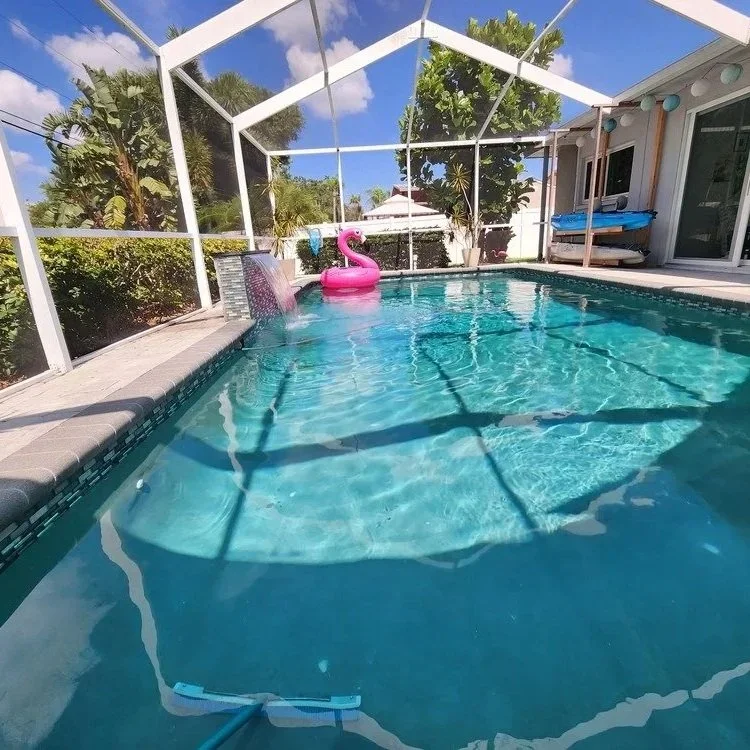
You have been adding water to the pool more often than you used to. Maybe an inch every few days, maybe more. You check around the equipment pad, you don't see anything dripping, and the pump sounds fine. So you chalk it up to the Florida heat — and you might be right. Or you might be slowly draining thousands of gallons a month into the ground without knowing it.
The problem with pool water loss is that evaporation and a slow leak can look identical from the pool deck. Both shrink the water line. Neither announces itself. The difference is that evaporation has a ceiling — a leak does not.
What Normal Pool Evaporation Actually Looks Like
Evaporation isn't a mystery. Heat and moving air pull water molecules off the surface and carry them into the atmosphere. What changes the rate is how hard each of those forces is pushing — surface temperature, air temperature, humidity, wind, direct sun exposure, and whether you have a screen enclosure.
In Clearwater and the broader Tampa Bay area, a pool can lose between ¼ inch and ½ inch of water per day during peak summer. July and August are worst. On a standard 15×30-foot pool, ½ inch of water is roughly 140 gallons. Losing that in a single hot, breezy day — with no leak, no backwash, no splash-out — is completely normal.
Cooler months change the math. Between December and February, Florida pools often drop to ⅛ inch or less per day, and some calm weeks evaporation is barely measurable. If you're worried about water loss in January, the bar for "normal" is much lower than it is in August.
Screen enclosures change the equation, too. A screened pool in Pinellas County blocks wind and limits direct solar heating on the water surface. An unscreened pool next door can lose twice as much on a windy afternoon. If your screen was recently damaged or removed, your pool's behavior changed right along with it — that alone can explain a noticeable jump in how often you're topping off.
How Much Water a Pool Leak Actually Wastes
Leaks don't come from a single place. They show up at fittings, O-rings, skimmer throats, return lines, underground pipes, and the shell itself. The daily loss depends entirely on where the leak is and how much the opening has grown.
Small fitting leaks — a cracked union at the pump, a worn O-ring on a return eyeball, a loose valve stem — can lose as little as ¼ to ½ inch per day. That's nearly the same as peak-summer evaporation, which is exactly why these leaks go unnoticed for months. Your water bill inches up, you add water every few days, and you tell yourself it's just the season.
Larger leaks — a cracked return line, a failing skimmer body, a fracture in the shell — can run 1 to 3 inches per day or more. At 3 inches, a 15×30 pool is bleeding around 840 gallons every 24 hours. You start to feel that number in your utility bill and in how often you're dragging out the hose.
Underground pipe leaks are the most deceptive. The water doesn't go anywhere you can see — it soaks into the ground below and around the equipment pad. The pool loses water steadily. The ground stays faintly damp. There's no puddle to find.
| Loss Source | Typical Daily Loss | Approx. Weekly Gallons (15×30 pool) |
|---|---|---|
| Summer evaporation (FL, unscreened) | ¼–½ inch | 500–1,000 gal |
| Summer evaporation (FL, screened) | ⅛–¼ inch | 250–500 gal |
| Winter evaporation (FL) | ⅛ inch or less | ~175 gal or less |
| Small fitting / O-ring leak | ¼–½ inch | 500–1,000 gal |
| Moderate skimmer / return leak | ½–1 inch | 1,000–2,000 gal |
| Significant structural leak | 1–3+ inches | 2,000–8,400+ gal |
The Bucket Test: Isolating Evaporation from a Leak
The bucket test works because it puts evaporation on a level playing field with your pool's water loss — same weather, same moment, same conditions. No special tools required. Just a 5-gallon bucket, a marker, and 24 hours.
Fill the bucket with pool water and set it on the second or third step so it sits partially submerged. You want the water temperature inside the bucket to match the pool, so evaporation hits both surfaces equally. Mark the level inside the bucket and on the pool wall with a grease pencil or tape. Run the pump on its normal schedule, leave the pool alone, and check back in 24 hours.
If both dropped the same amount, what you're seeing is evaporation. The bucket has no plumbing to leak from, so a matched result means the pool's loss is atmospheric, not structural.
If the pool dropped noticeably more — say the bucket fell ¼ inch but the pool fell ¾ inch — the extra ½ inch is coming from somewhere in the plumbing or shell. That gap is your daily leak rate.
Run the test twice to sharpen the picture. Once with the pump running, once with it completely off for 24 hours. More water loss with the pump off usually points to the shell, a skimmer, or a gravity-fed line. More loss with the pump running points to the pressure side — return lines, fittings, or the equipment pad itself.
Why Florida Makes This Harder to Read
Diagnosing pool water loss in Florida is tricky for a specific reason: the baseline for "normal" is already high. Evaporation rates here sit near the top of what most pool owners would expect anywhere in the country. That leaves less room to spot a slow leak hiding in the numbers.
That's the trap. When ½ inch per day from evaporation is normal, a slow leak that adds another ¼ inch goes right into the noise. You're losing ¾ inch a day, you blame the heat, and the leak keeps running.
Heavy summer rain throws off the baseline too. A big Pinellas County thunderstorm can add 1–2 inches overnight, pushing your water level up and masking the real loss rate. Then the skies clear, the level recovers, and you've lost your reference point. Running the bucket test over 3–4 consecutive days — not just a single 24-hour window — averages out those variables and gives you a number you can actually use.
A slow pool leak is like a small hole in a bucket you keep filling from the hose. You're always refilling it, the bucket never runs dry, and the hole never gets your attention. The problem only becomes obvious when you stop filling and watch for a few days.
Splash-out is real but often overstated. A busy afternoon with kids can cost you a few inches. Over a week that might account for ¼ inch of extra loss — annoying, but not the same order of magnitude as a plumbing problem. But if the pool is dropping overnight or on days no one is swimming, splash-out isn't the answer.
When to Stop Watching and Start Calling
The threshold most pool technicians work from: more than ½ inch per day during cooler months, or more than 1 inch per day in summer after accounting for splash-out, puts a leak on the table. When the bucket test shows the pool running ¼ inch or more ahead of the bucket, that gap is worth chasing.
Over a month, a ¼-inch-per-day gap above evaporation adds up to roughly 1,050 extra gallons. At typical Pinellas County water rates, that's $15–$30 above your normal fill cost — persistent, but easy to ignore. The number that matters more is what happens to the leak itself. A small O-ring leak or a hairline crack can hold steady for weeks, but the water pressure working against that gap doesn't stop. Skimmer cracks tend to grow because the plastic that cracked is still flexing with ground movement and temperature swings. A slow leak found in May can be a serious leak by September.
And the chemistry cost adds up too. Every time you top off the pool, you're diluting the existing water — meaning you're adding back raw tap water that's low on cyanuric acid and other stabilizers, which throws off your chemical balance and demands more product to correct.
What a Leak-Detection Company Does
Once the bucket test confirms a leak, the work shifts to finding it. That's a job for a leak-detection company, which has a few different approaches depending on where the problem is likely to be.
Pressure testing means pressurizing the return and suction lines with air or nitrogen to find which branch of the plumbing has an opening. A line that can't hold pressure has a breach somewhere in it.
Dye testing uses a non-staining dye injected near fittings, skimmer throats, return jets, light niches, and visible cracks in the shell. A thin plume of dye that pulls toward a crack rather than dispersing tells you exactly where the water is going.
Electronic leak detection uses listening equipment placed over buried pipe runs to pick up the sound of water escaping an underground line. The specialist can pinpoint the break without digging up the whole run first.
Most residential pool leaks come back to a short list of causes: worn O-rings at equipment fittings, cracked skimmer throats (very common in Florida, where UV and heat break down the plastic far faster than in cooler climates), failing return fittings, or shell cracks near steps and light niches where the structure flexes most.
Frequently Asked Questions
During summer in Clearwater and Pinellas County, a pool can normally lose 1¾ to 3½ inches per week from evaporation alone — roughly 500 to 1,000 gallons for a standard 15×30 pool. An unscreened pool loses more than a screened one. In winter, the rate drops to ¾ inch or less per week. If you're consistently above those ranges, the bucket test is the right next step.
Not accurately. Splash-out from swimmers adds to the pool's water loss but doesn't affect the bucket, so the comparison gets skewed. For a clean reading, run the test during a 24-hour stretch with no swimming — ideally over 3 or 4 days so you can average the results and rule out one-off conditions like wind or a short rain shower.
When water loss is higher with the pump off, the leak is almost always gravity-fed: the shell, the skimmer throat, a return fitting below the waterline, or a suction line. Water is pulling through a gap at or below the current water level. When loss is worse with the pump running, the pressure side — return lines, fittings, or the pump equipment area — is usually involved. Either result from the two-run bucket test narrows the diagnosis considerably before a technician arrives.
Simple fitting and O-ring replacements at the equipment pad typically run $100–$300 depending on how many components are involved. Skimmer repairs range from $200–$600. Underground pipe repairs requiring excavation run $500–$1,500 or more depending on depth and pipe access. Shell crack repairs below the waterline involve lowering the water and applying appropriate patch material — costs vary by crack size and location. Getting the right diagnosis first prevents paying for the wrong repair.
A small O-ring leak or a tight hairline crack can hold steady for several weeks without growing. The ones that tend to escalate are skimmer cracks, shell fractures near high-movement areas like steps and light niches, and any leak that's letting soil shift under or around the equipment pad. Once soil starts moving, nearby pipe joints and fittings are under new stress. A leak that seems stable is still wasting water and worth fixing — it just may not be racing a clock yet.
A liquid solar cover — a monomolecular film applied directly to the water — can cut evaporation by 30–50% without affecting chemistry or swimming. Worth using in the short term if you're topping off frequently while waiting on a service call. A standard pool cover is more aggressive about reducing evaporation, but requires covering the pool whenever it's not in use. Neither option fixes a leak — they only reduce how much water you're adding while the leak gets addressed.
Evaporation Has a Ceiling. A Leak Doesn't.
The bucket test takes ten minutes to set up and gives you a real answer in 24 hours. If you haven't run it, start there — you may find the pool is right in the normal range for a Florida summer and nothing else is needed. But if the test shows the pool running consistently ahead of the bucket by ¼ inch or more, or if you're adding water multiple times a week regardless of season, that's not a weather story anymore. It's a plumbing question. If the equipment pad is dry, it belongs with a leak-detection company that can pressure-test the lines and find the source before the problem gets bigger.
Dog Days Pools repairs leaks at the equipment pad, including pumps, filters, valves, and pad plumbing, in Clearwater, Safety Harbor, Dunedin, Palm Harbor, Oldsmar, and throughout Pinellas County. We don't do leak detection; if the leak is in a buried line, the skimmer throat, or the shell, we'll refer you to a leak-detection company. For weekly pool service or an urgent repair, call (727) 205-0566, seven days a week, 9 a.m. to 9 p.m. Florida Certified Pool Contractor CPC1460480.