
Is Your Pool Timer Bad? How to Tell Before You Replace It
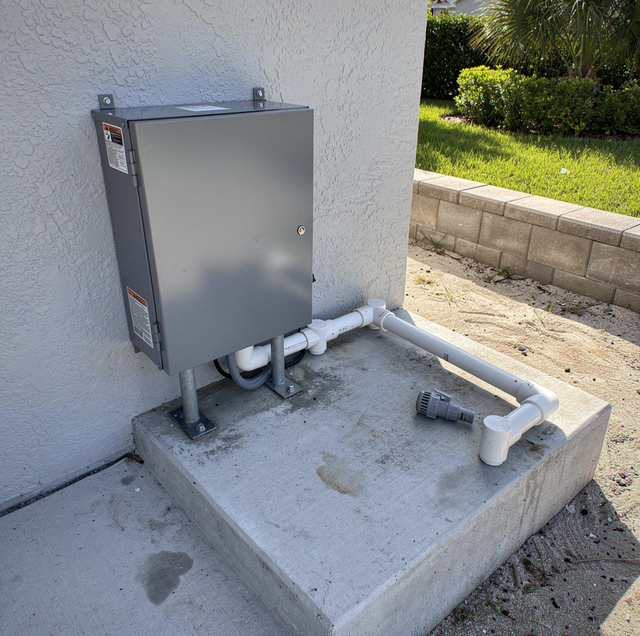
You walk out at seven in the morning, and the equipment pad is quiet. No hum from the motor, no ripple pushing out of the return jets, no water sliding over the skimmer weir. The pump should have started an hour ago. You look at the gray box bolted to the wall next to the motor and think what almost everyone thinks first: the timer is dead.
Maybe. The timer gets blamed far more often than it fails, because it sits at the one place on the pad where you lose visibility: power goes in, power comes out, and when the pump goes silent it is the nearest suspect.
Knowing means eliminating, in order. Each stage below rules out one option and yields a narrower question, until only one answer remains.
What a Pool Timer Actually Is: Two Machines in One Box
A mechanical dial timer holds two devices that share nothing but a housing. The first is a small synchronous clock motor, a couple of watts, geared down to turn a 24-hour dial exactly one revolution per day. Its speed comes from the 60 Hz line frequency, not a spring or a battery. The second is a set of heavy switching contacts sized to carry the pump motor's full running current, thrown open and shut by a spring-loaded actuator arm.
Those two halves fail independently, and that is the most useful fact in the whole diagnosis. The clock can seize while the contacts stay perfect, leaving the pump stuck on or off forever. The contacts can pit and weld while the clock keeps flawless time. A digital timer splits along the same line: a low-voltage board that keeps time, and a relay that carries the load.
Power enters on the line lugs from the breaker and leaves on the load lugs headed for the motor, both sets inside the same enclosure, inches apart.
A pool timer enclosure carries line voltage on both the incoming and outgoing lugs, and the line side stays live with the dial in the off position. Opening the box and touching terminals is licensed electrical or pool-service work.
Stage One: Confirm the Breaker Is Actually Holding
A residential pool pump usually runs on a 240-volt circuit through a double-pole breaker whose two handles are tied, so a fault on either leg drops both. A tripped breaker does not always look tripped: the handle often rests in a middle position that reads as on from across the garage, and it passes nothing there.
At the panel, push the handle firmly to full off, then back to on. That reset is the only part of this sequence that puts your hands on anything electrical. If the breaker will not hold, or trips again within seconds, stop there: a circuit that refuses to stay closed is reporting a ground fault or a short downstream, and the timer is the least likely culprit.
If the breaker holds and the pump still doesn't run, line power is reaching the timer. The question moves inside the box.
Stage Two: Is the Timer Passing Power to the Motor?
When the on tripper reaches the actuator arm, a spring snaps the contacts closed. The snap is deliberate. Contacts arc in the instant between open and closed, and the faster they cross that gap, the less metal burns off the faces. Even so, every make-and-break costs a little metal, and after enough cycles, the faces pit, carbon collects in the gap, and the resistance across a closed contact climbs. Higher resistance means heat; heat discolors the terminal block, and the contact eventually welds shut or stops passing enough current to start the motor.
Your evidence here is behavioral, and it costs you a day: watch whether the pump runs at any hour over a full turn of the dial. If it never runs across 24 hours and the breaker is holding, power is stopping at or before those contacts. If it runs sometimes but at hours nobody chose, the contacts are passing current fine, and the fault lives in the clock or the trippers.
Forcing the mechanism closed by hand with the manual lever settles it outright, but that puts a hand inside an enclosure whose line terminals are live regardless of the dial position, so it is for a licensed technician.
Stage Three: Is the Clock Keeping Time?
The clock motor turns the dial through a gear train and draws power continuously whenever the pad is energized, not only during the run window. Two consequences follow: the dial advances only while power is present, and it cannot correct itself once it falls behind.
When the clock motor burns out or a gear tooth strips, the dial stops, and where it stops decides what you see. Stopped with the contacts open, the pump never starts, which looks identical to stage two. Stopped with the contacts closed, the pump runs continuously and never shuts off, the clearer signature because healthy trippers cannot produce it.
Then there is the case where a working timer gets thrown away. After a power outage, a mechanical timer does not forget its schedule. It loses its place in the day. The dial freezes when power drops and resumes from that exact spot when power returns, so every start and every stop shifts later by the full length of the outage. A three-hour interruption moves an 8 a.m. start to 11 a.m. and leaves it there until somebody resets the dial to the correct hour. The schedule is intact; the clock is reading the wrong time of day.
Write down the clock time the pump starts and stops on two consecutive days. A start that slides later each day points to brief power interruptions the dial never made up; a wrong but stable start time points to the trippers.
Stage Four: Are the Trippers Set and Seated?
Trippers are the small steel dogs clamped to the outer rim of the dial, each held by one set screw. One trips the mechanism on, one trips it off, and the dial carries them past the stationary actuator once per revolution. The whole schedule is where those two pieces of metal sit and how tightly they are clamped.
The pad shakes hard every time the motor starts, and vibration backs set screws out. A tripper that loosens creeps around the rim, and the run window drifts or shortens with it. A tripper that loosens completely drops off the dial: lose the on tripper, and the pump never starts; lose the off tripper and the pump never stops. A tripper reinstalled facing the wrong way rides past the actuator without engaging it, so the pump ignores half its schedule while the mechanism is healthy.
Run duration gives this away. A pump that starts on time but runs until you cut the breaker is pointing at the off tripper. A pump that quits after a short stretch is pointing at trippers that have migrated toward each other. Neither is a failed timer. How many hours the pump should run once the trippers are set is a scheduling decision driven by turnover and falls outside this diagnosis.
Stage Five: When the Motor or Its Capacitor Is the Real Fault
A single-phase pool motor cannot start on its own. Its start winding, fed through a start capacitor under a hump on the motor's top or inside its rear terminal cover, carries current phase-shifted from the run winding, and the offset between the two windings creates the rotating magnetic field that breaks the rotor loose. The capacitor is an electrolytic can, and heat and age dry out its electrolyte until capacitance falls below what the start winding needs. The motor then sits energized and stalled, pulling locked-rotor current and buzzing at line frequency until the thermal overload opens.
That is why this stage comes last, and it carries the cleanest observation in the sequence: sound. A timer that has failed to pass power produces silence at the motor: no hum, no vibration, no warmth, no click. A motor receiving power that cannot turn makes noise you can hear from several feet away.
So if you hear anything from the motor during the window when it should be running, the timer already did its job: it closed and delivered power. A pump that hums and refuses to spin is a motor and capacitor workup with its own evidence. A pump that starts on schedule and then loses prime or pulls air through the suction side is a plumbing fault, not a switching fault.
How Digital Timers and Variable-Speed Pumps Fail Differently
A digital timer is a low-voltage board with a display, a timekeeping circuit, and one or more relays. The relay carries the motor current and fails much like mechanical contacts do, through pitting, welding, and chatter. The board fails on its own terms. Its timekeeping circuit rides out interruptions on a small backup cell or capacitor, and once that backup is exhausted, the clock resets on the next outage. The display flashes, the schedule reverts to a factory default, and the pump runs at an hour nobody programmed.
Two symptoms are digital-only. A dark display with the breaker holding points at the board or its low-voltage supply, not the relay. A display reading the correct time and schedule while the pump never starts points the other way, at a relay no longer closing.
Variable-speed pumps change the picture again: they usually store the schedule internally on the drive keypad and often have no external timer on the wall at all, so if one misses its start time, it's reporting a problem with its own programming, not a wall box.
Frequently Asked Questions
Yes, on a mechanical dial. Most residential timers ship with one pair of trippers (on and off), but the dial rim accepts more, and the common 24-hour models take up to 12 on-off pairs. Each added pair creates one more run window in the same 24-hour rotation.
Usually not. On most mechanical units, the clock motor is sold as its own replacement part, and the complete mechanism, called the works, lifts out of the back plate as a module. A technician can swap either one while the enclosure, conduit, and wiring stay put.
That is the clock motor, and it is normal. Its supply is wired ahead of the switching contacts rather than through them, so it stays energized around the clock, and its laminations give off a faint buzz you can only hear with your ear near the enclosure. A timer box gone silent is more concerning than one that buzzes.
It can damage a digital one. The board, the relay coil, and the low-voltage supply are all vulnerable to a surge riding in on the incoming power or induced through the bonding network during a nearby lightning strike. A mechanical dial timer has no circuit board to lose, which is why it often survives the event that kills the automation panel beside it.
Mechanical timers commonly run for eight to twelve years, and the contacts, rather than the clock, generally set the limit. A timer switching a pump on and off once a day makes roughly 730 contact operations a year, each one burning a trace of metal off the faces, so pitting is a normal end state, not a defect.
Indirectly, in most installations. Salt chlorine generators and gas heaters are wired to energize only when water moves, through a flow switch or pump interlock, so a timer that leaves the pump off also stops chlorine production and blocks the heater from firing. A timer stuck closed keeps the cell producing all night.
Book a timer and pump diagnosis — get a clear answer on whether the clock, the contacts, or the motor is at fault before anything gets replaced. Dog Days Pools serves Clearwater and Pinellas County. CPC1460480. Call (727) 205-0566.
