
Does a Robotic Pool Cleaner Replace a Whole Service Visit?
The robot reaches the deep-end wall, climbs it, and, at the tile band, either turns and tracks back down or crawls the last inch and runs the line. Which one it does is a property of that machine's design, and it is the first sign that the answer to the bigger question is split: a robot takes over part of a weekly visit and leaves the rest where it was on your list. It is a floor-and-wall machine with its own drive, brush, and filter, and at that job it is very good. It measures nothing. Watch yours finish a cycle and your pool looks finished too, which is where you get into trouble.
The Brush Path Is the Whole of What a Robot Covers
Underneath, a robot is three things bolted together. A sealed motor turns tracks or wheels that hold it against whatever surface it is driving on. A brush roller at the leading edge scrubs ahead of the intake. An impeller pulls water up through that intake, through a basket or a set of cartridge panels, and out a discharge port on top of the housing. The whole cycle happens submerged, on its own power, with your pool's own pump entirely out of the picture.
How long the cycle takes is a per-model number, and it varies widely by design. A cordless model may run a cycle covering floor, walls and waterline in up to two hours. A corded machine can take roughly four to six hours to clear a pool of debris. Some models also offer a one-hour floor-only mode alongside a two-hour full cycle. Those are figures for those machines, and yours carries its own.
Everything It Picks Up Stays Inside the Machine
None of what it lifts goes back through the plumbing. Water enters under the body, passes through the machine's own basket, and leaves through a discharge port a foot away.
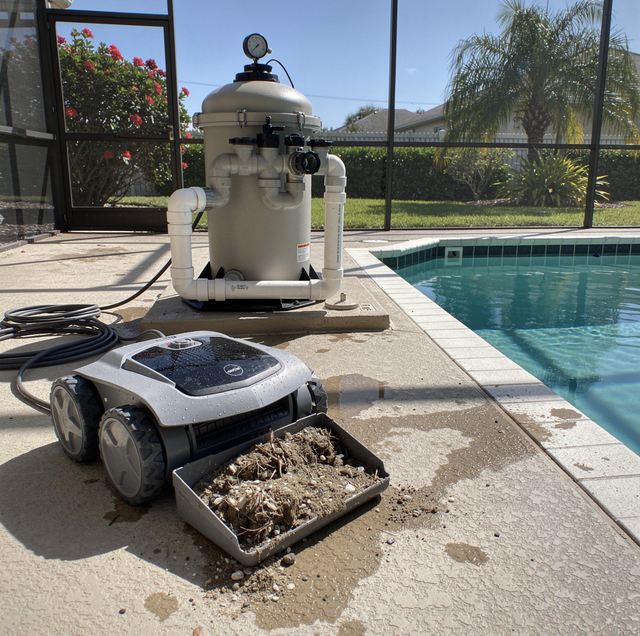
It works the way a shop vacuum does. What it lifts goes into a bag it carries, and the room's own ventilation never sees any of it. Mesh size sets what stays. A filter basket around 200 microns is coarse enough to hold sand, leaf stems, and the matted film that settles on a floor, and open enough that anything finer passes back out the discharge and stays in suspension. So the load leaves the pool inside the machine instead of traveling up the suction line, and your pool's own filter never sees that coarse fraction. The route the dirt takes out of the water is the whole of what has changed.
Some of the Pool Sits Outside the Cycle Entirely
Steps are the clearest example. Some corded machines are not designed to clean steps, swimouts, or areas under a solar cover automatically. A machine that finds its way by holding a surface loses it at a riser. Depth sets the other edge. Minimum operating depth on some models runs around 0.4 meters, about sixteen inches, so a sun shelf shallower than that is out of its range.
Everything still floating belongs to your skimmer. The machine works submerged and ignores the surface, so the pollen film and the leaves that land during a two-hour cycle remain when it stops. Baskets tell the same story. A skimmer basket and a pump basket fill on their own schedule, and a machine that never enters the plumbing is never going to empty for you either.
The equipment pad sits outside the cycle too. Filter pressure, return flow, a valve someone left half closed, a motor running warmer than it did in June: none of that is visible from the pool floor, and none of it is in a robot's job description. Your machine can run a flawless cycle every day while the reason your water is losing ground sits dry on the pad.
A Clean Floor Can Sit on Top of Drifting Chemistry
The machine removes what has settled. What decides whether anyone should be in the water is dissolved, and none of it shows from the deck. Federal guidance for home pools sets free chlorine at a minimum of 1 part per million, or 2 parts per million when cyanuric acid is in use, maintains pH between 7.0 and 7.8, and recommends readings at least twice a day. None of those numbers moves because the floor got brushed.
The dependency runs the other way, too. Manufacturer ratings on some domestic models cap the water a robot may run in at 4 parts per million free chlorine, a pH of 7.0 to 7.8, and 5,000 parts per million salt. Your machine carries a chemistry requirement and no chemistry function. Because the floor is the thing most easily read from a deck, a machine on a schedule keeps that reading favorable for as long as the pool is open.
What Stays on Your List After the Robot Runs?
A robot takes over the vacuuming half of a weekly visit, not the testing half. The vacuuming half is real work and it is most of the physical labor: the floor scrubbed and lifted, the walls worked, and on the machines that publish it, a pass along the band at the surface. Handing that to a device that repeats it four times a week rather than once is a real change in how your pool looks between visits, and it is the change owners notice first.
The testing half is a different kind of work, and none of it is mechanical. A reagent reading is a measurement. A dose is arithmetic run against that measurement and against the volume of your pool, and the answer moves every time the reading moves. A robot measures nothing, adds nothing, and cannot tell a pool holding a clean level from one that has been at zero since Wednesday. It drives the same pattern through either, and finishes looking equally successful in both.
That is why the two halves fail so differently. A skipped vacuuming shows up on the floor within a couple of days, in a form anyone can see from your deck. A skipped reading shows up as nothing at all, for as long as the sanitizer holds, and then all at once when it stops holding. An owner running a robot and testing properly is covering both halves. An owner running a robot alone is covering the half that was already visible and leaving the half that never announces itself.
A Visit With the Vacuuming Already Done
A visit that still happens spends its time differently. The pole and the brush come out less, and the minutes that used to go into the floor go into the water and the pad. The machine also joins the list of things on the property that wear out: its basket, its brushes, and its cable all have a service life, and they run on their own schedule.
Lift the basket out at the end of a cycle and tip it onto the deck. Sand, leaf stems, and a gray mat of pollen pressed flat against the mesh: that is a complete record of what was sitting on your floor two hours ago. Set it beside a chlorine reading taken the same afternoon and only one of the two tells you whether anyone should get in.
Frequently Asked Questions
Brush material and drive type are matched to a surface, and a machine sold for plaster is not automatically right for vinyl or fiberglass. A PVC brush is sometimes rated as suited to all pool surfaces, while other models pair a wheeled drive with a softer roller. Check the surface rating for your machine before you buy, because a drive that cannot hold a slick fiberglass wall will stop climbing yours.
Robots are rated for a chemistry range, and on some models the free chlorine cap is 4 parts per million. A pool sitting well above that right after a heavy dose is outside the range the manufacturer allows. Cloudiness is a separate limit: particles finer than the basket mesh pass through and come back out, so a cycle into cloudy water changes very little of what you see.
It brushes only where it drives. Tight corners, the space behind your ladder, the underside of a swimout, and the radius where a step meets a wall are places the drive cannot square up to, so the pole still comes out for those. What changes is frequency more than coverage: your open floor and walls get brushed more often than you would manage by hand, and awkward geometry stays with you.
Instructions have you disconnect the power supply before handling it, then lift it out and rinse it before the debris dries on. Left in the housing, the seals and cable sit in sanitizer and sun around the clock, a harder duty than they were rated for. A cable left coiled in the water holds its twist, and a twisted cable is the usual reason a robot misses a whole end of your pool.
Some robotic cleaners are not designed to perform initial cleanup for a new pool or to open a pool for the season. A heavy load fills your basket in minutes, and once it is full, the machine pushes the rest around your floor. Get your water back to a stable baseline first, and then you'll have the right tool to keep it there.
Yes, and it runs on the machine's clock. Recommended filter-cleaning frequency varies by model: some call for cleaning the basket after every cycle, others suggest about once a month. A loaded basket cuts the flow through the machine, and that same flow is what pins it to the wall, so weak climbing is usually the first symptom. It is a maintenance item your pool's filter never generates, so it doesn't fall under any cadence you already keep.
Water readings are the half of the job a machine on the floor cannot take over — a scheduled visit puts a measured chlorine and pH number into your week, and that number is the one thing a clean floor never shows you. Dog Days Pools serves Clearwater and Pinellas County. CPC1460480. Call (727) 205-0566.
