
Pool Waterline Crust? What Calcium Scale Is Telling You
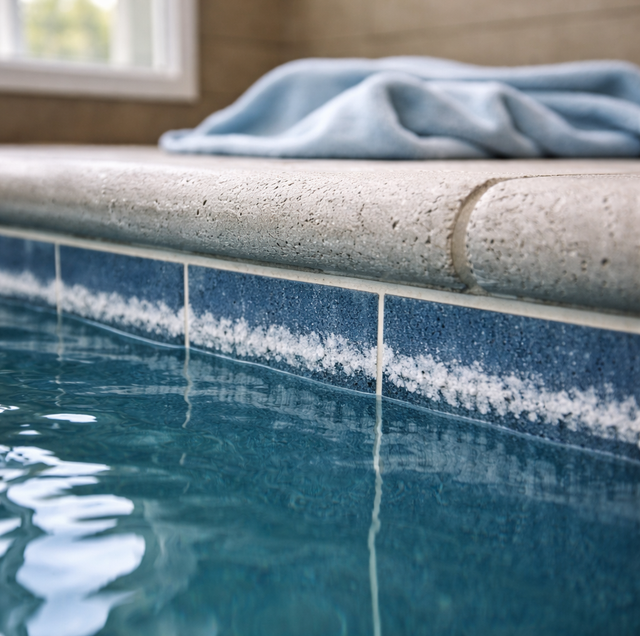
You run your hand along the tile at the top of the water and feel it before you see it: a rough, chalky band where the smooth surface should be. Sometimes it is bright white, sometimes it reads gray or dingy, and it seems to grow back no matter how often you scrub. That crust is a message about your water, not a cleaning failure.
Quick Answer: A gray or white crust at the waterline is almost always calcium scale, mineral deposits that harden out of the water when calcium hardness, pH, and total alkalinity are high enough together. Fixing it means both removing the buildup and correcting the chemistry that keeps feeding it.
What The Crust Actually Is
The white or grayish band riding along your tile and just below the surface is calcium carbonate. It is the same compound that forms lime buildup inside a kettle or the hard ring around a faucet, and it comes out of solution when the water can no longer hold all the dissolved minerals it is carrying.
Pool water is a solution of dissolved solids, and calcium is one of the big ones. As long as the chemistry stays in a certain range, that calcium stays invisible and dissolved. Push the water past its comfort point, and the calcium starts to crystallize onto the nearest hard surface. Tile grout, plaster, glass tile, and the pebble finish at the waterline are all favorite landing spots.
White crust vs. a grayer stain: There is a real difference between scale and a stain, and telling them apart saves you from treating the wrong problem.
Calcium scale is raised. You can feel it as a rough, crusty texture, and it is usually white, off-white, or a cloudy gray-white. Drag a fingernail or a coin across it, and it feels like sandpaper or thin crust. Fresh, chalky white deposits are typically calcium carbonate. A harder, more crystalline gray-white version that resists acid is often calcium silicate, which builds more slowly and clings harder.
A stain, by contrast, is flat. It sits in the surface rather than on top of it, and it is smooth to the touch. Grayer, brownish, or greenish discoloration that you cannot feel is usually metal or organic staining, not scale. Iron, copper, and manganese in the water can leave gray, rust, or bluish marks, and dirt or leaf tannins can leave a dull gray film. If the mark is smooth and you cannot scrape any texture off it, you are looking at a stain, and scale removers will do nothing for it.
Tell scale from a stain before you treat it. Calcium scale is raised and rough like sandpaper, while a stain sits flat in the surface and feels smooth. If you cannot scrape any texture off the mark, a scale remover will do nothing, because you are looking at a metal or organic stain instead.
Why The Water Chemistry Drives It
Three numbers decide whether your water deposits scale or stays clear: calcium hardness, pH, and total alkalinity. When all three run high at the same time, the water tips into scaling territory.
Calcium hardness is simply how much dissolved calcium the water carries. Fill water from a hard-water source starts you off high, and every gallon that evaporates leaves its calcium behind, so hardness climbs over a season. pH measures how acidic or basic the water is. As pH rises, calcium becomes far less willing to stay dissolved. Total alkalinity acts as a buffer that resists pH change, but high alkalinity also supplies the carbonate half of calcium carbonate, feeding the reaction.
The saturation idea in plain terms: Pool techs track all of this with a single figure often called the saturation index, and the plainest way to think about it is a balance point. Water wants to sit right at the point where it is neither hungry for calcium nor overloaded with it.
When the index reads positive, the water is oversaturated: it is holding more calcium than it comfortably can, so the excess precipitates out as scale on your tile and inside your equipment. When it reads negative, the water is undersaturated and turns aggressive, pulling calcium out of plaster and grout and etching the surfaces instead. Scale is the positive-side problem. It tells you calcium hardness, pH, and alkalinity have combined to push the water over its holding limit, and the crust is the overflow made solid.
Water temperature nudges this too. Warmer water holds less dissolved calcium, so a heated spa or a pool running warm through a hot stretch will scale a little more readily than the same water would when cool. That cuts both ways across the year, so it is one factor among several rather than the whole cause.
Why It Lands At The Waterline Specifically
Scale can form anywhere, but the waterline gets the worst of it for one reason: that is where water disappears into the air. Evaporation happens right at the surface, and every time a film of water evaporates off the tile at the very top of the pool, it leaves its dissolved minerals behind on that exact strip.
Repeat that thousands of times a day and the waterline becomes the most concentrated zone in the whole pool. Splashing, the slight rise and fall of the level, and sun-baked tile that dries between splashes all pile more calcium onto the same narrow band. The result is a hard rim that follows the water level around the entire perimeter, heaviest on the sunniest, most-splashed side.
What The Buildup Does If You Ignore It
Scale is not only a cosmetic complaint. Left alone, it works its way from the tile into the parts you actually depend on.
On the surface, the crust turns smooth tile and coping rough enough to scrape skin and snag swimsuits, and it traps dirt and algae in its texture so the waterline looks dirty faster. Heavy scaling can also seed general cloudiness, since the same oversaturated water throwing deposits on the tile can shed fine calcium crystals into the water column and haze it up.
The higher cost is hidden. Scale coats the inside of the plumbing, narrows pipes, and clouds the heat exchanger in a heater so it transfers heat less efficiently. In a salt pool, it is especially unforgiving: calcium plates directly onto the electrolytic plates of the salt cell, insulates them, and slowly chokes chlorine production. A scaled cell reads low output, throws no-flow or inspect-cell warnings, and eventually needs an acid bath or replacement. Catching waterline scale early is often the first warning that the same chemistry is quietly furring up equipment you cannot see.
How To Remove It
Removal depends on how thick the crust is and what surface it sits on. Match the method to the buildup rather than reaching for the most aggressive option first.
Light to moderate scale on tile: For a thin, gritty film on ceramic, porcelain, or glass tile, a pumice stone rubbed against the deposit with the surface kept wet is the standard hand tool. The pumice is softer than glazed tile and grinds the calcium away without scratching, though you should keep both the stone and the tile wet the whole time and test a small hidden spot first. Pumice is for hard tile and masonry only. Never take it to vinyl, fiberglass, or painted surfaces, where it will leave permanent scratches.
For deposits that resist scrubbing, a scale remover or descaler formulated for pools dissolves calcium chemically. These are typically acid-based, so handle them strictly per the label, wear eye and hand protection, work with good ventilation, and never combine them with chlorine or any other pool chemical. Follow the product's dwell time and rinse instructions exactly.
Heavy or crystalline buildup: When the crust is thick, has hardened into the calcium-silicate type that shrugs off acid, or wraps the entire waterline, hand tools stop being practical. The professional answer is bead blasting, where a technician uses a controlled media blaster to strip the scale off the tile without harming the glaze. It is done with proper containment and equipment and is not a DIY job.
A full drain of a plaster pool is professional work for a reason that has nothing to do with the acid. Emptying the pool removes the water weight that holds the shell down, and where the water table is high, hydrostatic pressure can float an empty shell up out of the ground. Leave draining and acid-washing to a licensed pro.
How To Keep It From Coming Back
Removal without a chemistry correction just buys you a few weeks. The crust returns because the water is still oversaturated, so prevention lives in the test kit.
Keep pH and total alkalinity in their normal ranges rather than letting them drift high, since high pH is the single biggest lever that tips balanced water into scaling water. Watch calcium hardness over the season and know that in hard-fill-water areas it only climbs as water evaporates and you top off. When hardness has crept too high, the reliable reset is to drain a portion of the pool and refill with fresh water to dilute the calcium back down. A sequestrant or scale-inhibitor additive can hold a modest calcium surplus in solution between corrections, buying time, though it manages the problem rather than removing the calcium.
The quiet habit that prevents most waterline crust is simply testing on a schedule and adjusting before numbers run to the top of their range. Balanced water that sits near its neutral point neither scales your tile nor etches your plaster, and the waterline stays smooth.
Frequently Asked Questions
Put a few drops of a diluted acid, such as muriatic acid or even white vinegar, directly on the deposit and watch. Calcium carbonate fizzes and bubbles on contact because the acid is dissolving it. If it foams, it is soft calcium scale. If nothing happens, you are looking at either the harder calcium-silicate scale or a metal stain, both of which need a different approach. Handle even diluted acid with gloves and eye protection.
No. Scale has nothing to do with your sanitizer level or type. It is driven by calcium, pH, and alkalinity, so a chlorine pool and a salt pool with identical mineral balance will scale identically. In a salt system, the salt itself does not add calcium, but the higher pH that salt cells tend to push water toward can accelerate scaling, which is why salt-pool owners are told to watch pH closely.
It contributes but rarely acts alone. Very hard fill water starts your calcium hardness high, and because only pure water evaporates, every top-off after evaporation concentrates that calcium further. A partial drain-and-refill lowers hardness, but if your fill water itself is very hard, you may need a pre-filter or hose filter on the fill line to slow how fast hardness rebuilds.
A cover usually helps, because it sharply cuts evaporation, and less evaporation means less mineral concentrating at the surface and a more stable water level. The tradeoff is that a covered pool can trap heat and let pH drift upward if it is not tested, and warmer, higher-pH water scales more readily, so a covered pool still needs regular chemistry checks to get the benefit.
Calcium hardness changes slowly, so testing it every few weeks to once a month is usually enough, unlike pH and chlorine, which move daily and should be checked several times a week. The exception is right after you add fresh fill water, refill after a partial drain, or add any calcium-based product, when a fresh hardness reading tells you where you actually stand.
With the water still oversaturated, a visible rough band can redevelop within a few weeks to a couple of months, and the hidden plumbing and any salt cell keep accumulating deposits the entire time even before the tile looks bad again. That is why technicians treat a scrubbed waterline as only half a repair and always retest and rebalance the water so the crust has no reason to reform.
Feel a rough crust building on your tile? — get the waterline cleared and the chemistry balanced so it stops coming back. Dog Days Pools serves Clearwater and Pinellas County. CPC1460480. Call (727) 205-0566.
