

A sharp, sinus-clearing chlorine smell rising off your pool gets blamed on too much chlorine, but the smell points to a different problem: chlorine that has already reacted with swimmer waste and turned into a byproduct called combined chlorine, or chloramines, faster than the free chlorine in the water has cleared it. Chlorine itself, at a normal working level, has only a faint odor. The sharp smell that stings the eyes and burns the back of the throat comes from chloramines formed when chlorine reacts with sweat, urine, and body oils swimmers bring into the water. The fix isn't cutting back on chlorine; it's testing to determine how much of what's in the water is still doing its job and how much has turned into the smelly byproduct, and then treating the cause.
Free Chlorine Versus Combined Chlorine
Two different numbers hide behind the single word "chlorine" on a test strip. Free chlorine is whatever hasn't reacted yet: the working supply still able to disinfect and oxidize whatever lands in the water. Combined chlorine is what's left after chlorine has already reacted with nitrogen-containing waste in your water, the ammonia and urea that come from sweat and urine. Once chlorine bonds to that nitrogen, it forms a chloramine compound that is weaker as a sanitizer and stronger as an irritant.
Total chlorine is the sum of free and combined chlorine. A basic test strip can report only total chlorine, which is why your reading can look normal while the water still smells strong: the number on the strip doesn't tell you how much of that chlorine is free and working versus combined and just sitting there producing odor. Separating the two numbers shows how much of your chlorine is still working.
How Chloramines Form, and Why They Sting Eyes and Skin
Chloramines form in stages. Chlorine first reacts with ammonia to form monochloramine; subsequent reactions can shift it toward dichloramine and trichloramine as more chlorine and more nitrogen waste become available. Trichloramine is the compound behind the sharp odor and the stinging in the eyes and airways, and it forms where a steady supply of swimmer waste meets chlorine, with low pH pushing the reaction further toward it.
This is why your pool can smell worse after a crowd swims: more people means more sweat, more body oil, and more urine entering the water at once, so the chemical reaction that produces chloramines has more raw material to work with. The smell isn't a sign your water has too much sanitizer in it; it's a sign the sanitizer is spending itself neutralizing waste and turning into a compound that lingers instead of disinfecting.
Testing Free Chlorine and Total Chlorine
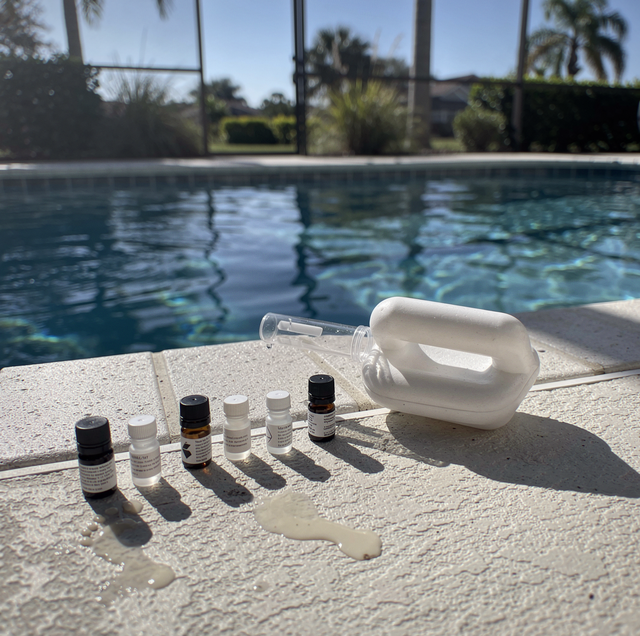
A test that reports only total chlorine can't tell you whether your pool has a chloramine problem or is well within range. A test that separates free chlorine from total chlorine lets you subtract one from the other and see the combined chlorine figure directly. Liquid drop kits designed for this purpose read free and total chlorine separately, while some basic strips lump both together into a single color block.
On a drop kit, read the free-chlorine result right away rather than letting the sample sit. Chloramines slowly color the sample as well, so a late reading shows more free chlorine and less combined chlorine than the water holds.
If your free chlorine number sits close to the total chlorine number, combined chlorine is low, and the smell has another explanation, such as a fresh dose of sanitizer that hasn't fully dissolved yet. If the gap between the two numbers is wide, chloramines are the driver, and the fix is a shock calculated from that gap, not a routine top-up of the dose that's already being consumed.
Breakpoint Chlorination: How a Professional Shock Clears Chloramines
Clearing chloramines out of your water takes more than a routine dose of chlorine. It takes a large enough dose, calculated from how much combined chlorine is already present, to push past what's called the breakpoint: the point where added chlorine stops feeding more chloramine formation and instead oxidizes the chloramines that already exist, breaking the chemical bond and releasing the nitrogen as a gas that leaves the water.
Dosing below the breakpoint can make the smell worse before it gets better, because a partial dose still has enough chlorine to react with the waste and produce more chloramine, leaving too little to break it apart. Getting the dose right requires knowing the current combined chlorine reading and calculating from there, which is the part of this job best left to the service rather than guessed at with a bag of shock off a store shelf. Once the dose goes in, swimmers stay out until the level drops back into the normal range on a retest, following whatever wait the product label sets. The target a technician works to is free chlorine of roughly ten times the current combined chlorine reading, since below that ratio the reaction keeps adding chloramine instead of breaking it down. That calculation starts from a fresh test result, not a flat amount off a label.
Shock mixed with acid or another pool chemical can give off a toxic gas, and water poured onto the dry product can spatter it back. Leave dosing to the technician and keep swimmers out until a retest clears the water.
Keeping Chloramines from Building Back Up
Prevention comes down to keeping the raw material for chloramines out of your water and keeping the water moving so chlorine reaches everything in it. A quick rinse before swimming removes a share of the sweat, body oil, and residue that would otherwise react with chlorine once someone gets in, and it's one of the few controls that sits with swimmers themselves rather than the equipment.
Circulation and filtration matter just as much. Water that sits still in a corner or behind a ladder doesn't get fresh chlorine circulated to it as fast as the rest of the pool, so waste sitting in that pocket has more time to react and form chloramines before the sanitizer catches up. Keeping the pump running enough hours to turn the whole volume over supports the chemistry as much as it supports clarity.
Outdoor pools get some help from sunlight, since its ultraviolet breaks down part of the chloramine in the water, though not enough to stand in for a shock. Indoor pools don't get that assist at all, and an indoor pool room without enough air exchange over the deck traps the smell instead of letting it clear, which is part of why an indoor facility can smell stronger than an outdoor pool carrying the same reading.
Matching What You Smell to What the Test Shows
What you notice next to what the test shows narrows the fix to one of these patterns:
| What you notice | What the test shows | What fixes it |
|---|---|---|
| Sharp smell, stinging eyes, water otherwise clear | Wide gap between total and free chlorine (high combined chlorine) | A calculated breakpoint shock |
| No unusual smell, but eyes still sting | Free chlorine low or pH out of range, combined chlorine low | Rebalance pH and raise free chlorine |
| Faint chlorine smell, comfortable to swim in | Free and combined chlorine both within range | No treatment needed; keep testing on schedule |
| Smell strongest indoors, mild outdoors | Chloramine gas building up in still indoor air | More air exchange over an indoor pool |
| Smell spikes right after a crowd swims, fades by the next day | Temporary rise in combined chlorine from bather load | Circulation, then a retest; a gap still open calls for a shock |
Frequently Asked Questions
A crowd of children adds urine and sweat, and the urea in urine reacts with chlorine more slowly than ammonia does, so chloramines can keep forming for hours after the swim has ended, not only while everyone is in the water.
It can affect breathing as well as eyes. Trichloramine gas is heavier than air and collects in a thin layer just above the water's surface, which is why swimmers with their face close to the water, such as during breaststroke, can notice throat and chest irritation that someone standing at the edge does not.
Shocking after dark lets the breakpoint reaction run its course without sunlight burning off any of the surplus chlorine needed to drive it, so less product goes to waste, and the pool is more likely to test clear by the next morning.
It's the same reaction, and a spa reaches it with fewer people: its small volume of water takes the same sweat and body oil from each bather that a pool would, and the heat speeds the reaction along.
Not on its own. Filtration removes particles and debris but does not break the chemical bonds that hold chloramine together. Circulation helps carry free chlorine to every pocket of the pool, but a wide gap between free and total chlorine still requires a calculated shock.
It can. Low pH pushes chloramine chemistry toward trichloramine, the most volatile and irritating form, so a pool running below its pH range can smell and sting more at the same combined chlorine reading than one held in range.
Arrange a chemical balancing visit — free and total chlorine tested separately, and a breakpoint shock dosed from the combined reading when the gap calls for one. Dog Days Pools serves Clearwater and Pinellas County. CPC1460480. Call (727) 205-0566.