

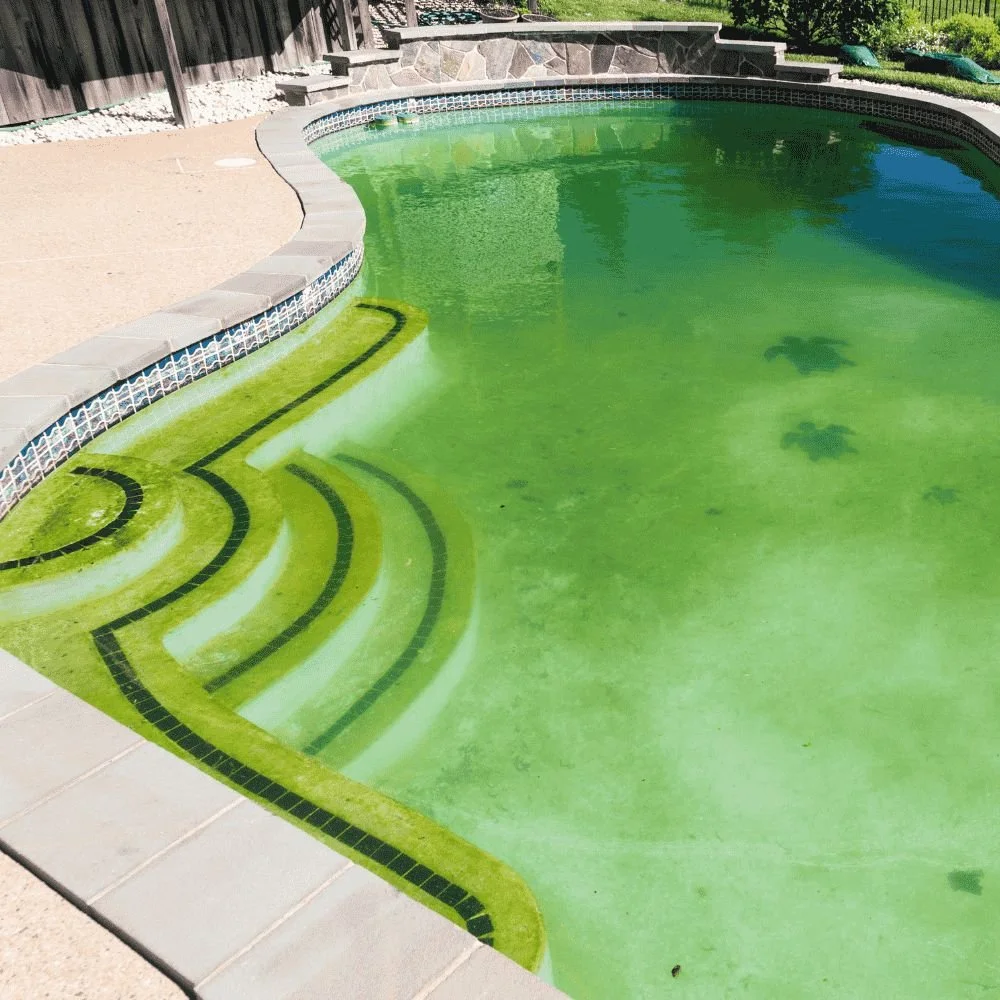
You tested the water this morning. Chlorine is right where it should be. pH is 7.4. Alkalinity looks fine. And yet the pool is sitting there, unmistakably green, like you haven't touched it in weeks.
Before you reach for more shock, stop. Adding oxidizer to a pool that already has adequate chlorine won't fix this — and in one specific scenario, it'll make the color deepen. A green-but-balanced pool is a diagnostic problem, not a dosing problem. Something is turning the water green that your standard test kit isn't measuring, and the fix depends entirely on identifying what that something is.
What Your Test Kit Measures — And What It Misses
Most home test strips and drop kits check free chlorine, combined chlorine, pH, total alkalinity, and sometimes cyanuric acid (CYA) and calcium hardness. These are the parameters that drive algae growth, equipment corrosion, and swimmer comfort, which is why they're the right things to monitor weekly.
What they don't check: dissolved metals like copper, iron, and manganese; phosphate levels; the effective sanitizing power of chlorine at your current CYA concentration; and the presence of dead organic matter still suspended in the water column. A pool can read perfect across every standard parameter and still look green because of something in that second list.
The table below maps the most common symptom patterns to their likely cause so you can narrow things down before reaching for chemicals.
| Symptom Pattern | Most Likely Cause | First Step |
|---|---|---|
| Green appeared after adding algaecide or after shocking | Dissolved copper oxidizing in the water | Test for copper; use a metal sequestrant |
| Greenish-blue tint near return jets or after heater runs | Copper from heater heat exchanger or copper plumbing | Test for copper; check pH history |
| Pool stays green despite repeated shocking with normal chlorine | High CYA neutralizing chlorine's sanitizing power | Test CYA specifically; consider partial drain |
| Dull green or gray-green haze after treatment, chlorine fine | Dead algae in suspension | Flocculant + vacuum to waste; run filter continuously |
| Yellow-green dusty film on floor and walls, wipes off cleanly | Pollen or fine organic debris | Brush and extended filter run; no chemicals needed |
| Orange-brown or rust-green tint | Dissolved iron or manganese | Test for metals; use a metal sequestrant |
| Green returns within days even after successful treatment | High phosphates feeding new algae cycles | Test phosphates; use a phosphate remover |
Dissolved Copper: The Most Common Metal Culprit
Copper doesn't behave like algae. It has no biological lifecycle, doesn't respond to shock, and has nothing to do with whether your filter is running or your pH is in range. It enters pool water in ionic form — completely colorless — and stays invisible until something oxidizes it.
The three most common sources are copper-based algaecides, the copper heat exchanger in a pool heater, and copper plumbing in older systems. In Florida's climate, heater corrosion is particularly prevalent. When pH drifts below 7.2 — even briefly, and Florida pools frequently drift downward after heavy summer rain or heavy shocking — the water turns chemically aggressive enough to pull copper off heat exchanger surfaces at a microscopic level. That copper dissolves into solution and waits.
The oxidation trigger is usually chlorine. Add a heavy shock dose to a pool with high dissolved copper, and the chlorine converts the copper ions into copper oxides that turn the water blue-green or teal. The reaction happens fast — sometimes overnight. The next morning, your chlorine reads normal (it did its job: it oxidized the copper), and the pool is green. The chemistry looks fine because the copper is no longer in ionic form. What's left behind is color.
The fix is a metal sequestrant — a chemical that binds to dissolved metals in solution, prevents further oxidation, and allows the filter to remove them over several days. In moderate cases, sequestrant treatment alone clears the color within a week. Severe cases may need partial draining to reduce the copper concentration before the sequestrant can manage what remains. Adding more chlorine does nothing except risk deepening the discoloration.
Preventing this from recurring means keeping pH consistently in the 7.4–7.6 range. Water at proper pH is far less corrosive to metal components. It's worth checking pH more frequently during Florida's rainy season, when dilution and organic loading from rain both push pH downward.
High CYA: When Your Chlorine Is There But Can't Work
This is the cause that catches the most homeowners off guard, because the test strip reads fine. You have chlorine. It shows up at 2 or 3 ppm. Everything is balanced. And yet algae is growing freely.
Cyanuric acid (CYA) — also called stabilizer or conditioner — is added to outdoor pools to protect chlorine from UV degradation. Florida's sun destroys unprotected chlorine within hours, which is why CYA is necessary. But CYA doesn't only shield chlorine from UV. It also chemically bonds to chlorine molecules, reducing how reactive they are. Think of it like a powerful medication that's been diluted into so much water that the concentration can no longer do anything — present, but not at the level needed to be effective.
At moderate CYA levels (30–50 ppm), that trade-off is worthwhile: enough UV protection without sacrificing much sanitizing power. When CYA climbs above 70–80 ppm, the math shifts. A pool at 100 ppm CYA needs roughly three to four times the free chlorine to achieve the same kill rate as a pool at 50 ppm. Your test strip reads 3 ppm — technically accurate — but the effective sanitizing power of that chlorine is a fraction of what 3 ppm means in a pool with normal CYA levels. Algae thrives in this environment because there's not enough active chlorine to kill it, even though the number looks right.
The only way to lower CYA is to dilute it out. In Florida, where pools don't get drained seasonally, CYA accumulates year after year from trichlor tablet use — every tablet adds stabilizer along with chlorine. Many pools in Pinellas County have CYA levels well above 100 ppm after a few years of tablet use without a partial drain. If your pool keeps cycling back to green despite correct chemistry and regular shocking, test the CYA level specifically. It's not included in every home test kit.
Dead Algae Still Floating After Treatment
Shock kills algae cells. Dead algae cells don't disappear — they break apart into fine organic particles that stay suspended in the water, turning it a cloudy green or gray-green color. Your chlorine did its job. The algae is dead. But the water still looks green because the debris hasn't cleared the filter yet.
This cause fits a specific sequence: the pool was actively green, you shocked it, the color shifted from bright green to a dull, hazy green, and now the chemistry tests fine. You're past the treatment phase. What remains is a filtration problem.
The fastest fix is a flocculant — a chemical that causes fine suspended particles to clump together and sink — followed by vacuuming directly to waste (bypassing the filter entirely), then running the filter on extended cycles. If you backwash and send the settled material back through the system, the particles stay in circulation and the water stays hazy regardless of how long the filter runs.
One detail that matters here: dead algae cells release phosphates as they break down. Those phosphates then feed the next algae bloom if chlorine levels fall even briefly. This is why pools that recover from a green episode sometimes turn green again within two to three weeks — the algae is gone, but it left behind the fuel for the next cycle.
Pollen: The Seasonal Impostor
Pollen creates a yellow-green haze that looks remarkably like early algae, especially in photographs. In spring and early summer, pools collect airborne pollen that settles on the surface and sinks to the floor and walls.
The key diagnostic difference is texture. Pollen forms a powdery, dusty film that brushes off the walls cleanly without leaving any slippery residue. Early algae starts as a slippery, almost oily film that resists brushing and tends to cling. Brush the pool walls. If the green material wipes away cleanly with no slick feeling underneath, pollen is almost certainly the cause.
Standard brushing, skimming, and extended filter run times resolve pollen without any chemical adjustment. Shocking a pool because of pollen does nothing useful — the pollen isn't alive, it doesn't respond to chlorine, and it'll come back as long as the trees are blooming.
How to Diagnose Which Problem You Have
The single most useful action with a green-but-balanced pool is a full water analysis that goes beyond the standard parameters. Bring a sample to your pool supply store or use a test kit that specifically checks copper, iron, and phosphate levels — these aren't included in most home kits. Your pool supply store's in-store analysis takes about five minutes and covers what you can't measure at home.
Beyond testing, the timeline gives you a lot to work with. Did the green appear overnight after adding algaecide or shock? Copper oxidation. Did it shift from bright green to dull green after a shock treatment? Dead algae in suspension. Did it develop slowly over weeks despite regular chemical maintenance? Test CYA specifically — high stabilizer is probably limiting your chlorine's effectiveness. Does it keep coming back within a week or two of treatment? Phosphates are likely feeding the cycle.
One combination that's common in Florida pools: high CYA from years of tablet use, combined with high phosphates from organic debris and rain runoff. The CYA allows algae to survive the chlorine, the phosphates keep feeding it, and the standard test strip reads perfectly normal throughout.
Frequently Asked Questions
That color is almost always dissolved copper oxidizing in response to chlorine. When chlorine contacts copper ions in the water, it converts them to copper oxide compounds that are blue-green or teal. The copper likely came from a copper-based algaecide, a corroding heater heat exchanger, or copper plumbing. Adding more shock makes the discoloration worse. You need a metal sequestrant to bind the copper and allow the filter to remove it over several days.
Yes, very likely. At 90 ppm CYA, your chlorine's effective sanitizing power is well below what the ppm number suggests. Algae can survive and actively grow in a pool that tests at 2–3 ppm free chlorine when CYA is that high. The fix is dilution — partially drain the pool and refill with fresh water to bring CYA back to the 30–50 ppm range. Shocking alone won't overcome a high CYA level.
With continuous filtration and a flocculant treatment, most pools clear within two to five days after the algae is dead. The step people most often skip is vacuuming the flocculated material to waste rather than letting it recirculate through the filter. If the dead particles stay in circulation, the water stays hazy regardless of how long the pump runs.
Phosphates don't turn pool water green by themselves — they serve as fertilizer for algae. A pool with high phosphate levels will keep cycling back to green even when chlorine and other parameters look fine, because every time chlorine drops even slightly, the algae has all the nutrients it needs to restart. Common phosphate sources include decaying organic debris, lawn fertilizer runoff during Florida's rainy season, and dead algae breaking down after treatment.
Yes, and the staining happens faster than most homeowners expect. High copper concentrations leave teal or blue-green streaks on pool plaster, tile grout, and vinyl liner surfaces. Staining that appears around return jets or along the waterline is typically copper. Treating the metal immediately with a sequestrant prevents cosmetic discoloration from becoming a resurfacing problem down the road.
If the pool keeps cycling back to green despite correct treatment and balanced chemistry, the source hasn't been identified. Recurring green water almost always means an ongoing input — CYA accumulation from years of tablet use, a corroding heater releasing copper continuously, or persistent phosphate loading from the surrounding yard and runoff. A professional water analysis covering metals, CYA, phosphates, and total dissolved solids will usually identify what a home kit can't.
Test First, Then Treat
A green pool with normal chemistry is telling you something specific: whatever is causing the color isn't showing up in your test kit. That's a starting point, not a dead end. Test for metals. Test CYA directly. Look at the timeline and the pattern. Most of the time, one of the causes above fits what you're seeing — and once you've identified the right one, the fix is clear.
Dog Days Pools provides complete pool troubleshooting, chemical balancing, and equipment repair in Clearwater, Safety Harbor, and surrounding Pinellas County communities, including Dunedin, Palm Harbor, and Oldsmar. Whether your water keeps turning green despite proper maintenance or you need a professional water analysis to find the actual cause, call (727) 205-0566. Licensed Certified Pool Contractor #CPC1460480.