

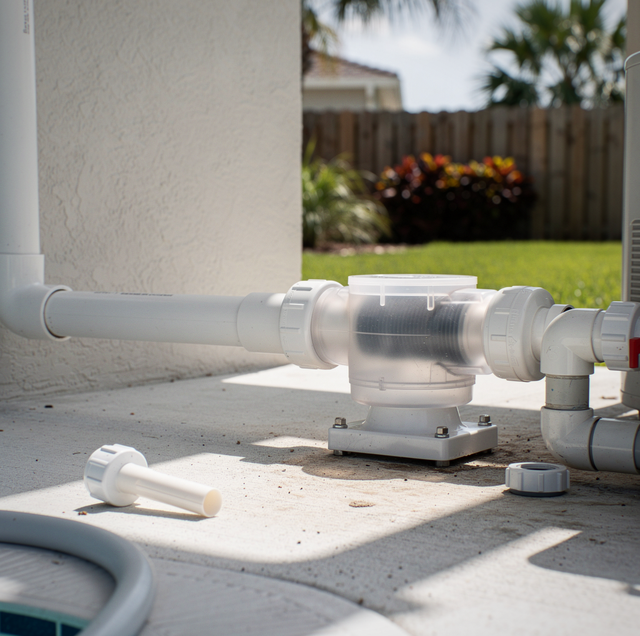
A salt chlorine generator cannot detect water moving through its cell on its own. It relies on a flow switch or flow sensor in the plumbing beside the cell, and until that device reports water passing, the control keeps the cell switched off. The reason is gas: a cell carrying current keeps splitting salt water whether the water moves or not, and in still water the gas it makes has nowhere to go. A no-flow message with the pump running is a narrower statement than it sounds. It says the switch is not seeing enough flow, and that can come from low flow at the cell, air sitting at the switch, a switch that is stuck or fouled, a switch fitted in the wrong spot or facing the wrong way, or a switch cable that is not connected. When the message appears, and what changed at the pad just before it separates those causes, as this comparison of message patterns and their likely causes shows.
| When the No-Flow Message Appears | Likely Cause |
|---|---|
| Right after the pump starts, then it clears | A start-up delay, or air clearing from the line, while water reaches the switch. |
| Only while the pump runs on a low speed | Flow at that speed too weak to move the switch |
| After a valve was turned or the filter was cleaned | A valve left sending water around the cell, or one not returned to its running position |
| With air bubbles showing in the pump basket | Air collecting at the switch in place of water |
| All the time, with strong flow at the returns | A stuck, fouled or failed switch, or a damaged or loose switch cable |
| Starting right after plumbing work at the pad | A switch set in the wrong spot or facing the wrong direction |
How the Flow Switch Keeps the Cell Off
The cell is a stack of metal plates housed within a component of the return pipe. Current passed across the plates splits the dissolved salt: chlorine forms at one set of plates and hydrogen gas at the other. With water moving, both leave in the stream. The chlorine dissolves into the pool, and the hydrogen leaves as fine bubbles carried out through the returns.
Stop the water, and the current does not stop on its own. Gas gathers in the upper part of the cell housing; the pocket grows, pushing water away from the plates, and hydrogen is flammable. A sealed housing, filled with it, can crack or burst. Power reaching the pump does not prove that water is moving either: a pump that has lost prime or one pushing against a closed valve can run with little or no water passing the cell. The flow switch exists to answer one question, yes or no, about water moving past the cell.
On some designs, it is a paddle switch. A small plastic paddle hangs into the pipe through a tee, moving water pushes it over, and a magnet in the paddle closes a contact in the switch body. Other designs use an electronic sensor in place of a paddle. Either way, the control box reads the signal through a cable plugged into it, and no signal means no power to the plates.
A flow switch jumpered, taped, or tied closed lets the cell switch on in still water, where hydrogen can collect in the sealed housing and burst it, potentially injuring anyone at the pad. Restoring a bypassed switch is work for a pool technician.
Low Flow at the Cell
Water can be moving and still not move enough to satisfy the switch. A paddle needs a certain push before it swings far enough to close its contact, and anything that slows the stream past it can leave the paddle hanging short of that point.
Pump speed: Set to a low speed, a variable-speed pump can move enough water for filtration but not enough to push the paddle over. When that is the cause, the message follows the speed schedule, appearing when the pump steps down and clearing when it steps up. The repair is in the programming: the generator's hours are set to overlap a speed the switch registers.
The filter: As a filter loads with dirt, the flow reaching the returns drops, and the switch sits downstream of it; a gauge reading well above its clean level is one sign that the filter is part of the problem, alongside the valves and the pump speed.
Valves: A diverter turned toward a spa, a water feature, or a cleaner line can send the stream down a branch that never passes the cell. A valve eased partly closed while the filter was being cleaned and never opened again; it throttles the flow the same way. A check valve whose flap is stuck partway can also restrict the line.
A pump pushing against a closed or nearly closed valve churns the same water inside its housing, heating it, which can soften plastic fittings and damage the shaft seal. With the pump off at the breaker, a valve turned during cleaning can be set back to its running position. If the handles carry no marks and nobody remembers where they sat, the valve setup is a job for the technician.
Air Trapped at the Switch
Air drawn in through a suction-side leak ahead of the pump passes through the pump and the filter, then rides the return line to its high points, and the tee holding the switch can be one of them. A paddle sitting in an air pocket has nothing to push it, and an electronic sensor reads air around its tip as missing water.
This cause leaves visible evidence. Bubbles churn under the clear lid of the pump basket, and the returns spit and sputter where they would otherwise push a smooth stream. Air trapped in the filter tank after cleaning can do the same for a while, until the tank's air relief valve lets it out. When the bubbles stop, and the message clears with them, the switch was reporting the air correctly.
When the Switch or Its Cable Is the Fault
A switch can report no flow while water rushes past it. The paddle can be wedged by a scrap of debris that got past a damaged filter or into the pipe during plumbing work. Calcium scale can build up on the paddle's hinge or on a sensor tip, holding it in place. The paddle can crack or snap off, leaving nothing in the stream to move, and the contact inside the switch body can wear out while the paddle looks fine.
The cable is the other half. It runs from the switch to the control box, outdoors, beside equipment that vibrates. Its jacket can turn brittle in the sun, animals can chew it, the pins at its plug can corrode, and a plug that was bumped can sit half-seated in its socket. Any of these breaks the signal, and the control reads a broken signal as no flow.
None of these faults is one to handle by hand. The generator, its control box, and the switch cable are powered equipment, and the control box stays closed to anyone but the technician. The breaker comes off before any hands touch the cable or anything else on the pad, and wet hands or standing water on the pad mean the power stays off until the technician arrives.
Plumbing Layout at the Equipment Pad
Where the switch sits determines whether it can read the flow there. Water leaving an elbow, a valve, or a tee swirls before it settles, and a paddle placed in that swirl can flutter between open and closed or sit in a dead spot where the stream never pushes it. For that reason, the switch needs a straight run of pipe ahead of it, so the water reaches it flowing evenly.
A paddle switch also has a direction. An arrow on the switch body marks the way water should flow, and a switch fitted backward, or rotated in its tee when a nearby union was tightened, has its paddle pushed the wrong way. The switch has to sit in the same line as the cell too, never on a branch a valve can close off. Each of these can follow plumbing work at the pad: a new pump, a new filter, a re-plumbed valve, or a replaced cell can each disturb the switch, which is why a message that began the day after that work is the one worth mentioning first.
What the Pattern Tells You Before Anyone Opens Anything
The evidence behind each pattern can be gathered without touching the equipment. The time of day the message appears, the speed shown on the pump's display at that moment, whether the basket lid shows bubbles, where the filter gauge reads relative to its clean level, and what changed at the pad that week are all things you can observe from a step away.
A phone photo of the pump display, the valve handles, and the filter gauge, taken while the message is displayed, keeps a record of the fault conditions for a technician arriving at a time when the message has cleared.
The Control Board Comes Last
The control board is the last suspect, reached only after flow at the cell has been confirmed, the switch has been shown to change state with flow, and the cable has been shown to carry the signal. Replacing a board first can leave a stuck paddle or a broken cable in place and the message on the screen.
Frequently Asked Questions
No. A generator and a pump can run on separate circuits or timers, so if the pump motor's thermal overload opens or the pump quits for any other reason, the generator can remain powered. A forced switch keeps telling the control that water is moving, and the cell keeps making gas in a still pipe.
Yes. Production stops completely while the message appears, but the salt level in the water remains the same. The chlorine already in the pool is continually consumed by sunlight and swimmers, so the level declines day by day. Liquid chlorine added by the pool's service technician can hold the level while the repair is arranged.
It depends on where the sensor lives. On some systems, the flow sensor is built into the cell itself, so a new cell comes with a new sensor. On others, the switch is a separate part in its own tee, and a new cell leaves a failed switch exactly where it was.
Automated valve actuators are one explanation. On a pad with automation, a small motor turns a diverter for a spa, a water feature, or a cleaner line on a schedule, and while it sits turned, the stream can bypass the cell. The message then tracks the actuator's schedule, not the pump's.
Yes, and that failure is silent. A switch stuck in the flow position produces no message at all, so everything looks normal while the cell has lost its protection. It shows itself when the pump is stopped, and the switch still reports flow.
On control boxes that stay powered with the pump off, yes, and it is expected: no water is moving, and the message says so. On units that draw power through the pump's circuit, the display goes dark with the pump, rather than showing the message.
Hire salt system repair for a no-flow error — flow switch, switch cable, cell plumbing and control board diagnosis. Dog Days Pools serves Clearwater and Pinellas County. CPC1460480. Call (727) 205-0566.