

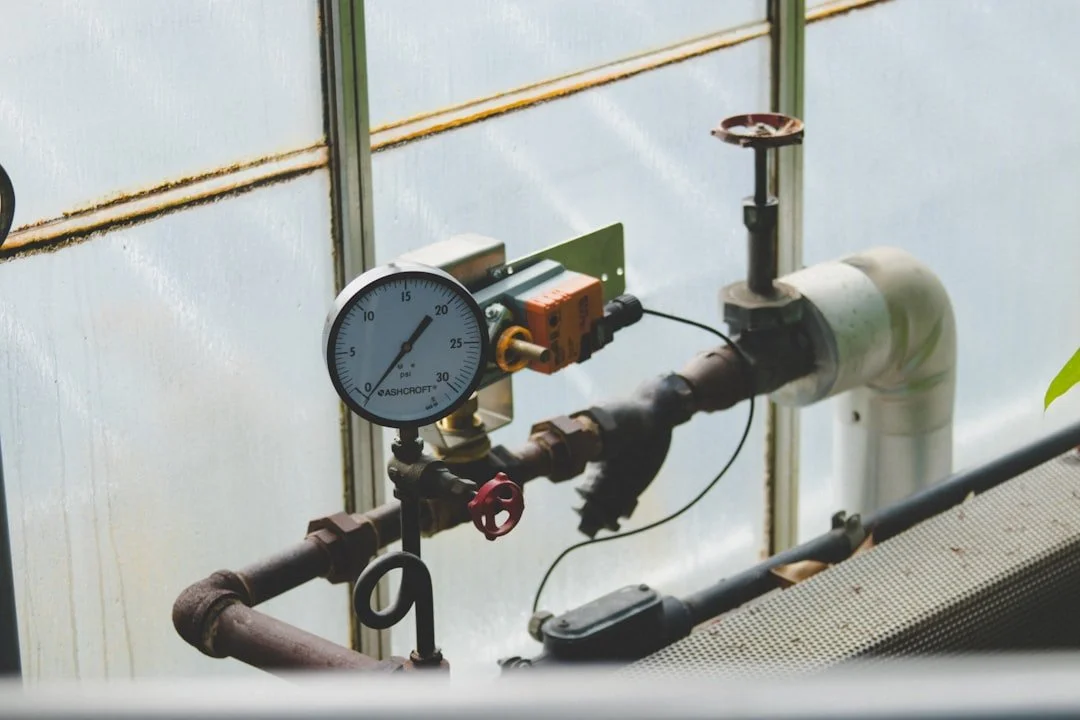
The gauge on your filter was sitting at 12 PSI last week. Now it reads 22, and the return jets feel noticeably weaker. The water has that slightly off look — not green yet, but not quite right either. You've added chemicals, but they're not doing what they usually do. Something is wrong, and the gauge isn't explaining itself.
That reading is the filter's way of telling you it's struggling. High filter pressure has a short list of causes, and once you understand what the gauge actually measures, the diagnosis gets clearer. The tricky part is knowing which cause you're dealing with — because the fix for a saturated cartridge is completely different from the fix for a closed valve or a failing multiport valve.
What the Pressure Gauge Is Actually Measuring
The gauge on your filter sits at the point where water exits the filter housing. What it reads is the resistance water encounters as it pushes through the filter media — whether that's a cartridge, sand bed, or DE-coated grids. Water enters the housing under pump pressure, works through the media, and exits toward the return lines at lower pressure. The gauge shows how much of that pressure remains after the media does its job.
Every filter system has a baseline — the reading you get when the media is clean and all valves are fully open. For most residential pools, that baseline falls somewhere between 8 and 15 PSI, though the exact number depends on your pump size, pipe diameter, filter model, and how long your plumbing runs are. The baseline is specific to your system. What matters is not the absolute number, but how far above that personal baseline the gauge climbs.
When the filter media becomes loaded with debris, algae cells, scale, or organic matter, water has a harder time pushing through. The pump keeps working at the same rate, but the resistance builds. Think of it like breathing through a sponge that keeps tightening — the effort goes up even when the output stays the same.
The threshold that should trigger action: anything 8 to 10 PSI above your established baseline.
The Most Likely Causes, Ranked by Probability
A dirty or saturated filter is the cause the overwhelming majority of the time. Cartridge filters capture debris in their pleated polyester media, and when enough accumulates, flow slows and pressure rises. Sand filters develop a compacted layer on top of the sand bed that resists flow. DE filters lose efficiency as the diatomaceous earth coating on the grids becomes saturated with debris. In each case, the fix is the same in principle — clean or backwash the media — though the specific steps differ by filter type.
An algae bloom drives pressure up faster than almost anything else. Algae cells are small enough to pass straight through the skimmer basket and pump basket without getting caught, so the filter takes the full biological load. A pool that turns visibly green or cloudy can clog a cartridge filter within 24 to 48 hours. High pressure alongside any green tint or cloudiness in the water usually signals a biological load, not just debris.
A closed or partially closed return-side valve is less common but the fastest to confirm. If a valve was left in the wrong position after a spa switchover, a repair, or even just someone bumping the handle, the pressure gauge spikes because water has nowhere to go downstream. This type of rise is immediate and dramatic. Walk the return side of the system and check every valve before assuming the filter is the problem.
A failing multiport valve on a sand or DE filter can create pressure anomalies that don't respond to backwashing. The spider gasket and O-ring seal inside the valve wear out over time. When they fail, water can route incorrectly — sometimes back through itself, sometimes through the backwash line when it should be going to the pool. If you've backwashed completely and pressure is still high, the multiport valve deserves a close look.
Scale accumulation on the filter media develops more slowly and is more common in areas where calcium hardness runs high. Calcium deposits form on cartridge pleats and DE grids, restricting flow even after cleaning. The sign is that pressure returns to near-normal after a thorough cleaning but climbs back to high faster each subsequent cycle — as if the media is saturating faster than it used to.
| Cause | How Fast It Develops | Confirm By | Urgency |
|---|---|---|---|
| Dirty cartridge / sand / DE media | Days to weeks | Pressure drops after cleaning or backwash | Moderate — clean promptly |
| Algae bloom loading the filter | Hours to 48 hours | Green or cloudy water alongside rising PSI | High — treat water and clean filter together |
| Closed or partially closed return valve | Immediate | Walk and inspect every return-side valve | High — open valve now |
| Failing multiport valve | Gradual | Pressure stays high after a full backwash | Moderate — inspect valve |
| Scale accumulation on media | Weeks to months | Pressure climbs faster each cycle after cleaning | Lower urgency — acid wash or replace media |
What Sustained High Pressure Does to Your Equipment
Pool filters, pumps, and plumbing are all rated for a working pressure range. Residential cartridge filter housings typically carry a maximum rating of 50 PSI, though most manufacturers flag anything above 30 as territory where close monitoring is warranted. Running the system above normal operating pressure puts continuous stress on every component downstream: O-rings compress past their design range, filter housing lids crack at the threads, and pump seals wear faster from the extra load.
A filter pushing against high resistance also delivers less water flow per minute. Chemicals added to the pool circulate poorly, leaving concentration spikes near the return jets and dead zones in corners and steps where sanitizer barely reaches. Dead spots are exactly where algae takes hold first. A pool running with persistent high filter pressure isn't just wearing out equipment faster — it's creating the chemistry conditions that make the next problem inevitable.
If your pressure gauge reads above 35 PSI while the pump is running, shut the pump off immediately. Do not attempt to open the filter lid, remove a cartridge, or backwash under pressure — release system pressure first by turning off the pump and opening the manual air relief valve on top of the filter housing before touching anything. A housing failure under pressure can cause serious injury.
How to Work Through the Diagnosis
Start by knowing your baseline. If you've never tracked it, clean or backwash the filter completely, open all valves, run the system for 10 minutes, and read the gauge. Write that number on a piece of tape and stick it near the equipment pad. Every future reading only means something in relation to that number.
If pressure is 8 to 10 PSI above baseline, clean the filter first. For a cartridge: shut off the pump, bleed the pressure by opening the air relief valve, remove the cartridge, and rinse it thoroughly with a garden hose — work between the pleats from top to bottom, not across them. Reinstall and restart. For a sand filter: set the multiport to backwash, run until the sight glass clears, then rinse for 30 seconds before switching back to filter. For a DE filter: backwash until clear, then add a fresh charge of diatomaceous earth through the skimmer with the pump running on filter mode.
If pressure drops back to baseline after cleaning, a dirty filter was the cause. If pressure stays high, move to the valves. Physically walk every return-side valve and confirm each one is fully open. A valve that's 80 percent open feels almost normal to the touch but will push pressure noticeably higher than a fully open valve.
If all the valves are open and pressure is still high, look at the water. Any cloudiness or green tint alongside persistent high pressure means algae is reloading the filter nearly as fast as cleaning clears it. The chemistry and the filter have to be addressed together — fixing one without the other will have you right back in the same spot within a day.
If the water looks clear, valves are open, and pressure is still high after a thorough cleaning, the problem is mechanical — most likely the multiport valve, a degraded cartridge, or scale buildup that cleaning alone won't clear.
When Cleaning Isn't Enough
Cartridge filters don't last indefinitely. A typical residential cartridge handles one to three years of service depending on how heavily the pool is used and how consistently it's cleaned. As the polyester pleats age, the fibers degrade, oils and minerals embed into the material, and a thorough rinse can't restore what the original media delivered. If your filter needs cleaning more frequently than it used to, and even a freshly cleaned cartridge doesn't bring pressure back to its old baseline, the cartridge is past its useful life.
DE filter grids fail differently — torn grids let DE pass through to the pool — but grids that are intact yet aged can still lose flow efficiency. A fresh set of grids on a well-maintained DE filter makes a measurable difference in operating pressure.
Replacing a cartridge or a set of grids is significantly less expensive than replacing the pump seals, filter housing, or plumbing fittings that fail when a system runs at high pressure for months. The media is the wear part in the filter system. It's designed to be replaced.
Frequently Asked Questions
The answer is relative to your system's baseline. Whatever your filter reads when the media is clean and all valves are open is your normal. A reading 8 to 10 PSI above that baseline is the signal to clean or investigate. A reading above 30 PSI on a residential cartridge filter warrants caution, and anything approaching the maximum rated pressure stamped on the filter housing — typically 50 PSI — means shutting the pump off immediately.
A sudden spike, especially when the water looked fine the day before, points to one of two things: a valve was accidentally closed or partially closed, or an algae event is loading the filter rapidly. Algae can go from invisible to producing a heavy filter load in under 24 hours in warm water. Check your valves first, then look closely at the water. Any cloudiness or greenish tint means treat the chemistry and clean the filter at the same time.
Running briefly at high pressure won't cause immediate damage, but running for days or weeks at sustained high pressure stresses seals, O-rings, and the filter housing, and significantly reduces the water circulation your pool needs to stay clear. Don't treat a high pressure reading as something to deal with next week — the longer the filter labors, the more wear accumulates on every component downstream.
If pressure returns to the high range within a day or two of a thorough cleaning, the filter is being reloaded faster than normal. An active algae bloom is the most common reason in warm climates. A heavy debris event — a nearby tree losing pollen or leaves, or a storm — can do it too. If the water tests chemically normal and there's no obvious debris source, a cartridge at end of life may no longer be filtering and restoring properly, and replacement is the next step.
For cartridge filters, the housing itself typically outlasts many cartridge replacements — it's the pleated insert that wears out and needs periodic swapping. Unless the housing is cracked, leaking, or has stripped threads, you're replacing the cartridge, not the unit. DE filter housings and manifolds similarly outlast the grids inside them. Sand in a sand filter typically holds up for five to seven years before it becomes fine enough to lose meaningful filtration efficiency.
A gauge that reads zero with the pump running, or that doesn't change no matter what condition the filter is in, has almost certainly failed. Pool filter gauges take a beating from water chemistry and UV exposure, and they wear out. A failed gauge can't warn you when pressure is rising. They're inexpensive and easy to replace — if yours looks the same whether the filter is clean or saturated, replace it before relying on it for diagnostics.
The Gauge Is Telling You Something
A pressure gauge that goes up isn't going up randomly. Every reading reflects what's happening inside the system — whether the filter needs maintenance, a valve is out of position, or something has changed in the water. The rise is almost always gradual enough that it's easy to get used to seeing a higher number. Most pool equipment failure stories start with a gauge reading that crept up slowly, got accepted as normal, and eventually showed up as a cracked housing, a burned motor, or a chemistry problem that took weeks to unravel. Reading the gauge and acting on it early keeps a maintenance task from becoming a repair.
Dog Days Pools offers professional pool filter repair and cleaning, pump diagnostics, and complete pool maintenance in Clearwater, Safety Harbor, Dunedin, Palm Harbor, Oldsmar, and throughout Pinellas County. Whether your filter pressure is climbing or your circulation system needs a full checkup, we're available seven days a week, 9 a.m. to 9 p.m. Call (727) 205-0566 to schedule service.