

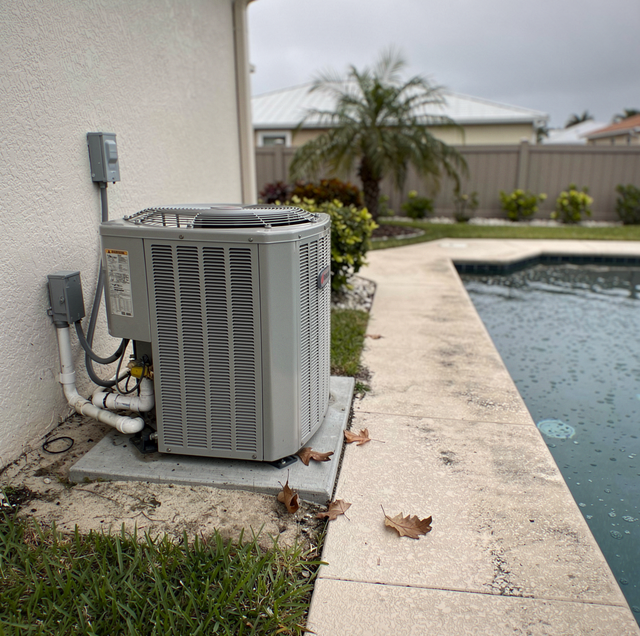
Quick Answer: A heat pump moves heat from the air rather than burning fuel, so its output tracks the outdoor temperature. Cooler air can appear to be a fault. Confirm the setpoint, clear airflow around the cabinet, and give it a full run first.
The pump runs, the display holds the set temperature, and the unit hums along exactly like it did last month, but the water still comes up short. Nothing looks broken. Nothing sounds wrong. The pool just isn't gaining ground the way it did a few weeks earlier, and the only thing that's really changed is the air.
A Heat Pump Moves Heat Out of the Air
A gas heater burns fuel and produces heat on demand, so its output doesn't care what the air is doing outside. A heat pump operates on a completely different principle: it draws warmth already present in the outside air and delivers it to the pool water through a refrigeration cycle, rather than generating heat through combustion. That distinction is the whole answer to why cold air changes everything.
Because the unit isn't generating heat from scratch, it can only move what the air is willing to give up. Warm air holds more usable heat energy, so a heat pump harvests it easily and recovers the pool fast. Cooler air holds less of that same energy, so the same compressor, the same fan, and the same refrigerant charge come away with a smaller catch every time they cycle through. The equipment hasn't changed. The raw material it depends on has.
Following the Heat From the Air Into the Water
Inside the cabinet, a fan pulls outside air across an evaporator coil filled with cold refrigerant. The refrigerant absorbs heat from the passing air and turns into a gas; a compressor then compresses that gas until its temperature climbs well above the pool water, and a second coil transfers that concentrated heat into the water flowing past it before the refrigerant cools, turns back into a liquid, and starts the loop again.
Every stage of that loop depends on the air being warm enough to give something up in the first stage. When the air is cold, the refrigerant absorbs less heat at the evaporator coil, which means there is simply less heat for the compressor to concentrate and hand off downstream. The unit isn't struggling against the cold so much as it's working with a thinner supply of raw heat than it had on a warmer day.
Where Output Falls Off
Output doesn't drop suddenly at one temperature. It tapers as the air cools, and several conditions widen the gap between what the unit delivers and what the pool loses on a given day.
Wind across the pool: A breeze strips heat and water from an uncovered pool surface, so on a cold, windy morning the unit's reduced output works against a greater loss than it faces on a still morning.
Frost on a cold, damp coil: Humid air actually hands the coil extra heat as its moisture condenses, but once the coil surface nears freezing that same moisture turns to frost, which insulates the coil from the air it's drawing heat from.
Nighttime versus daytime swings: A pool loses heat overnight regardless of whether the heat pump is running, and it has to claw that loss back once the sun and the air both warm up, so the unit often looks weakest first thing in the morning and strongest by afternoon.
A pool sized at the edge of the unit's capacity: A heat pump chosen for a smaller pool or a lightly used one may keep pace fine most of the year, then fall visibly behind once the air cools and its already-reduced output has to fight a bigger heat loss from an open pool surface at the same time.
Where the Unit Protects Itself and Shuts Down
A heat pump carries controls that stop it from running in conditions where continued operation would damage the compressor or accomplish nothing useful. Most units include a built-in low-ambient cutoff, a point below which the unit locks out heating rather than running the compressor on air too cold to be worth harvesting. That threshold is a known, fixed value rather than guesswork, and it varies by model and refrigerant, which is why a single number for every heat pump is unreliable.
Frost on the coil triggers a related response. Once ice builds up past a certain point, the unit typically pauses heating and runs a defrost cycle, either by reversing the refrigerant flow or by stopping the compressor and letting the fan clear the coil, before it goes back to heating. From the pool deck, a defrost cycle looks exactly like the unit randomly stopping, when it's actually the equipment maintaining itself so the coil keeps working.
Occasional icing in cold, humid weather that clears itself within a short defrost cycle is normal, not a fault. Icing that never fully clears, or builds fast, points to an airflow or refrigerant issue worth a technician's look.
Telling Normal-for-the-Air From Broken
The practical question isn't whether output changed; it's whether the change matches the air or has outrun it. A heat pump that heats more slowly on a cold week, keeps pace once conditions warm, and defrosts occasionally without drama is behaving as designed. A unit that has stopped raising the temperature at all, that runs constantly without narrowing the gap to the setpoint even on a mild day, or that ices up repeatedly and never fully clears is showing a fault layered on top of the seasonal slowdown.
Tracking how many degrees the water gains over a full day, and comparing that against a similarly cool day a few weeks earlier, gives a much better read than judging the unit hour to hour, and it's a baseline worth keeping through the coldest stretch of the season when a pool stays open and in use every month; a pool that isn't open all year only meets that same slowdown in the shorter windows around opening and closing. A heat pump that's merely working through thin, cold air still adds ground steadily across a full cycle; one with a real problem stalls no matter how long you give it.
Checks You Can Make Before Calling
A short list of checks stays entirely on the outside of the cabinet and can rule out the easy explanations first.
- Keep shrubs, fencing, and pool covers pulled back far enough that the unit isn't drawing in air it just exhausted, which starves it of fresh, warmer air to work with.
- Note the outdoor temperature and time of day when you check the water, then check again on a milder day before deciding the unit is underperforming.
- Look at the unit's display for a defrost or low-ambient code before assuming a fault; either one means the unit is managing the cold on its own, not failing.
Anything past that- opening the cabinet, handling refrigerant lines, or working on electrical components- is a technician's task. A pro can measure the actual temperature differential across the unit, check the refrigerant charge, and compare real output against the manufacturer's rated performance for that air temperature, which settles the question far better than watching the pool from the deck.
Frequently Asked Questions
There's no single number that applies to every model, because output depends on the specific unit's rated capacity and how far the air has dropped from its design range. What's consistent is the pattern: a healthy unit slows gradually as the air cools and speeds back up as it warms, rather than stopping outright or staying flat regardless of conditions.
Pool heat pumps are commonly rated at two standard test conditions, a warm one and a cool one, with the same water temperature for both. The cool-condition figure is the closer guide to what the unit delivers on a cold morning, and it is the number to compare against when the pool falls behind.
Some models are built with a reversing valve specifically to run in a cooling mode on hot days, which is a deliberate feature rather than a malfunction. If a unit that's only ever been used for heating suddenly starts cooling the water, check the mode setting first; if it's already set to heat and the water still cools, a stuck reversing valve is a technician's call.
Yes. Scheduling the heat pump to run during the hottest stretch of the afternoon puts its runtime when the air holds the most usable heat, and a cover overnight holds on to that gain. The pool pump has to run on the same schedule, since the heat pump only heats while water is moving through it.
Yes. A first start has to raise the whole pool from its resting temperature rather than hold a setpoint, so the heat-up runs through cold mornings as well as warm afternoons, and any hour below the model's low-ambient cutoff adds no heat at all. Give it several days if the season opens during a cold snap, and keep the cover on overnight.
The coefficient of performance (COP) is the heat delivered per unit of electricity, and it runs lower at cool-air test conditions than at warm ones, so a cold week draws more electricity per degree the water gains.
Get the heat pump's real output checked against its rated capacity for the current air temperature — a technician can confirm in one visit whether it's the season or a genuine fault. Dog Days Pools serves Clearwater and Pinellas County. CPC1460480. Call (727) 205-0566.