

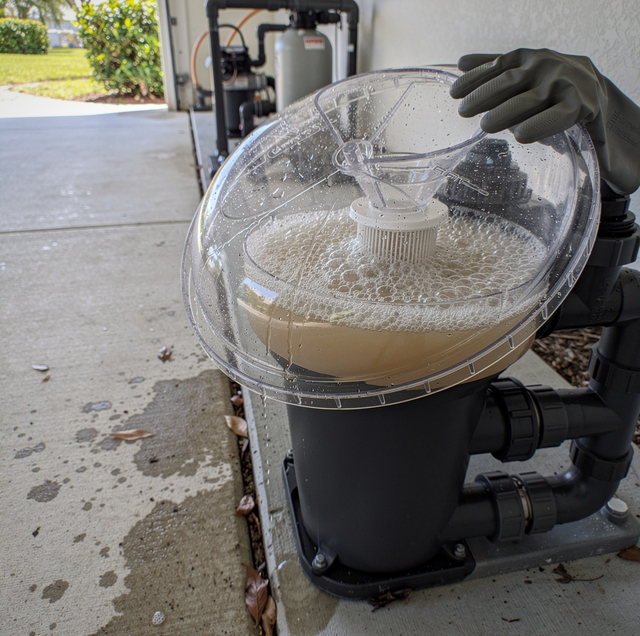
Pull the skimmer basket and look into the throat below it, or catch the pump's strainer pot through its clear lid while the system runs: the water isn't a solid column. It's a churn of bubbles and foam, half air, half water. Or you saw it at a return jet instead, a stream of tiny bubbles chattering back into the pool every time the pump cycles on.
That basket is a window onto the suction side, the plumbing between the pool and the pump. Everything there runs under negative pressure while the pump works, and negative pressure draws air in through any gap open to the atmosphere rather than pushing water out, so a suction-side leak can run for weeks without ever leaving a wet spot on the deck. A pump that hums without spinning is a separate problem, either in the motor or in its capacitor; this article is about a pump that spins fine but still can't hold a solid column of water.
| Bubble Pattern | Likely Source | Diagnostic Step |
|---|---|---|
| Bubbles right after the pump is refilled or restarted, then it clears | Trapped air working itself out, not a leak | Give it a few pump cycles first |
| Basket stays foamy the entire time the pump runs | Skimmer throat, weir, or basket | Check water level against the skimmer opening |
| Bubbles increase when a variable-speed pump is turned up | A leak somewhere on the suction side | Note the speed and have the line pressure tested |
| Basket is empty every morning, primed fine the day before | A valve or fitting not holding at rest | Check unions and valve seals near the pump |
A pool filter and pump form a pressurized system. Never open a pump lid, filter, or drain plug without first turning off the pump and releasing pressure at the air relief valve. A lid released under pressure can be thrown with force.
Water Level Below the Skimmer Throat Starts Most Air Leaks
The skimmer throat is the opening in the pool wall where the skimmer pulls water off the surface, built to run submerged and draw a continuous sheet of water. When the level drops below the bottom edge of that opening, the skimmer can't draw a full column anymore. It draws whatever is at the opening, and once the level is low enough, that includes air, showing up as foam in the basket before it reaches the pump.
What lowers the level: Evaporation is the steady drain on any pool, faster in heat or wind. Splash-out and water pulled out during a filter backwash do the same job faster and don't depend on weather. Any of the three can expose the throat; the response is the same regardless of cause: top the pool off until the water covers the opening with room to spare.
The Skimmer Weir and Basket Can Let Air Follow the Water Down
Every skimmer has a weir, a floating door hinged at the top of the throat, that holds back the water above it and keeps flow into the skimmer steady as the level shifts. A weir that's stuck open, warped, or missing lets water fall and swirl into the throat instead of arriving as a controlled sheet, and that turbulence pulls air down with it, adding bubbles even when the level is otherwise fine. It's an easy failure to miss at a glance, since the skimmer still looks like it's drawing water normally; sun and chlorine exposure make the plastic brittle years before the rest of the equipment shows its age, which is why an older weir is worth a direct look rather than an assumption.
The basket below the weir catches debris. A cracked basket, or one missing entirely, opens a path for air around the mesh rather than through it. Some skimmers also pull part of their suction through an equalizer line, a secondary pipe that ties the skimmer housing to the main drain plumbing, serving as a backup source if the level drops below the throat.
A Suction-Side Leak Draws Air In, It Doesn't Push Water Out
This is the distinction that makes a suction-side problem different from almost any other leak in the yard: it hides. The suction line, the buried pipe (or pair of pipes, on a system drawing from both the skimmer and a main drain), runs under negative pressure the entire time the pump is on. The impeller throws water outward on the discharge side, creating a vacuum that pulls the next slug of water in behind it. A gap anywhere along that run, a threaded fitting, a glued joint with a hairline crack, or a crack in the pipe wall, draws air toward the low pressure rather than pushing water out. Nothing puddles, nothing stains.
Two suction points, one problem: On a pool plumbed with both a skimmer and a main drain, the lines meet at a valve before the pump, and each carries part of the total suction. A leak on the main drain line can draw in air even when the skimmer, checked alone, looks normal, because the air joins the flow downstream before reaching the pump. A low water level is a separate cause tied to the skimmer throat; a suction-line leak pulls air with the water level perfectly fine.
The Pump Lid O-Ring and Drain Plugs Are Common, Quick-Check Entry Points
The strainer pot, the housing the pump's basket sits inside, is the last stop on the suction side before water reaches the impeller, sealed by a rubber O-ring compressed between the lid and the housing rim. An o-ring that's dried out, flattened, cracked, or missing a section no longer fills that gap evenly, and grit or a stray hair caught in the seating groove can break the seal in one spot even when the o-ring itself is fine. Watch for a stream of small bubbles rising from one side of the clear lid, distinct from the general foam a low water level produces throughout the basket.
At the base of the volute, the housing that the impeller spins inside, a pair of drain plugs allows the pump to be drained for service. Each seals with its own small O-ring that dries out and cracks from age alone since the plugs are rarely removed, and a plug that isn't seated fully draws air through the same vacuum as the lid does. Both are a quick visual check before looking further upstream.
A Partially Blocked Impeller Eye Changes How the Pump Primes
Self-priming is the mechanism that lets a pump starting with air in the line pull itself down to a solid flow without help. The impeller spins inside the volute, flings the water already present toward the discharge port, and creates a partial vacuum at the impeller eye, its center opening, strong enough to pull the next slug of water in behind it. The sequence depends on an airtight suction side; any air entering upstream gets pulled through that same eye and has to be flung out and replaced, over and over, before the pump can build a solid column.
A partially blocked impeller eye, clogged with debris small enough to pass through the basket but large enough to restrict flow, weakens the vacuum, so a pump that would otherwise re-prime in a cycle or two struggles to catch up, or catches and loses it again. The sound gives it away before the basket does: cavitation, water vaporizing into bubbles at the eye and collapsing under higher pressure downstream, produces a rattling, gravel-like noise distinct from the smoother hum of a pump running clean.
A rattling, gravel-like sound while the pump runs means cavitation is chewing at the impeller. Shut it off at the breaker rather than let it keep running while you trace the air leak; cavitation erodes the impeller and the shaft seal.
Valves and Unions Between the Skimmer and the Pump
Between the skimmer and the pump, most systems run through a three-port or diverter valve that selects how much suction comes from the skimmer versus the main drain, and through at least one union, a threaded fitting built into the run so the pump can be disconnected for service. Both seal with O-rings or flat gaskets rather than glue, which is convenient for service and also a point that loosens on its own: vibration from the running pump, plus the pipe's expansion and contraction as it warms and cools, can work a fitting loose over months of use.
Why a leak can appear only when the pump is off: A loose valve or union doesn't have to leak while running to cause a problem the next morning. At rest, there's no vacuum, only the static weight of water in the piping trying to settle back down through any fitting that isn't sealing fully. A system that primes fine every time it starts, but shows an empty basket each morning, usually points to exactly this.
What a Suction-Side Pressure Test Narrows Down
When bubbles are visible, but their source isn't, a professional pressure test settles the question a walk-around cannot answer. The suction line normally runs on vacuum rather than pressure, so there's nothing to watch for at the surface; charged with air instead and read on a gauge, a section with no leak holds steady, while one with even a pinhole opening loses pressure at a rate that says something about the size of the opening before anyone digs. That's the only way to catch a joint buried under decking, which can pull air for weeks without ever disturbing the ground above it.
Frequently Asked Questions
On a system with a three-port or diverter valve, closing it toward one source at a time, skimmer only, then main drain only, while watching the basket narrows the search. Bubbles nearly stopping with the valve turned toward the main drain point to a leak on the skimmer's line, and the reverse points the other way. Do this only briefly, with the water level comfortably above the skimmer opening; a pump left running on a single starved source too long overheats, and that heat can damage the shaft seal and the housing. It aims a technician at the right pipe, not a repair.
Yes, when it's functioning. The equalizer line carries a spring-loaded check valve meant to stay shut and open only if the water above the skimmer throat runs completely dry, and if a weak spring or a bit of debris holds that flap open, it draws air on its own, independent of the pool's visible water level. On some older or oddly plumbed systems, a technician who confirms the line isn't needed will cap it at the tee rather than chase a worn valve; that's a professional's call, not a homeowner's.
A suction-side automatic cleaner connects its hose into the suction path, through a dedicated wall fitting or the skimmer basket, ahead of the pump. A cracked hose or loose connection at the wall fitting introduces air the same way a bad skimmer basket would, so a connected cleaner is worth ruling out before assuming the leak is in the buried plumbing.
Yes. A timer that runs the pump mostly at low speed for daily filtration and switches to high speed only for a shorter cleaning window can hide a marginal leak most of the day, since the added vacuum that pulls a small gap wider open only occurs during that high-speed window. An intermittent leak that seems to come and go on its own is often just following the timer, not getting better or worse on its own.
Yes, and it behaves differently depending on whether the pump is running. The shaft seal sits where the motor shaft enters the wet end, in a zone under vacuum while the pump runs, so a worn seal draws air in during operation rather than leaking water out. Once the pump stops and that vacuum disappears, the same seal typically shows itself the ordinary way instead: a drip at the base of the motor.
Suction-line fittings, threaded or glued, expand slightly as the water inside them warms during a long pump cycle, and a joint that's tight when cold can open just enough to draw air once warmed. This kind of leak comes and goes with the run cycle rather than appearing at startup, making it easy to miss during a quick check.
Get a suction-side leak isolated and pressure-tested — before it drains a pool's worth of water without a puddle in sight. Dog Days Pools serves Clearwater and Pinellas County. CPC1460480. Call (727) 205-0566.