

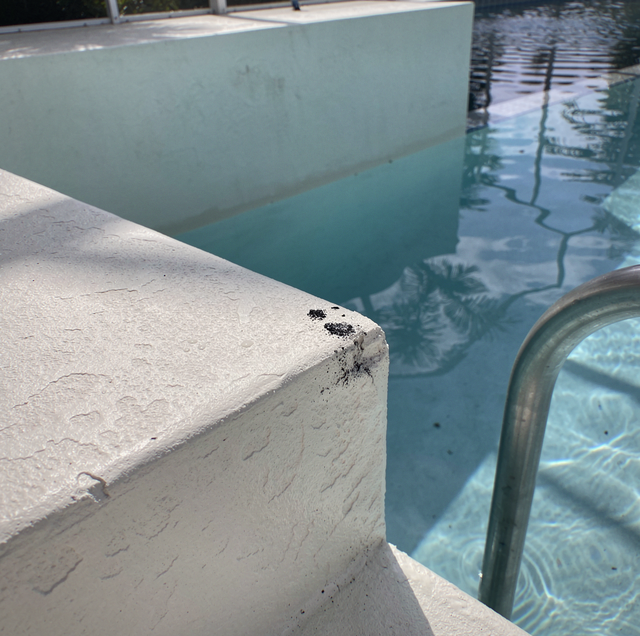
Black spots on your pool's plaster can look like dirt or mildew, so the instinct is to grab a brush and add extra chlorine, as you'd treat ordinary algae or a waterline ring. That instinct doesn't work here. Green or mustard algae rub off with a brush and clear within a day of shocking; a mineral stain lightens with the right chemical. Black spots resist both, no matter how hard you scrub or how much chlorine you add.
That's because black spots are algae rooted into the plaster itself, not sitting on top of it, which is why your normal routine can't reach it. Getting your water clear again means treating that colony where it lives, not just scrubbing what you can see.
Black Spots That Won't Brush Off Are a Different Organism
Black algae appears as small, dark green-to-black clusters that sit slightly raised above the plaster surface, usually in shaded corners, on steps, and behind ladders, where circulation is weakest. From a few feet back, it can pass for dirt ground into the finish or a shadow under the surface. If you run a fingertip over one, you'll feel the bump before you can see it clearly, a texture no ordinary stain has.
The test that separates it from everything else is simple: press a pool brush against a spot and drag it hard, the same motion you'd use on a patch of green algae. Ordinary algae gives way and clouds the water around it. Most mineral and metal staining lightens or smears under the same pressure. Black algae holds its shape and its color, because the part a brush reaches is only the outer layer of a much deeper structure.
A pool with a handful of spots that survive that test and a normal chlorine level is not looking at a cleaning problem it can out-scrub over a weekend. Add heat and heavy summer rain on top of that, both routine in a warm-climate backyard, and a colony that starts as three or four spots behind a ladder can spread across a whole wall section within a couple of weeks.
Unlike green or mustard algae, which often drift in on wind or rain runoff, black algae usually arrives a different way entirely: hitching a ride on a swimsuit, pool toy, or piece of pool gear last used in a lake, pond, or river. Rinsing anything that touched natural water before it goes back into the pool helps keep a new colony from ever getting a foothold.
You'll usually find the first spots in shaded corners, steps, and behind ladders, wherever water circulation runs weakest, well before they show up anywhere else around the pool.
What Clouds the Difference Between Black Algae and Ordinary Pool Staining?
Shaded steps and corners hide color the same way they hide everything else in a pool, so a homeowner glancing at a dark patch under low light has no easy way to separate algae from a mineral or metal stain without touching it. If you're checking it under the pool lighting after dark, you can miss the raised texture entirely and call it a stain at first glance.
Texture and pattern do more work than color. A stain from iron, copper, or manganese usually spreads as a smooth, flat smear that tracks the exact fitting, fill line, or ladder anchor the mineral is entering through. Black algae clusters instead in raised, irregular spots scattered across a surface with no nearby metal source, because it's spreading as a living colony rather than settling out of the water.
Because the two causes call for completely different fixes, sequestering a metal stain versus draining and acid washing a plaster shell, a technician confirms which one is actually present with a hands-on brush test and a look at the surrounding fittings before recommending either. Guessing from a glance across the yard is how a metal stain ends up treated like algae, or the reverse, and neither approach touches the problem that's actually there.
Black Algae Grows Roots Into the Plaster Itself
Ordinary green and mustard algae live entirely on the surface, a film sitting on top of the plaster that a brush and a strong chlorine dose can reach in full. Black algae is built differently. Beneath the visible spot, it sends root-like filaments into the pores of the plaster itself, anchoring the colony beneath the surface rather than on it. The part you can reach with a brush is only the cap sitting above that structure.
Plaster is a porous material, full of microscopic gaps left over from the curing process, and those pores give the filaments a place to lodge that a brush bristle can never enter. The layer a homeowner can see and scrub is only the visible tip of it. Beneath the surface, the organism sits protected inside the plaster itself, out of reach of anything applied from the outside.
What Clouds a Chlorine-Only Response to Black Algae?
Chlorine works by oxidizing organic material it comes into direct contact with, which means it clears whatever is exposed at the surface of the water and does almost nothing to whatever is shielded a few pores deep inside plaster. A normal shock dose, even a heavy one, oxidizes the exposed cap of a black algal colony while leaving the rooted structure underneath completely untouched.
That's what makes this organism look like it's responding when it isn't. The visible spot can fade or lighten for a few days after a shock treatment, because the surface layer really has been knocked back, and a homeowner reasonably reads that as progress. The roots below the surface stay unaffected, and the colony rebuilds its cap from underneath within a week or two, often in the exact same spot. Sustained summer heat keeps chlorine demand high, and the cycle repeats faster.
You can keep raising the chlorine level after that and still watch the same spot return, because the chemical still isn't reaching the part of the organism that's actually alive. Clearing black algae for good means reaching what's under the plaster surface, not adding more of what's already failing to get there.
Clearing Black Algae Means Draining the Pool and Acid Washing the Plaster
A technician typically starts with the same brush test described earlier to confirm that black algae is present rather than a stain, before recommending the full process. Once that's confirmed, the pool is drained, since the plaster has to be dry and fully exposed for the next step to reach the rooted colony, rather than just water sitting on top of it.
With the pool empty, the plaster gets an acid wash: dilute muriatic acid applied to the surface, scrubbed in by hand, and rinsed off, strong enough to strip the outer layer of plaster holding the algae's root structure and take the embedded colony with it. Getting that concentration and contact time right, without damaging the plaster underneath or the surrounding decking and equipment, is exactly the kind of process a pool owner isn't set up to do at home, which is the whole reason this is a licensed technician's job and not a weekend project. Because algae spores travel through the same water the circulation pump moves, the plumbing lines get a full flush before anything gets refilled, so spores sitting inside the pipes can't reseed the plaster the moment fresh water goes back in.
Acid washing uses concentrated muriatic acid strong enough to burn skin and eyes and release lung-irritating fumes, so a licensed pool technician handles this step, not the pool owner. Never try to dilute or apply muriatic pool acid yourself.
Skipping the plumbing flush is the most common reason black algae comes back within a season after an otherwise successful acid wash: the plaster gets treated correctly, but the pipes get overlooked, so the water refilling the pool carries the colony's spores right back onto the fresh surface. Warm, sunlit pool water keeps surviving spores from sitting dormant for long, so a wall that looked clear at the walkthrough can show a new spot within weeks.
The Treatment Runs in a Fixed Order From Drain to Refill
The sequence runs in a fixed order, and skipping ahead is the usual reason for a callback: assessment and the brush test first, then draining, the acid wash, the plumbing flush, refilling, and finally rebalancing the water chemistry. You'll see that same order reflected on the service invoice once the job is finished.
Start to finish, a job at this level typically runs five to ten days and more than one visit, not a single afternoon appointment, because draining, drying, washing, flushing, and refilling each need their own time before the next step can start. A pool that's fought the same black spots for more than one season is usually looking at exactly this sequence, not a bigger dose of the same chemical that already failed twice.
Frequently Asked Questions
Press a pool brush against one spot, as you would with ordinary algae. Most mineral and metal staining lightens or clears under that pressure, while black algae holds its shape, color, and slightly raised texture, since most of the organism sits below your surface, out of the brush's reach. A technician confirms it the same way during your assessment visit.
Chlorine only reaches what's exposed at the surface of your water, and black algae's root structure sits inside the pores of your plaster, where the chemical never makes contact. A shock dose can fade the spot you're watching for a few days, which can look like progress, but the colony underneath survives and rebuilds within a week or two in the same location.
Yes, once the brush test confirms it's really black algae in your pool. Acid washing the plaster, the step that removes the root structure, only works on a dry surface, so your water level has to come down below the affected area before your technician can start. Most jobs combine the drain with a plumbing flush in the same visit, since spores left in the pipes would otherwise reseed the plaster once your fill water is turned back on, undoing the work already done.
Most jobs take 5 to 10 days from your first visit to a fully refilled pool, and they require more than one appointment. Draining, drying your plaster, acid washing it, flushing your plumbing, refilling, and rebalancing your water chemistry each need their time, and rushing any of those steps gives the colony a chance to reestablish before your job is finished.
It can, most often when the plumbing wasn't flushed along with your plaster. Spores surviving inside your pump, filter, or pipe runs travel back into an acid-washed pool the moment it's refilled, seeding a surface that was otherwise clear. A full plumbing flush, along with your acid wash, is what keeps your treated pool from reseeding itself in the same season.
Swimming in your pool with a normal chlorine level and a few black spots isn't the same emergency as a true chlorine crash, since the organism stays anchored to the surface it's rooted into and not spreading through the water you're in. Treatment itself is different: once your pool is drained for an acid wash, there's no water to swim in, and the acid, its fumes, and the drained equipment make that work area one for a licensed technician, not you or your family, during the job. Once the plumbing is flushed, your pool's refilled, and the chemistry's rebalanced and tested clear, normal swimming picks back up again like any other refill.
Get a black algae assessment scheduled now — a technician runs the brush test, checks the plumbing, and lays out the drain, acid-wash, and flush sequence a confirmed case actually needs before another chlorine shock gets wasted chasing the wrong problem entirely. Dog Days Pools serves Clearwater and Pinellas County. CPC1460480. Call (727) 205-0566.
