
Where Your Pool's Water Is Actually Going
You have topped off the pool for the third week in a row, and the hose has practically earned a spot on the deck. The bucket test came back clear: the pool is dropping faster than a bucket of water sitting right beside it in the same sun. So it is not the weather. It is a leak. Now comes the part nobody enjoys: figuring out where a few gallons a day are actually going when the pool looks completely normal from where you stand.
That question has an answer, and it is more mechanical than mysterious. Pool water only has a handful of ways out once evaporation is off the table, and each one leaves its own kind of clue. Walking through them in order, from the surface down to the pipes buried under the yard, is how you go from "there's a leak somewhere" to "it's probably right here."
The Bucket Test Only Told You That, Not Where
A bucket test is good at one job: separating a real leak from ordinary evaporation. It cannot tell you which fitting, crack, or pipe joint is responsible, since a bucket on the steps has no way to sense what is happening at a skimmer throat or six feet underground. Once the test confirms a leak, the next step is to think of the pool as a system of connected parts, any one of which can fail on its own schedule.
That system breaks down into four general zones: the skimmer and its throat, the shell and tile line, the equipment pad, and the buried plumbing connecting all of it. Each fails differently and shows up differently in how fast the pool drops and what you notice around it.
The Skimmer Throat Is Often the First Place to Check
The skimmer is where many leaks start, and it is one of the easier spots to inspect without special equipment. The throat is the narrow neck where the skimmer basket housing meets the pool wall, usually built from a different material than the surrounding wall. That seam is a weak point by design. Ground settling, age, or a hard freeze somewhere in the plumbing's history can crack the throat or pull it slightly away from the shell, opening a gap that only shows itself once water is running past it.
A cracked skimmer throat tends to leak more with the pump running, since suction pulls water and sometimes air through the gap, which is why some owners notice a faint hissing or a few extra bubbles from the returns without ever seeing standing water. Because the leak sits right at the pool's edge, a soft or discolored patch of decking near the skimmer, or grass that stays a shade greener right beside it, is often the first visible sign before anyone finds the crack itself.
Structural Cracks Show Up as a Level That Stops Dropping
Cracks in the shell or along the tile line behave differently than a skimmer leak, and that difference is a useful clue. A crack in the plaster, gunite, or tile grout only lets water out down to the height of the crack. Once the water line drops below it, the leak stops, since nothing is left above the opening to push through. A structural leak often shows up as a pool that drops noticeably, then stabilizes at a new, lower level rather than continuing to fall.
Finding one usually starts with a visual pass around the waterline and the deck: hairline cracks in tile grout, a step or bench edge that feels rough or hollow, or a soggy strip of ground where the shell meets the surrounding soil. None of these guarantee a leak on their own, since older plaster develops cosmetic cracking that never lets a drop out, but a crack paired with a stalled water level and a nearby soft spot in the ground is worth a closer look.
The Equipment Pad Hides Leaks in Plain Sight
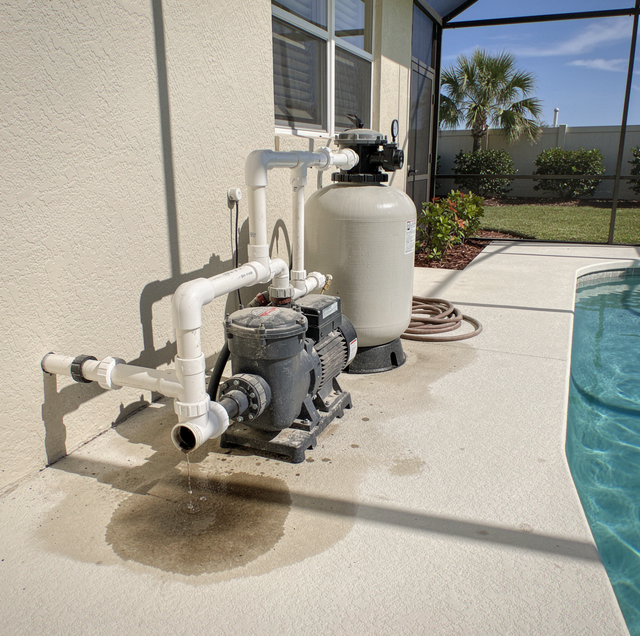
Walk past the pump, filter, and valves enough times, and you stop really looking at them, which is exactly how an equipment pad leak goes unnoticed for weeks. The pad is a cluster of fittings, unions, gaskets, and O-rings, and any one of those connection points can weep instead of holding. Unlike a skimmer or shell leak, water lost here often never reaches the pool at all, so the level drops with no obvious explanation, since the loss is occurring a few feet away, not inside the shell.
Picture the pad as a length of garden hose made from several shorter pieces. Each coupling holds fine under normal pressure, but age, sun exposure, or a gasket gone slightly brittle turns any one of those joints into a slow drip. A puddle that forms only when the pump is running, a damp patch under the filter tank, mineral crust building around a union, or a pump that gradually loses its prime all point to the pad rather than the pool. Because the filter, pump, and any heater or salt system valves come together at this cluster of fittings, a leak on the equipment pad can also throw off pressure gauge readings, making a filter problem look like the source of loss that is really coming from a fitting nearby.
Underground Joints Are the Hardest to Find
The toughest leaks to pin down sit in the pipe runs buried between the equipment pad and the pool. These lines carry water under pressure on the way out to the returns and under suction on the way back from the skimmer and main drain, and every joint along that run, glued or threaded, is a potential failure point. A joint that separates slightly, or a line that splits from ground shifting or a root pressing against it, can leak steadily with nothing visible above ground except maybe a patch of unusually lush grass or a slightly sunken spot in the lawn tracing the pipe's path.
With no crack to see and no fitting to inspect by eye, these leaks usually need equipment rather than a walk-around: pressurizing the lines and checking for a drop, or listening for the sound water makes as it escapes from a pipe underground. That is where guessing stops being useful and locating the exact spot becomes a job for someone who does this daily.
How a Leak Detection Visit Actually Narrows It Down
A proper leak detection visit works through these zones in roughly the order above, since ruling out the easy answers first saves time on the harder ones. A visual inspection of the skimmer, returns, light niche, and visible shell comes first, because a surface leak found by eye needs no further testing. Dye testing follows for suspected fittings: a small cloud of dye released next to a skimmer throat, return, or crack gets pulled into a real gap in a thin, steady stream, confirming or ruling out that spot in seconds. Pressure testing the plumbing lines isolates each run and checks whether it holds pressure over time, separating a suction-side problem from a pressure-side one. Listening equipment finds the sound of water escaping underground when nothing else has turned up an answer.
Working in that order stops the pool from being opened up in the wrong place. Digging near the equipment pad when the real leak is a skimmer throat crack means paying for a repair that never touches the problem, and the pool keeps dropping right afterward.
What the Season Does to the Picture
A pool that runs and gets swum in every month of the year takes on more wear at its seals, valves, and plumbing joints than one that sits idle for half the year, simply because more running hours and more use mean more chances for a gasket, O-ring, or fitting to reach the end of its life. That is part of why leak detection stays relevant even outside any obvious crisis: a system under near-constant load ages at its weak points faster than one that gets a long rest each year.
Weather adds its own static to the reading. A heavy bout of rain can pour enough water into the pool to mask an active leak for a few days, since the level holds steady or even rises while the leak continues draining beneath the rainfall. And in a humid climate with hard water, mineral scale builds up around fittings, valves, and the salt cell housing in a way that can look like the source of a wet spot or a stubborn drip, when the real leak is a seal just behind that crust. Scrubbing the scale away without checking what sits underneath it can leave the leak untouched.
None of that changes what the leak needs: tracing it back through the same four zones and confirming the source before anything gets repaired. A pool that keeps dropping after the bucket test says it should not be is not a mystery so much as a system with one weak point somewhere between the skimmer and the buried lines, waiting to be found.
Frequently Asked Questions
Yes, in a way that's often blamed on chemicals rather than water loss. Water leaving through a leak takes dissolved salt, chlorine, and stabilizer with it, so a salt system may show a lower salt reading than expected, or chlorine may seem to disappear faster than usual, even though the real cause is that treated water is leaving the pool and being replaced with untreated fill water. If chemical balancing keeps sliding for no clear reason, a leak is worth ruling out alongside the usual chemistry checks.
They can, because a pressure-side leak in the plumbing or at the equipment pad only loses water while the pump pushes water through that section. A schedule with shorter cycles, or an automation system that varies pump speed throughout the day, changes how many hours the leak is active, which can skew day-to-day comparisons if run times differ between them. Keeping the schedule consistent for a few days makes the comparison more reliable.
A heater's plumbing unions are worth checking on their own. The metal in a heat exchanger expands and contracts with every cycle, and that movement can gradually work a nearby union or fitting loose even when the heater itself is working fine. A damp spot near the heater, separate from the rest of the pad, points toward one of those connections rather than the heater's internal parts.
It does. A plastered or gunite shell tends to leak at cracks in the plaster or along tile grout lines, the joints in an otherwise solid surface. A vinyl-liner pool leaks differently: water finds its way through a puncture or a loose fitting behind the liner, then travels between the liner and the wall before it shows up anywhere, which can make the wet spot appear far from the actual hole. Fiberglass shells rarely crack, so a fiberglass pool losing water points more often to the plumbing or the pad than to the shell.
It does, and the difference is useful for narrowing things down. A leak below the current waterline, such as one in the skimmer or a submerged return fitting, will continue as long as the pool stays full enough to reach it. A leak just above the current water line, on the other hand, only starts draining once the pool is topped off high enough to reach that spot again, which can make water loss seem to slow down or stop partway through a top-off cycle, then pick back up once the level rises past it.
Running the bucket test again a few days after the repair is worth doing, because pools with one aging leak sometimes have a second one that was masked by the larger loss. If the pool still drops faster than the bucket once the known leak is closed, that points to a separate spot rather than a failed repair, and it is far easier to trace with the bigger, more obvious leak already out of the picture.
Schedule a professional leak detection visit — get your pool's water loss traced to its actual source instead of guessing. Dog Days Pools serves Clearwater and Pinellas County. CPC1460480. Call (727) 205-0566.
