

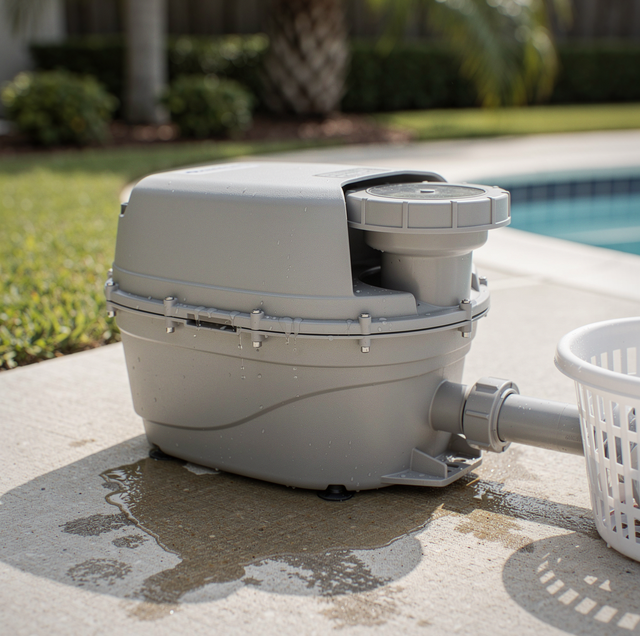
A pool pump is designed to move water without ever allowing it to reach the motor's electrical side. A drip at the seam where the motor bolts to the wet end, with the lid, plugs, and fittings above it dry, points to the seal that sits at that junction breaking down. Figuring out which part failed and how far the water has already traveled determines whether the pump needs a small internal swap or a full replacement.
The Shaft Seal and Where It Sits
Every pool pump pairs a wet end (the volute and impeller, the parts that move water) with a motor that spins the shaft driving that impeller. The shaft passes from one side to the other through a single opening, and that opening is where the mechanical shaft seal lives: a spring-loaded assembly with two flat faces, one fixed to the shaft and spinning with it, the other stationary and fixed to the housing, pressed together under constant spring tension. Those two faces ride against each other in a microscopically thin film of water, and as long as they stay flat, clean, and pressed together, no water crosses from the wet end into the motor.
The housing around that seal is built with a small opening just below it, a weep hole, there to let any water that does get past the seal drain outward and downward rather than collect inside the motor housing. A drip appearing at the underside of the motor, right where the wet end bolts to it, is that weep hole doing exactly what it was built to do: showing you the seal has started to fail before the leak turns into something bigger.
Why a Failed Seal Drips at the Motor End
The seal faces wear from three separate directions. Age and constant spinning slowly polish and pit the faces until they no longer seat flat against each other. Grit fine enough to slip past the pump basket can score a groove across a face. And a pump started before it's fully filled with water spins those faces against each other with no film between them, which can generate enough friction heat in seconds to crack the ceramic seat or scorch the rubber boot around it.
Water pooling around a running motor sits next to live electrical connections. Shut the breaker off before you touch the pump, and leave the wet-end teardown and seal swap to a pool technician rather than opening the housing yourself.
Any one of those three failure paths leaves a gap the spring can no longer close, so water finds that gap continuously rather than only under pressure spikes. Because the seal sits at the exact boundary between the wet end and the motor, and the weep hole is built into the motor-side housing just below it, a failing seal is the failure that shows up specifically as a drip at the seam where the motor bolts to the wet end, not higher up on the pump lid or lower at a pipe joint.
What Water Reaching the Motor Bearings Does
A weep hole buys time, but it isn't a permanent drain. Once a seal is worn enough to allow a steady trickle rather than an occasional drop, some of that water passes through the weep hole and into the motor housing itself, reaching the bearings that support the spinning shaft. Bearings are precision metal parts that ride on a thin lubricant film and were never built to sit in water. Once water reaches them, the metal starts to rust from the inside, and rust turns a smooth bearing race into a rough one.
The pump keeps running, but the shaft now turns against that rough surface, which produces a grinding or gritty noise. Left running long enough, the bearing seizes, or wears enough play that the rotor drags against the stator, and the motor overheats or stops. A seal caught early, before the drip has had time to reach the bearings, stays a contained repair. One that's been dripping long enough to rust a bearing turns the job into a bearing replacement or a motor replacement, not a seal swap alone, since a new seal pressed against a shaft riding on damaged bearings will not hold.
Telling a Seal Drip from a Leaking Fitting, Lid O-Ring, or Drain Plug
Not every drip at the equipment pad traces back to the shaft seal, and where the water shows up points to which part is failing.
| Where the water shows up | What's likely failing | What decides the fix |
|---|---|---|
| Directly under the motor, at the seam where it bolts to the wet end | The shaft seal | Seal replacement, or a bearing or motor swap if bearings have already rusted |
| Around the clear pump lid, at the top of the housing | The lid O-ring, dried or seated wrong | Clean and reseat it, or replace the O-ring |
| At the base of the pump housing, at one of the small drain plugs | A drain plug O-ring, dried and cracked | Replace the plug O-ring |
| Along a threaded pipe joint feeding into or out of the pump | A loose fitting or dried thread sealant | Re-tighten or reseal the joint |
On some systems, the drain plugs and lid O-ring sit on a section held under negative pressure whenever the pump is running, which makes them a more common source of air pulled into the plumbing than water pushed out, a separate diagnosis from a seal that leaks water from the moment it starts failing. A pipe joint leak can leave a wet trail running away from the pad along the pipe, rather than a puddle centered directly beneath the motor.
How Long It Can Run (It Shouldn't Be Left Dripping)
A new seal can weep a few drops while its faces seat, then stop on its own. A drip that continues past that settling period, or one that starts on a seal that's been in service for years, is not something to leave running while you decide what to do. Every additional hour the pump runs with a compromised seal is another hour water has a path to the bearings, and catching the leak early rather than late can be the difference between replacing a small internal part and replacing the whole motor.
With the breaker off, wipe the seam where the motor meets the wet end dry. Run the pump one short cycle, switch the breaker off again, then look: a wet seam, with the lid and plugs dry, points at the shaft seal.
Cutting power at the breaker and having the pump checked promptly, rather than letting it keep running while the puddle grows, is the choice that keeps a seal failure a small repair instead of a motor replacement.
Seal Replacement vs. a Motor or Pump Replacement, and What Decides It
A seal replacement means opening the wet end, which is technician work rather than a homeowner repair. Once the seal is replaced and the housing is clean and dry, the pump with an otherwise sound motor and wet end returns to normal service.
Two conditions push the repair from a seal swap toward a motor or full pump replacement instead. The first is bearing damage: if water reached the bearings before the leak was caught, a technician checking the shaft will feel roughness, resistance, or play instead of a smooth, quiet spin, and a rusted bearing set is not something a new seal alone fixes. The second is the age and condition of the rest of the pump; a motor that's already old, or a housing that's cracked or corroded from long exposure to the leak, can make replacing the whole pump the more sensible call rather than putting a repair into equipment that's failing on other fronts too. A technician who opens the pump can check both in one visit and tell you which category the leak falls into before any parts are ordered.
Frequently Asked Questions
No. The mechanical seal holds its two faces together with spring pressure built into the assembly itself, not with a bolt or hose clamp a person can adjust from outside the housing. Nothing on the outside of the pump changes how hard those internal faces press together, so a drip from a worn seal keeps happening no matter how tightly the housing bolts are torqued.
Yes. Shaft seals are sized to a specific shaft diameter and seat depth, and a seal built for a different pump model can seat at a slightly different height inside the housing. A seal for a different shaft size or seat depth will not compress to the right spring load, so it can leak from the first start.
It can. The faces of a mechanical seal are typically hard ceramic discs running against softer carbon discs, and water that is left too acidic or contains undissolved chlorine can etch and pit the ceramic face over time. Once that face is pitted, it no longer seals evenly even though the spring behind it is still pressing at full strength.
No. Surface rust on the outside of a motor housing is cosmetic, but if water reached the windings or bearings before the leak was caught, drying the outside does not undo damage that already happened inside. A technician checking a motor after a leak can run an insulation resistance test on the windings, a reading that shows whether moisture has degraded the wire coating enough to risk a short, rather than judging the motor by how dry it looks from outside.
Yes, and that pattern can point to a seal that's marginal rather than fully failed, or to a fitting that leaks only when the pump stops or starts. A seal near the end of its life can hold a thin film between its faces during steady running, then lose that film and start dripping when the pump cycles on and off or changes speed. Intermittent dripping is not a reason to wait it out. It can be the early stage of the same failure that later becomes constant.
A completely dry base is normal for a healthy pump, but a seal is designed to run with a microscopically thin film of water between its faces, so a very light dampness, with no visible drop or pooling, can be within normal operation on some units. Dampness confined to a small area right under the motor bolts, rather than spread across the whole base, is the pattern that points to the seal, since a splash or spill from work at the pad wets a wider area instead. Any standing water or active drip at that seam, with the lid, plugs, and fittings above it dry, means the seal has shifted from its normal thin film to an actual leak.
Book a shaft-seal repair while the water still drains out the weep hole — a technician opens the wet end, replaces the seal and checks the bearings for play. Dog Days Pools serves Clearwater and Pinellas County. CPC1460480. Call (727) 205-0566.