
How Long to Run Your Pool Pump: The 1-Turnover Rule
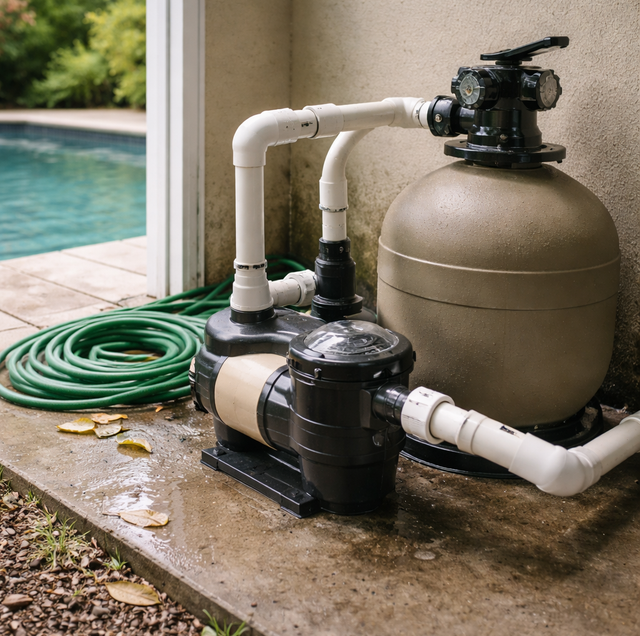
Quick Answer: As a rule of thumb, run the pump long enough to move all your pool water through the filter about once a day, which lands near 8 hours for a typical residential pool. The exact number depends on your pool's volume, your pump's flow rate, and how hard the pool is being used.
Ask ten pool owners how long they run the pump, and you will get ten different answers, most of them guesses. The honest answer is that the clock matters far less than the water. Your pump has one core job: to push the entire volume of your pool through the filter often enough to keep the water clean, mixed, and moving. Once you understand how much water your pump actually handles, the daily hours stop being a mystery and start being simple arithmetic.
Turnover Is the Number That Actually Matters
Every runtime recommendation traces back to one idea called turnover: the time it takes to circulate a volume of water equal to your entire pool through the pump and filter once. It is a measure of water, not hours.
The math is short. Take your pool's volume in gallons and divide it by your pump's flow rate in gallons per minute (GPM), then convert to hours.
A Quick Turnover Example: Say your pool holds 20,000 gallons and your pump moves 50 gallons per minute. That is 3,000 gallons per hour. Divide 20,000 by 3,000, and you get roughly 6.7 hours to move one full pool's worth of water. That figure is your turnover time, and one full turnover a day is the baseline most residential pools aim for.
Two pools with the same gallon count can need very different runtimes if one has a stronger pump. That is why a flat "run it 8 hours" tip works for some pools and leaves others cloudy. The gallons and the flow rate set the target; the clock just follows.
Why Circulation Matters More Than You Think
Standing water is a problem waiting to happen. When water moves, it does three jobs at once.
It spreads your chemistry: Chlorine and other treatments only protect the water they reach. Circulation carries sanitizer into every corner instead of letting it pool near the return jets while dead zones go unprotected.
It filters out what you cannot see: Fine dust, pollen, sunscreen residue, and microscopic debris ride the current to the filter, where they get trapped. No flow means no filtering.
It denies algae a foothold: Algae love still, warm, untreated water. Constant motion plus circulated sanitizer keeps spores from settling long enough to bloom. Skip circulation for a couple of warm days, and you can watch the water turn from clear to hazy to green.
Think of the pump as the pool's heartbeat: when it stops for too long, everything downstream starts to suffer, quietly at first, then all at once.
The Factors That Move Your Number Up or Down
The one-turnover baseline is a starting point, not a fixed rule. Several things push your ideal runtime higher or lower.
Pool Volume and Pump Strength: A bigger pool needs more running time to complete a turnover; a stronger pump needs less. Pump horsepower and the plumbing it pushes through set the real flow rate, which is often lower than the sticker number once you account for filters, heaters, and pipe friction.
How Hard the Pool Gets Used: Bather load matters more than people expect. A pool hosting a weekend full of swimmers picks up body oils, sunscreen, and debris that all demand more filtration. A quiet week with the cover on demands less.
Debris, Weather, and Heavy Days: After a storm rolls through and drops leaves, dust, and runoff into the water, extra runtime helps the filter catch up and helps sanitizer recover from the dilution. The same goes for a pool ringed by shedding trees. On calm, low-use stretches, you can ease back.
Warm Stretches Versus Cool Ones: Heat and strong sun burn off sanitizer faster and speed up biological growth, so warmer, high-use periods call for longer runtimes. During cooler, low-use stretches when the water is cold and few people are swimming, the same pool can hold clear on noticeably less. Adjust with the conditions rather than setting one number and forgetting it.
Single-Speed Versus Variable-Speed Pumps
The kind of pump you own changes how you should think about runtime.
A single-speed pump runs at one fixed, high speed whenever it is on. It hits your turnover quickly but draws a lot of power the entire time, so owners tend to run it in short, concentrated blocks.
A variable-speed pump can slow down, and that changes the whole strategy. Running at a low speed moves less water per minute, which means it needs more hours to reach a full turnover, but it uses dramatically less energy at that reduced speed and runs far quieter. Many owners of variable-speed pumps run them many hours a day at a gentle, low RPM, which keeps the water in near-constant motion while sipping power. Longer runtime at low speed often costs less to operate than a short blast at full speed, and the steady circulation tends to keep water clearer.
One Long Run or Several Short Cycles
You do not have to complete your turnover in a single unbroken block. Splitting the daily runtime into two or three cycles spread across the day keeps water from sitting still for long stretches, which helps sanitizer distribution and discourages algae during the gaps.
A single long run is simpler to set and fine for many pools, especially with a variable-speed pump humming along for extended hours. Split cycles shine when a pool sees heavy afternoon use or when you want circulation during the warmest part of the day. Either approach works as long as the total daily runtime still adds up to at least one full turnover.
Split the daily runtime into two or three cycles across the day so the water never sits still for long. The shorter gaps help sanitizer spread evenly and give algae less chance to settle, as long as the total still adds up to at least one full turnover.
Timing Runs for Lower Energy Use: Electricity often costs less during off-peak hours, typically overnight and outside the late-afternoon peak. Scheduling part of your runtime into those windows trims operating cost without shortchanging the water. A timer or the pump's built-in scheduler makes this automatic, so the pump does its work when power is cheapest, and you never have to think about it.
Signs You Have the Runtime Wrong
Your water will tell you long before a chart does.
Signs of under-circulation show up as cloudy or dull water, a filter struggling to clear haze, chlorine that reads fine in the morning but vanishes by afternoon, and algae appearing on walls or in shaded corners. Poor chemical hold, where sanitizer disappears faster than it should, is one of the earliest tells that water is not moving enough.
Signs of over-running are quieter but real. If the water stays crystal clear on far less runtime and your energy use is high, you may be paying to circulate water that is already turned over. There is no water-quality penalty for a little extra circulation, only a cost one, so trimming back gradually while watching clarity is the smart way to find the floor.
The goal is the shortest runtime that reliably keeps the water clear, the chemistry stable, and the surface free of algae. Find that number by adjusting a little at a time, not by guessing.
A Note on Safety: A pump should never run dry or against a clogged, air-locked line; losing prime can overheat the pump and destroy the seal. Always cut power at the breaker before opening the pump basket or clearing a skimmer, since electricity and water together are a serious shock hazard. Pump wiring, motor replacement, and any electrical repair are jobs for a licensed pro, not a weekend fix. And for anyone swimming, a working suction-entrapment-safe main drain cover is not optional; it is a core safety feature that protects against dangerous suction at the drain.
Always cut power at the breaker before opening the pump basket or clearing a skimmer, since electricity and water together are a serious shock hazard. A pump should never run dry or against a clogged, air-locked line, because losing prime can overheat the pump and destroy the seal.
Frequently Asked Questions
It keeps water in constant motion, but past one full turnover the water-quality gains flatten out while energy use keeps climbing. The exception is a green-pool recovery or the aftermath of a storm, when running continuously for a day or two helps the filter and sanitizer catch up. For everyday maintenance, a well-set schedule that hits your turnover does the same job for far less power.
Use the real, in-system flow rate, not the pump's rated maximum on the box. Filters, heaters, elbows, and pipe friction create resistance that drops actual flow, sometimes by a fifth or more. A pool pro can read it from a flow meter or estimate it from your filter's pressure gauge and plumbing, which gives you a turnover figure that reflects your pool rather than a lab bench.
Yes. Running during active swimming pulls introduced contaminants like sunscreen and body oils to the filter while sanitizer is being consumed fastest. The only time to briefly pause is if suction near a drain or skimmer feels strong to a swimmer, which is a signal to check that the drain cover is intact and compliant before anyone gets back in.
It can let you trim runtime slightly. A cover cuts evaporation and blocks some sunlight, which slows chlorine burn-off and reduces the debris landing in the water, so the pool stays balanced on a little less circulation. Pull the cover back periodically, though, since trapped water under a covered, low-circulation pool can still develop problems if flow drops too far.
Warmer water accelerates both sanitizer consumption and algae growth, so a heated pool generally needs a bit more circulation than the same pool left unheated. If you run a heater, keep the pump running for a stretch after the heater shuts off so residual heat clears the equipment rather than sitting in the plumbing.
Yes, and many owners do exactly that. A common approach is long hours at a low, efficient speed for steady circulation, plus a short high-speed burst timed for vacuuming, running a cleaner, or backwashing the filter when stronger flow is truly needed. The low-speed hours handle everyday turnover while the high-speed window covers the tasks that demand real muscle.
Not sure your pump is turning the water over enough — let us dial in the right schedule and keep your water clear. Dog Days Pools serves Clearwater and Pinellas County. CPC1460480. Call (727) 205-0566.
