
Why Does Pool Water Burn Swimmers’ Eyes Even When Chlorine Is Normal?
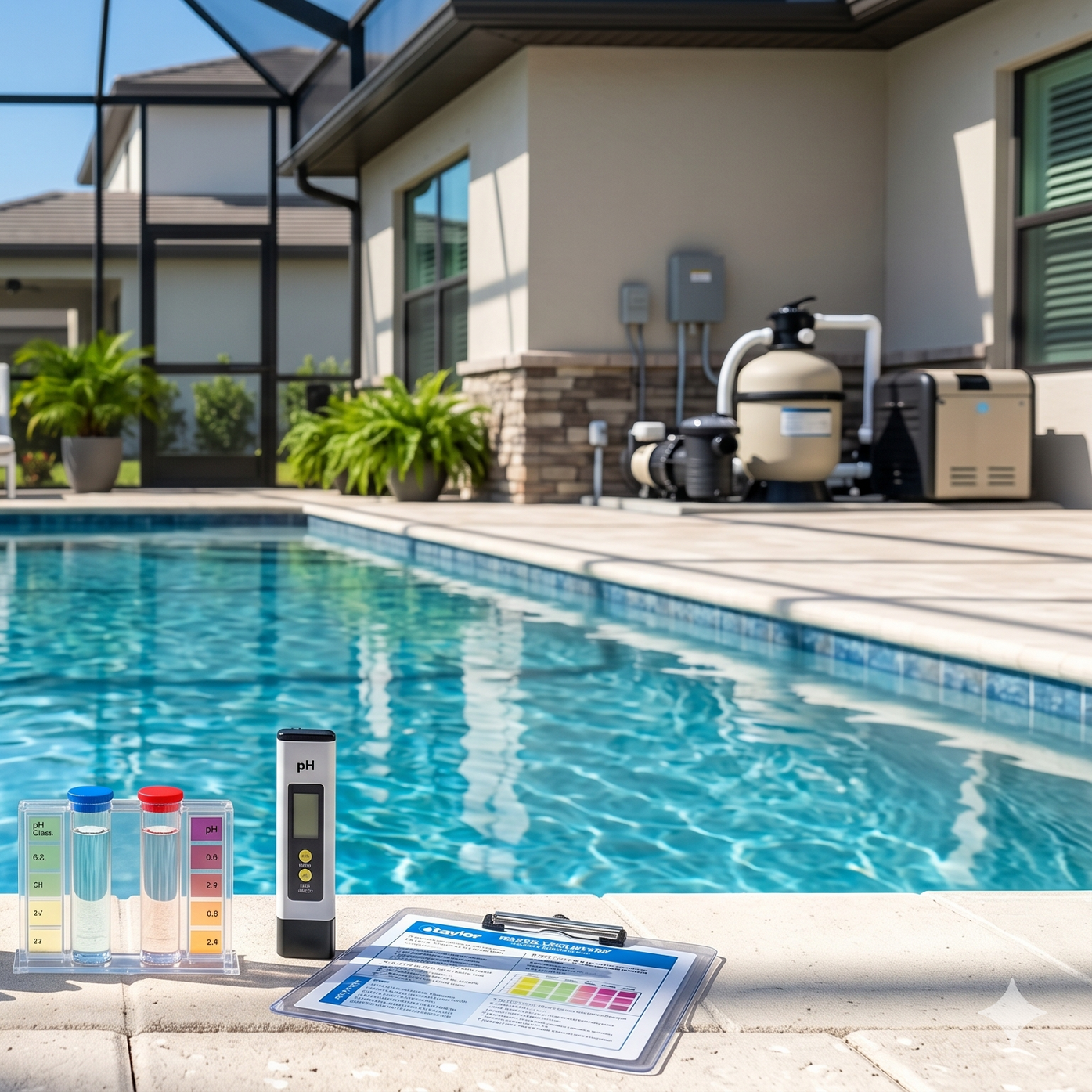
You get out of the pool, your kids are rubbing their eyes with their towels, and everyone's blinking like they walked through smoke. You grab the test strips. The chlorine reads fine — right in the middle of the target range. So what's burning them?
This is one of the most common complaints pool owners hear, and one of the most misread. The instinct is always to blame high chlorine, but chlorine by itself — at normal swimming concentrations — doesn't cause that sharp, prolonged eye burn. The chemistry is more specific than that.
Why "Normal Chlorine" Doesn't Tell the Whole Story
A free chlorine reading between 1 and 3 ppm is what most pool owners are testing for, and most home test strips are designed to show exactly that number. What they don't show is how that chlorine is distributed — whether it's free and available to sanitize, or whether it's already reacted with contaminants and become something else entirely.
That "something else" is the real culprit in most cases of eye irritation.
When free chlorine reacts with ammonia-based compounds — sweat, body oils, sunscreen residue, urine — it forms chloramines. These are chlorine compounds that have already been used up. They can't sanitize, but they do irritate. And because your test strip reads total available chlorine rather than breaking it down, a pool with a serious chloramine problem can still show a reading that looks perfectly acceptable.
This is why a homeowner can add chlorine, watch the number climb to 2.5 ppm, and then have swimmers complain about stinging within minutes. The number is "normal." The water isn't.
The Four Sources of Eye Irritation — Ranked by How Often They Show Up
| Cause | What the Test Strip Shows | What It Won't Tell You |
|---|---|---|
| Chloramines (combined chlorine) | Normal free chlorine reading | That combined chlorine is high |
| pH too low | Chlorine looks fine | That water is acidic and pulling moisture from eye tissue |
| pH too high | Chlorine looks fine | That chlorine effectiveness is impaired and water is alkaline |
| High CYA (cyanuric acid) | Chlorine reads present | That the chlorine is chemically bound and inactive |
Chloramines- This is the most common cause by far. Human tears sit at a pH of roughly 7.4, and they contain a natural buffering layer that protects the cornea. Chloramines break through that layer in a way that free chlorine at normal levels doesn't. Monochloramine — the most common form — is a direct irritant to the mucous membranes around the eye. It's also responsible for the strong chemical smell most people associate with "too much chlorine." That smell is a diagnostic signal: a well-balanced pool with properly maintained free chlorine and minimal bather waste has almost no odor. The sharp pool smell means chloramines are present in quantity.
pH out of range- The acceptable pH range for a swimming pool runs from 7.2 to 7.8, but the comfortable range for swimmers is tighter than that: 7.4 to 7.6. Human tear fluid sits right at 7.4 to 7.5. When pool water drops below 7.2, it becomes acidic enough to pull moisture from the cornea's outer layer, triggering redness and a burning sensation within a few minutes. When pH climbs above 7.8, alkaline mineral load in the water starts to irritate — and as a bonus, chlorine works progressively worse above that threshold, which allows contaminants (and chloramine formation) to accelerate.
High cyanuric acid- CYA stabilizes chlorine against UV breakdown — it's a necessary part of an outdoor pool's chemical program, especially in Florida. But it builds up in the water over time and has no natural outlet except dilution. When CYA climbs above 80 to 100 ppm, it ties up a large portion of the free chlorine in a chemically bound state. The test strip reads "2 ppm" because the chlorine molecules are there — they're just not available to work. The pool behaves like an under-chlorinated system while reading like a balanced one, and that breakdown in sanitation allows bather waste to build up unchecked.
Alkalinity swings- Total alkalinity is the buffer that keeps pH from swinging around. When alkalinity drops below about 80 ppm, pH becomes unstable — it can drop significantly after rainfall or a heavy swim session. A reading taken on a Monday might show pH at 7.5; by Thursday after an afternoon storm and a pool party, it could be at 7.0. Irregular pH is harder to detect than steady low pH, because the test might catch it in range while swimmers are dealing with the swings in between.
The Test Your Home Kit Probably Isn't Running
Standard residential test strips and 3-way kits measure free chlorine, pH, and total alkalinity. That's enough for routine maintenance checks. It's not enough to diagnose an eye irritation complaint, because it tells you nothing about combined chlorine.
To find out whether chloramines are your problem, you need a kit that shows both free chlorine and total chlorine. The difference between those two numbers is your combined chlorine reading. Any combined chlorine reading above 0.2 ppm is detectable by sensitive swimmers; above 0.5 ppm, you'll get consistent complaints. The Taylor K-2006 is the standard diagnostic kit for residential pools — it tests free and total chlorine, pH, alkalinity, calcium hardness, and CYA, which gives you a complete picture rather than just the top-line numbers.
A combined chlorine reading above 0.5 ppm warrants a breakpoint chlorination shock. To break the chloramine bond, free chlorine needs to reach roughly 10 times the combined chlorine level — typically 1 to 3 lbs of calcium hypochlorite dissolved in a bucket and added to the pool with the pump running.
Why Florida Summers Push This Problem Harder
Florida pools collect more bather load per hour than pools anywhere north of the Carolinas. In August in Clearwater, swimmers arrive already perspiring, layered in waterproof sunscreen, and spend three to four hours in the water at a stretch — because the heat doesn't let up the way it does in a northern evening. Every body entering the pool brings nitrogen compounds that react with free chlorine to form chloramines. A pool serving eight people on a Florida summer afternoon is producing chloramines at a rate that the same pool would never see in March.
Florida's UV intensity also degrades free chlorine faster than in temperate climates — typically two to four times faster in peak summer, even with stabilizer present. This creates a scenario where chlorine is being consumed quickly from two directions at once: UV breakdown from above and bather-waste reactions from below. A pool that's balanced at 9 a.m. can be chloramine-heavy by 3 p.m. if the pump isn't running adequate hours or the shock schedule hasn't been adjusted for summer.
How to Work Through the Fix
Start with pH. It's the most frequent single cause and the quickest thing to confirm. Use a drop-based kit rather than strips for accuracy — strips drift in high humidity and shouldn't be used as a diagnostic tool. If pH is below 7.4, raise it with sodium carbonate (pH increaser). If it's above 7.6, bring it down with sodium bisulfate (pH decreaser). Run the pump for 30 minutes and retest.
If pH is correct, test combined chlorine. Subtract your free chlorine reading from your total chlorine reading. If the combined chlorine is above 0.5 ppm, shock the pool at breakpoint chlorination levels — enough to drive free chlorine to 10 times the combined reading. Keep the pump running for 12 to 24 hours, avoid swimming until free chlorine returns to below 3 ppm, and retest combined chlorine before letting anyone back in.
If combined chlorine returns within a few days of shocking, or if shock treatment isn't holding, the issue may be inadequate pump run time, a phosphate load driving algae-adjacent contamination, or CYA high enough to impair chlorine effectiveness. At that point, a full-panel water test will show where the chemistry is actually breaking down.
Frequently Asked Questions
That smell is chloramines, not free chlorine. A pool with well-balanced chemistry and adequate free chlorine has little to no odor — the active chlorine is doing its job quietly without producing irritating byproducts. The sharp chemical smell you associate with a public pool is a sign that chloramines are present in significant quantity, which usually means the pool needs a shock treatment, not more chlorine added on top.
Occasional mild irritation isn't a medical emergency, but it's a signal that the chemistry is off and needs attention. Repeated exposure to high chloramine levels can irritate the respiratory tract — particularly in a screened enclosure where vapor concentrates above the surface. If burning persists more than an hour after leaving the water, or if vision is affected, an eye doctor visit is the right call.
Free chlorine is the sanitizing form — the chlorine molecules available to kill bacteria and break down organic waste. Total chlorine is free plus combined. Combined chlorine is chlorine that has already reacted with contaminants, is no longer able to sanitize, and is the primary source of eye and respiratory irritation. Most home test kits only measure free chlorine, which is why a pool can test "fine" while swimmers are still being irritated.
Twice a week at minimum during peak summer, and after any event that disrupts the chemistry — a heavy rain, a large swim party, or a period where the pump wasn't running its full daily hours. Florida afternoon storms are slightly acidic and also dilute total alkalinity, which makes pH swing more freely for the next day or two. Testing more frequently during the rainy season — June through September — keeps you ahead of those swings.
High CYA doesn't irritate eyes directly. Its effect is indirect: by binding up free chlorine, it allows the pool to behave as though it's under-chlorinated even when the test strip reads normal. That shortfall in active sanitation lets bather waste accumulate, which drives chloramine formation, which causes the irritation. If pH and combined chlorine both test correctly but problems persist through the season, test CYA. Above 100 ppm, partial draining and refilling is the only practical correction — there's no chemical that removes excess stabilizer.
The fluctuating nature of chloramine buildup explains most of this. Bather load, heat, and time since the last shock all affect how quickly chloramines accumulate. A pool used heavily on Saturday with no shock that weekend may irritate on Sunday but test fine by Tuesday after running the pump and the chemistry stabilizing. Tracking test results alongside swim days often reveals the pattern — and points toward whether the fix is a more frequent shock schedule, longer daily pump run time, or both.
Red eyes and burning skin after swimming aren't a chlorine problem — they're a chemistry problem, and the right test will tell you exactly where to look. In most cases it comes down to pH sitting outside the comfortable range, combined chlorine building up faster than the routine maintenance schedule can clear it, or CYA climbing high enough to quietly undermine the whole chemical program. All three are fixable when you know which one you're actually dealing with.
Dog Days Pools offers professional pool chemical maintenance and balancing in Clearwater, Safety Harbor, Dunedin, Palm Harbor, and surrounding Pinellas County communities. For chronic eye irritation, persistent cloudiness, or chemistry that won't hold, our team provides accurate on-site diagnostics and same-visit treatment. For routine pool maintenance or an urgent pool repair, call (727) 205-0566.
