

Sand vs Cartridge vs DE: The Right Pool Filter
Quick Answer: Sand is the simplest and most forgiving but filters the coarsest (~20-40 microns). Cartridge filters finer (~10-20 microns), skips backwashing, and pairs well with variable-speed pumps. DE filters the finest (~1-5 microns) for the clearest water, but asks the most upkeep. Pick by the clarity you want, the maintenance you'll actually do, and how much water you're willing to send down the drain.
Every pool filter does one job: removing suspended dirt, dead algae, sunscreen oils, and fine grit from the water before the pump sends it back to the pool. What separates the three common types is *how fine* they strain and *what they ask of you* in return. Get that trade wrong, and you end up either fighting cloudy water all season or wasting hours and gallons chasing a level of clarity you never needed.
Here's the mechanism behind each one, and how to read your own pool to land on the right choice.
How Each Filter Actually Works
A filter is a tank that the pump pushes water through. Inside that tank sits the media, and the media is the whole story.
Sand filters hold a bed of specially graded filter sand. Water enters the top, works down through the bed, and the jagged sand grains trap debris in the gaps between them as it passes. Clean water collects at the bottom and returns to the pool. Over days of running, trapped dirt fills those gaps, pressure climbs, and flow drops. You clear it by *backwashing*: reversing the flow so water rushes up through the bed, lifts the packed dirt loose, and carries it out the waste line. The sand itself isn't consumed. A bed can run many years before the grains wear out and lose their bite and need changing.
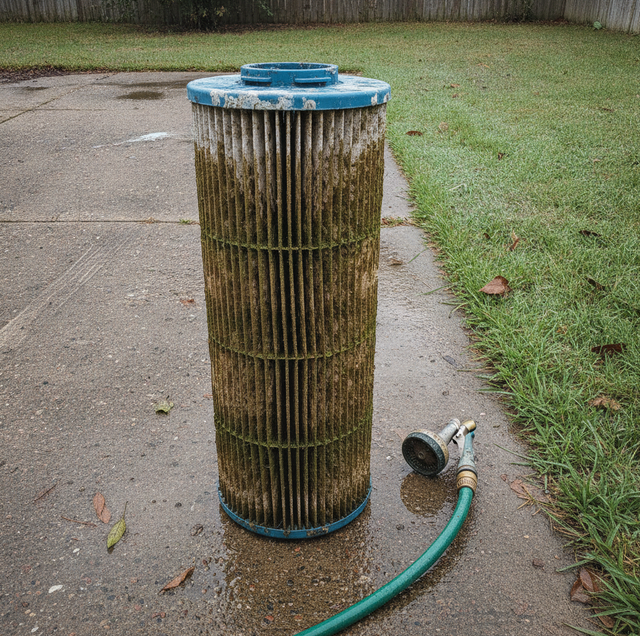
Cartridge filters replace the sand bed with a pleated fabric element, a tall cylinder folded into dozens of accordion ridges. All that pleating packs a large surface area into a small tank, so water passes through slowly and at lower pressure. There's no backwash valve. When pressure rises, you shut the pump, pull the cartridge, and hose the trapped debris out of the pleats over a drain or the lawn. The element goes back in and keeps working. Cartridges don't last forever; the fabric eventually frays and the pleats pack down, and then the cartridge gets replaced.
DE (diatomaceous earth) filters use a set of grids inside the tank coated with DE powder, a fine, chalky material made of fossilized diatom skeletons riddled with microscopic pores. You add the powder through the skimmer, and it coats the grids in a thin cake. Water strains through that cake, and the pore structure catches particles far smaller than sand or fabric can. Maintenance is a two-step affair: you backwash to flush the dirty DE out, then *recharge* the filter with a fresh measured dose of powder. The powder needs careful handling, and dosing has to match the filter's grid area.
The Real Tradeoffs, Side by Side
Think of the three like coffee filters of different weaves. A coarse metal mesh (sand) lets the most through and is nearly impossible to clog. A paper filter (cartridge) catches finer grounds and needs no rinse-reverse trick. A fine cloth (DE) gives you the clearest cup but takes the most fuss to set up each time.
| Filter | Filtration (microns) | Maintenance effort | Water use | Water clarity | Best for |
|---|---|---|---|---|---|
| Sand | ~20-40 | Lowest; backwash occasionally | Higher; backwashing sends water to waste | Good | Owners who want simple and forgiving |
| Cartridge | ~10-20 | Moderate; pull and hose the element | Lowest; no backwash | Very good | Water-conscious pools, variable-speed pumps |
| DE | ~1-5 | Highest; backwash plus recharge powder | Higher; backwashing plus DE handling | Best | Fussy-clear water, fine debris, algae recovery |
Filtration and clarity: The micron numbers tell the clarity story directly. Sand strains in the ~20-40 micron range, cartridge roughly ~10-20, and DE down around ~1-5. Smaller particles caught mean less haze scattering light, so DE produces that glass-clear, look-straight-to-the-drain water, cartridge lands close behind, and sand is the most forgiving but leaves the finest particles in suspension. For most backyard pools, sand or cartridge clarity is perfectly swimmable; DE is the choice when you specifically want water polished to a shine.
Maintenance effort: Sand asks the least of you day to day: flip a valve, backwash, done. Cartridge sits in the middle; no backwash, but eventually you're hosing pleats and, less often, swapping the element. DE asks the most, because every cleaning is a backwash *and* a recharge, and the powder demands care in measuring and handling.
Water use: This is where a hot, high-evaporation climate changes the math. Both sand and DE are cleaned by backwashing, which, by design, dumps filtered water out of the waste line every time. A cartridge never backwashes, so it holds onto your water. In a place where the pool already loses volume to sun and heat, and you're topping off regularly, the water a cartridge saves over a season is real and worth weighing.
Cost to run, in effort, not dollars: Skip the price tags and think in inputs. Sand's ongoing costs are mostly backwash water and a very occasional media change. Cartridge trades backwash water for the periodic cost of replacement elements and the labor of hosing them. DE stacks both: backwash water plus a fresh dose of powder at every cleaning. More clarity generally means more inputs to keep it running.
Fit with variable-speed pumps: If you run a variable-speed pump on a low, energy-saving setting, filter choice matters more than owners expect. A cartridge's large pleated surface area lets water pass at low pressure and low flow, which is exactly the regime a variable-speed pump likes to sit in. Sand and DE beds generally want more flow to work their best, so a cartridge is often the natural partner for a slow-and-steady pump schedule.
Recovery after algae or heavy load: When a pool turns, and you're clearing dead algae or a storm's worth of fine debris, DE's fine cake shines; it grabs particles the others let slip and clears the water fastest. A sand filter can handle heavy loads, too, but you'll backwash often as it loads up. Cartridges clear well but can clog quickly during a heavy algae dump, meaning more pull-and-hose cycles until the water returns.
How to Choose for Your Pool
Work through these in order, and the answer usually names itself:
- Clarity you want: Happy with clean, swimmable water? Sand or cartridge covers it. Chasing that polished, crystal look? DE.
- Maintenance appetite: Want the least fuss and the most forgiving system? Sand. Fine with periodic hosing to save water? Cartridge. Willing to backwash and recharge for top clarity? DE.
- Water conservation: In a climate that already loses water to heat and evaporation, a no-backwash cartridge keeps the most water in the pool.
- Pump type: Running a variable-speed pump on low? Cartridge's low-pressure, high-surface-area design is the strongest match.
- Pool size and bather load: A busy pool with a heavy swimmer count, and lots of oils and debris leans toward finer filtration (cartridge or DE) sized generously so you're not constantly cleaning.
No single type wins outright. The right filter is the one that matches the clarity you actually want to the upkeep you'll actually do, in the climate and pool you actually have.
Frequently Asked Questions
Up to a point, yes, which surprises people. As debris packs into sand, pleats, or a DE cake, the gaps between the particles tighten, so a filter that has been running a while catches finer material than a spotless one does, which is why you should not backwash or rinse at the first speck. What you are watching for is the turning point: once the trapped debris chokes flow, pressure climbs, water turnover drops, and the pool starts to lose clarity because it is not being circulated enough. That is the moment to clean, and it is read on the pressure gauge, not by how the media looks. Cleaning a sand filter too early is a common mistake, since fresh sand filters more coarsely until it loads back up.
It is more than lost gallons. Backwash carries chlorinated or salted pool water plus whatever the filter trapped, so dumping it on a lawn or garden can scorch plants, and salted water can harm soil over time. Running it into the street or a storm drain is discouraged or restricted in many areas because it is treated water. DE backwash adds spent diatomaceous earth to the mix, which some places ask you to catch in a separator bag rather than send down the line. Cartridge filters sidestep all of this, since there is no backwash discharge to route, which is part of their appeal, where both water and runoff matter. If you run sand or DE, plan a legal, plant-safe spot for that discharge before the first cleaning.
Each type runs on a different replacement clock. Sand is the media in a sand filter, and it slowly wears smooth and packs down, losing its jagged grip on debris, so the bed is usually changed every five to eight years, even though the tank lasts far longer. A cartridge's pleated fabric wears with every rinse and eventually loses its shape or develops a gap, so plan on replacing cartridges every couple of seasons, or sooner under heavy use. DE grids are the durable part of a DE filter and can last many years, but the DE powder is used up and added again at each cleaning. A torn grid lets powder back into the pool and must be replaced. Budget for the media on its own cycle, separate from the filter tank.
Yes, and sizing matters as much as type. Every filter carries a flow rating that needs to match the pump's output and the pool's volume, so the entire body of water turns over within a reasonable timeframe, typically 8 to 12 hours. An undersized filter for the flow clogs quickly, spikes pressure, and requires constant cleaning; forcing too much flow through it can push debris straight through. An oversized filter runs at lower pressure and extends the interval between cleanings, which is generally forgiving, though the equipment is larger than strictly necessary. This is also why swapping filter types is a sizing exercise rather than a drop-in: the new unit has to fit the flow you already have.
Usually, but it's a plumbing and equipment-pad question, not a drop-in swap. Sand and DE both need a backwash line and a multiport valve; a cartridge doesn't, so moving from sand to cartridge can actually simplify the plumbing, while going the other way adds a waste line. The new filter also has to be sized to your pump's flow so pressure and turnover stay in the right range. Have the pad assessed before committing to a type.
Watch pressure, not the calendar. Note the gauge reading with a freshly cleaned filter, then clean again once it climbs roughly 8-10 psi above that clean baseline, whichever type you run. Heavy heat, constant use, oils, and fast algae growth increase pressure faster, so cleanings come more often during peak season than during a quiet stretch. The pressure-rise rule keeps you cleaning when the filter needs it, rather than too early or too late.
Have a pro match the right filter to your pool and pump — clearer water with less wasted effort and water. Dog Days Pools serves Clearwater and Pinellas County. CPC1460480. Call (727) 205-0566.