
How a Failing Multiport Valve Disrupts Your Pool’s Circulation
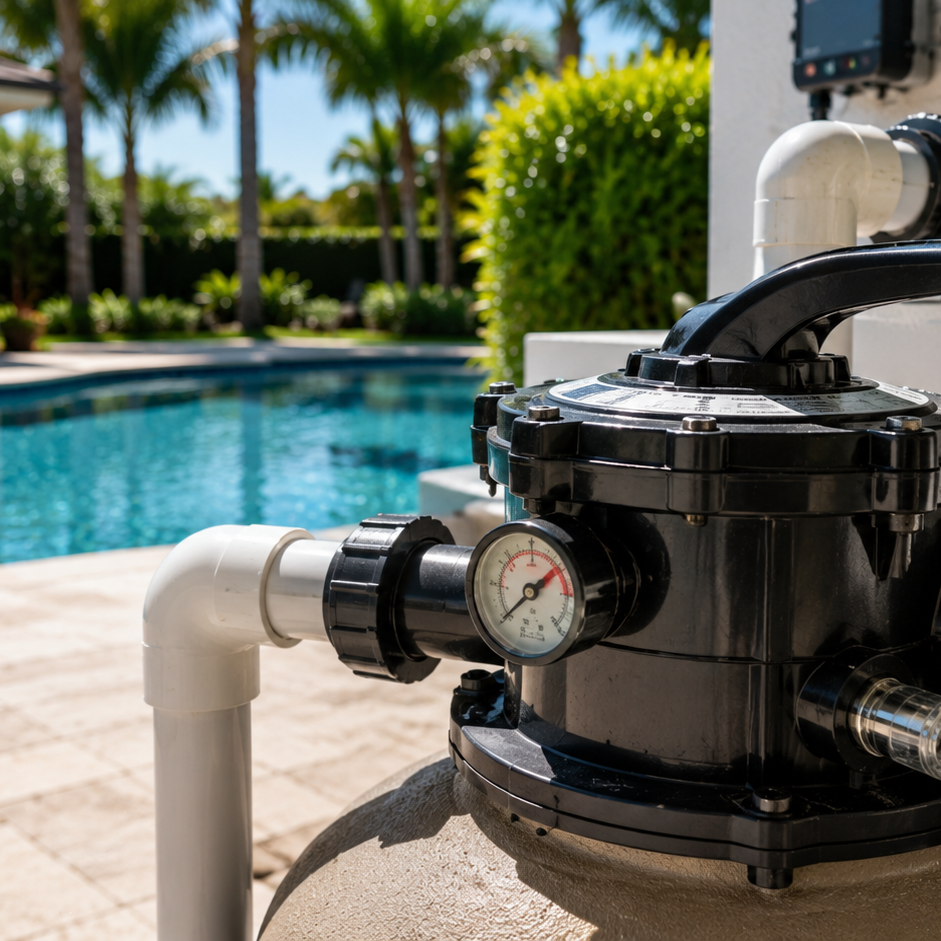
Your pool is running. You can hear the pump humming, and the pressure gauge looks fine. But the water's hazing up again. Debris circulates instead of getting caught. The backwash port is dripping when it shouldn't be. You shock it, the water clears for a day, then drifts back. Something is wrong — it just isn't announcing itself.
The multiport valve on top of your sand or DE filter is almost certainly the reason. It doesn't fail with a bang. It fails quietly, routing water to the wrong port or bleeding a fraction of every cycle through a gap in the seal while the pump keeps running as if nothing happened. The pool shows you the damage before you ever figure out where it's coming from.
What the Multiport Valve Actually Controls
The multiport valve is the traffic director for your pool's filtration circuit. It sits on top of the filter tank with a rotating handle that clicks between six positions: Filter, Backwash, Rinse, Recirculate, Waste, and Closed. Each position opens a different internal pathway — routing water into the filter media to be cleaned, out through the waste line to drain, or back into the pool without passing through filtration at all.
The part that does the actual work is a flat rubber seal inside the valve body called the spider gasket. Shaped roughly like a six-pointed star, it presses against different port openings as you turn the handle, closing off the ports that should stay sealed and letting flow through the ones that should be open. The gasket is doing all the directing. And it's almost always the first thing to go.
The valve housing is typically ABS plastic or, on older systems, Schedule 40 PVC. In Florida, that valve runs year-round — no seasonal shutdowns, no winter rest — which means it logs far more hours than the same valve on a northern pool. Heat, UV exposure, and constant contact with chlorinated water all wear at the gasket and the housing in ways a pool that closes for five months never sees.
How the Valve Fails
There are three distinct ways the valve breaks down, and each one hits your circulation differently.
Spider gasket deterioration is by far the most common. The gasket starts out flexible and resilient. With age and chemical exposure, it hardens, shrinks, and cracks. Gaps form between the seal and the port surfaces it's supposed to hold closed. Water stops staying contained in a single circuit — it bleeds through those gaps into adjacent ports. A valve set to Filter starts leaking into the Backwash or Waste port, sending a portion of your filtered water out the drain on every cycle. The handle still turns. The pump still runs. The only signs are a dripping waste port and water quality that won't hold.
A cracked valve housing is less common but harder to catch. A hairline crack in the plastic lets water escape internally without following any of the intended pathways. It doesn't necessarily leak to the outside — it moves between internal chambers, creating a partial bypass that cuts into the effective flow through the filter media. Pressure drops. The pump works harder. The pool filters at maybe 60 or 70 percent of rated capacity, with nothing obvious to point at on the equipment pad.
A worn handle assembly or internal spring creates a third kind of problem. The handle connects to the rotor through a spring mechanism that helps it seat cleanly in each detent position. If the spring wears out or the rotor develops flat spots, the handle can end up sitting between two positions — bridging two ports at once. At that point, the valve is serving neither function correctly, splitting the water flow in a way that satisfies neither filtration nor backwashing.
The Circulation Problems You'll Actually Notice
The way a failing valve disrupts your pool depends on which failure is happening and how far along it is. The most common patterns:
| Symptom | What's Likely Happening | Urgency |
|---|---|---|
| Pool clouds up within a day or two of backwashing | Contaminated backwash water bleeding back through failed gasket seal | Moderate — schedule repair |
| Water dripping from waste or backwash port during normal filter operation | Spider gasket losing seal between Filter and Backwash ports | Moderate — continuous water loss |
| Fine sand or grit appearing on pool floor or steps | Gasket gap allowing filter media to pass back through return circuit | Moderate — filtration is compromised |
| Pool water hazing despite balanced chemistry | Water bypassing filter media through cracked housing or failed seal | Moderate — filter not working properly |
| Pressure gauge reads lower than your normal baseline | Internal leak reducing effective flow through filter media | Moderate — pump working harder |
| Pool greening rapidly despite adequate chlorine levels | Filtration effectively bypassed — algae spores not being captured | High — address within days |
| Unusual grinding or squealing sound from valve area | Internal rotor or gasket dragging under wear | Moderate — inspect promptly |
| Visible water pooling at equipment pad around valve body | Cracked housing or failed o-ring at valve body seal | High — water loss risk |
The worst effect is also the hardest to see: partial bypass. When the spider gasket cracks, water under pressure finds the gaps and routes a fraction of every cycle through them rather than through the filter media. The pump runs fine. The pressure gauge looks reasonable. Chemistry tests in range. But 20 or 30 percent of your water is circulating without actually being filtered — algae spores that should be caught pass back into the pool, and the water can't hold chemistry because the filtration isn't there to back it up.
Think of the spider gasket like the weatherstripping on a door. New, it seals tight. Cracked and shrunken, air finds every gap. The door still closes. It just doesn't seal anymore.
What Florida's Year-Round Operation Does to These Valves
A pool in Chicago might run six months of the year. Your pool in Pinellas County runs all twelve. That's not a small difference — it's double or triple the cumulative hours on every rubber seal and plastic housing on the equipment pad.
The spider gasket in a continuously operated Florida pool typically needs attention around the three-to-five-year mark. In seasonal climates, the same gasket can last seven or more years. Florida pool chemistry adds to that wear: pools here often run higher cyanuric acid levels to shield chlorine from the relentless UV load, and high-CYA chemistry is harder on rubber seals than lower-stabilizer pools. Add in summer water temps that push 90°F and the near-daily thunderstorms from June through September that dilute and knock chemistry out of balance — and you've got an environment that chews through equipment faster than the warranty cards assume.
If your multiport valve has been running for six years or more without anyone looking at the gasket, there's almost certainly wear there. Whether you've noticed it yet is a separate question.
What You Can Check and What Needs a Pro
Here's a field test anyone can do: with the pump running in Filter mode, watch the waste or backwash port. A healthy valve in Filter position should have zero flow from those ports. Not a drip. If you see water running while the valve is set to Filter, the gasket is bleeding between ports.
Gasket replacement is within reach for a homeowner who's comfortable with basic plumbing. You shut down the pump, pull the valve off the filter, disassemble the rotor, peel out the old gasket, and press in the new one. Replacement kits for common valve models — Hayward, Pentair, Jandy — typically run under $20. If the valve is accessible and you're not squeamish about disassembly, it's a manageable afternoon project.
Before disassembling the valve, take a photo of the handle label and the position the rotor sits in. Gaskets are directional — they have to be oriented correctly when reinstalled or the port seal pattern won't align with the valve body, and the new gasket will fail within weeks.
But not every valve problem is a gasket fix. If the housing itself is cracked, a new gasket solves nothing — the housing is leaking, not the seal. If the valve is buried in a tight equipment bay that makes disassembly difficult, if you've replaced the gasket already and symptoms came back, or if you're not sure which failure mode you're dealing with, that's a call to a professional. Full valve replacement involves cutting and re-plumbing PVC pipe, and a mistake there — wrong fittings, improper cement, an introduced air leak — can layer a new problem on top of the original one.
Frequently Asked Questions
External leaks are visible — water dripping from the valve body, pooling on the equipment pad, or running down pipe connections. Internal leaks are different: water bleeds between ports inside the valve without leaving the housing. The tell-tale sign is water running from the waste or backwash port while the valve is in Filter mode. Another indicator is steady water-level drop in the pool without any visible source — filtered water is being routed to the waste line on every cycle.
Yes, and this is one of the most frustrating outcomes. If the gasket is failing and water is bypassing the filter media, algae spores that should be captured pass back into the pool on every circulation cycle. Your chlorine kills some of them, but continuous reintroduction overwhelms the sanitizer. The pool greens despite what look like normal chemical readings because the filtration is what's broken, not the chemistry.
Cartridge filters don't use multiport valves — they typically have a pressure relief valve and a simple drain for cleaning. The failure modes described here apply specifically to sand and DE filter systems. If your pool runs on a cartridge filter and you're seeing similar circulation issues (poor water clarity, weak return jets, low pressure), the likely culprit is a clogged or torn cartridge, not a valve problem.
Pinellas County pools run year-round, and the valve should be part of routine equipment service every three to four years. At that interval, a technician can catch gasket wear before it causes active symptoms. Waiting until you see problems typically means the pool has already been running with compromised filtration for weeks or months before anyone traces it back to the valve.
You can run it short-term, but it's not a situation to sit on. A valve leaking to waste continuously drops your water level — in a Florida summer, even a modest gasket leak can mean noticeable water loss within a week. More importantly, every gallon exiting through the waste port is a gallon that didn't get filtered. The net filtration rate drops, and in warm weather that gap shows up fast: haze first, then green.
If the valve body is intact and the handle seats cleanly in each detent position, gasket replacement alone usually gets you there. If the housing has visible cracks, the handle no longer clicks cleanly into position, or you are installing the same gasket for the second or third time, replace the whole valve. New hardware typically runs $80–$200, with labor on top for the plumbing work.
Dog Days Pools offers a complete, one-stop solution for professional pool repairs in Clearwater, Safety Harbor, and surrounding areas, including pool pipe and valve repair, multiport valve service, filter repair, and green pool clean-up. Our experienced team services residential pool systems with a focus on clean water, safe swimming conditions, and long-term performance. Whether you need routine pool maintenance or an urgent pool repair, we provide reliable service and responsive care. Schedule your pool service today — call (727) 205-0566.
