
Should I Add Automation to an Older Pool? Check the Pad First
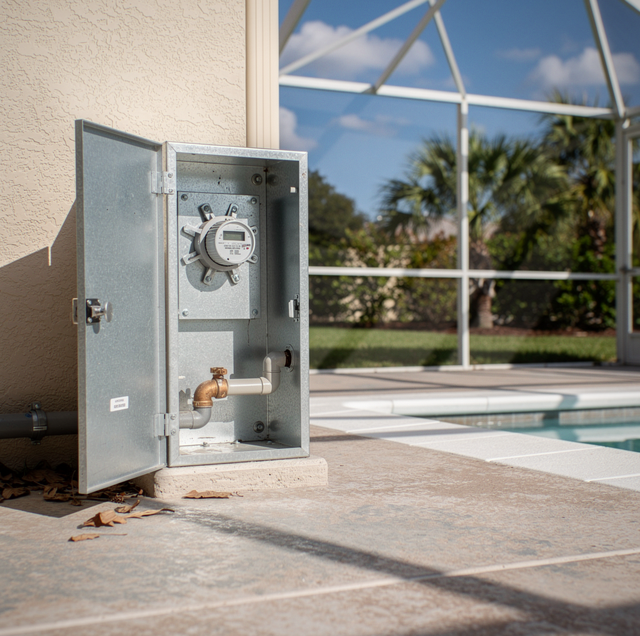
Pull the cover off the gray box beside an older pool pad and you find a metal dial marked off in 24 hours, with two steel trippers clamped to its edge. One tripper pushes the lever on. The other pushes it off. That is the entire control system on the pad, and it has been switching a pump motor for decades with no software anywhere in it.
So should you put a controller in its place? It depends on what is already bolted to your pad, and on three things in particular: whether the pump motor can turn at more than one speed, whether the plumbing carries diverter valves where a mode change would need them, and whether the heater and the sanitizer have a terminal a controller can talk to. Automation does not make old equipment do new things. It schedules and sequences equipment that is already capable. That is why the same controller can change how one pool runs while leaving another exactly as it was.
Scheduling Is the Layer a Time Clock Already Covers
What a time clock schedules is one circuit, in windows no finer than the width of a tripper against the dial's hour marks. Each extra pair of trippers buys you one more on-and-off window inside that same 24 hours, on that same circuit, held at whatever position you clamp it to all year.
A controller replaces that mechanism with relays and a program, and what it adds is count and independence: several named schedules running without reference to each other, filtration on one, a light on a second, a cleaner on a third. It also carries an astronomical clock, calculating sunset from the date and the pad's coordinates and sliding a light's on-time with it through the year.
On a pad with a single-speed pump, no valve actuators and no separate light circuit, a controller bought for scheduling puts a relay where a contact set used to be. The water does not know the difference. You get a schedule that is easier to read and change, and that is the whole of what changed.
Speed Control Is Where a Retrofit Earns Its Place
A single-speed pool pump runs at one speed because of how the motor is wound: an induction motor's speed is set by the number of magnetic poles in the winding and the frequency of the power feeding it, so a two-pole winding on 60-hertz power turns at a synchronous 3,600 rotations per minute and slips a little below that under load. Nothing on that motor accepts an input meaning "slower." A controller wired to it can close or open a contact, and that is the whole vocabulary you have bought.
Which pump belongs on your pad, and what a slower one saves you, is a comparison of its own. What decides this layer is narrower: until the motor can turn at more than one speed, the controller has nothing to vary, and the relay it closes is the one a tripper was already closing.
One wrinkle cuts against buying a controller for this layer alone. A variable-speed pump carries its own drive and a keypad that stores a schedule: several speeds, each with a start and a stop, held in the pump. A pool whose only automated element is the pump reaches the whole speed-control layer with nothing in an enclosure. A controller earns its place where a second circuit has to be sequenced against the pump's speed, which is the next layer down.
Valve Actuation Needs the Valves Already in the Plumbing
A three-port diverter valve holds a rotating plate inside the body on a splined shaft, with a handle clamped to its top. Turn the handle, and the plate swings across the two side ports, sending flow to one or the other, or splitting it between them. A valve actuator is a small gear motor in a housing that clamps over the same shaft in place of the handle, with cams inside that set where its travel stops at each end. Automating a spa mode, a waterfall or a cleaner line is that gear motor turning the handle for you.
The actuator cannot create a path the plumbing does not have. A spillover spa needs a diverter on the suction side to choose between the pool's drain and the spa's, a second on the return side to choose between the pool returns and the spa jets, and the two have to move together in sequence. Move one without the other, and the pump draws from the pool while pushing into the spa, emptying one into the other. A pad plumbed with two-port ball valves has no second port to divert to; an actuator on one of them can open or close the line, and that is all.
This is the layer where a retrofit on an older pad stops, and the fix is pipe: saw-cutting the plumbing and re-running it so three-port bodies sit at both junctions, with enough straight run either side of each to glue in. If your spa was never plumbed with its own suction and return, there is no junction to install a valve.
Heater and Sanitizer Control Depends on a Communication Terminal
A heater built to work with automation has a low-voltage communication terminal inside its control panel, a two-wire connection over which a controller sets the target temperature, reads back what the heater's own water sensor sees, and picks up a fault code when the heater locks out. A heater whose temperature is set by a knob on the front has no such terminal. Its thermostat is a capillary bulb in the water path, and the knob sets the point at which that bulb's expansion opens a contact. The setpoint stays where your hand left it.
A controller can still switch power to that heater, so it is energized only during hours you choose and cannot fire when the pump is down. A gas heater with a fireman's switch connection offers a middle rung: those two low-voltage terminals allow an external device to interrupt the call for heat. The controller opens that circuit several minutes before stopping the pump, so the burner shuts down first and water keeps moving long enough to carry residual heat out of the exchanger.
A heater will not fire until its pressure switch senses enough flow through the header to close, so a controller that can command the pump's speed raises it when heat is called and drops it afterward. A controller wired only to the heater's power cannot, so a low pump speed and a heat call sit in a standoff with nothing wrong on either device. A salt chlorine generator follows the same pattern: with a communication link, a controller sets the output percentage and reads cell status; without one, the generator keeps its own dial and draws only power. Either way, the generator's flow switch prevents the cell from energizing when no water passes through the plates.
The Pad's Wiring and Bonding Set the Outer Limit
A controller's relays switch line-voltage circuits but do not protect them. Overcurrent protection stays back at the panel, so anything you want scheduled on its own has to reach the enclosure as its own conductor run on its own breaker. A pad where the pump and the light hang off one feed from a single switch has one circuit, and a relay dropped into that feed takes both down together every time it opens. Separating them is conductor work, done before a program is written.
Bonding is the second limit, governing what may join the pad. A pool pad carries an equipotential bonding grid, a solid copper conductor tying the pump motor, the heater, metal parts of the pool structure, and the water itself to one another. Holding all of those at one potential leaves too little voltage difference between any two for a meaningful current to pass through a body touching both. That is a separate function from the grounding conductor, which carries fault current back to a panel to open a breaker. A controller enclosure, and any actuator or motor added beside it, becomes one more piece of metal on that pad, and each needs its own bond lug landed on the grid.
Cut or left off during equipment work, a bonding conductor gives no sign of it: pump, heater, and water run exactly as before while the grid tying them together sits open. Have the bond lugs checked before anyone swims.
Whether the grid has to be extended to a new enclosure, and whether the circuit feeding it needs ground-fault protection, is decided by the authority having jurisdiction where the pool sits, working from the rules in force when the pool was built. Ask the inspector and the licensed electrician doing the work.
Your own part of this ends at the outside of the enclosure. You can read a nameplate, count the pipe stubs entering a valve body, and check a heater's front panel with every cover closed. Opening a panel, a pump's wiring compartment or a controller enclosure puts you beside line-voltage conductors in a wet location, and that is where a licensed pro takes over.
Frequently Asked Questions
You can leave the clock on the wall with the trippers pulled off the dial and the manual lever set to permanent on, so the box serves as a disconnect while the controller's relay switches. Two switches in series on the same motor means the pump runs only when both are closed, so a dial left half-tripped will quietly fight your program.
No. A controller changes when circuits are energized and, on a variable-speed pump, how fast the motor turns. It has no effect on pipe diameter or filter area. Friction loss climbs with roughly the square of flow rate, so your 1.5-inch suction line that chokes at high flow chokes the same on a program as on a tripper.
No. The schedules live in nonvolatile memory inside the controller and run off its own clock, so your pad keeps switching on program with the router unplugged and the app uninstalled. Wireless access comes from a separate module or board that sits on top of an already-running system.
It depends on what drives yours. A pressure-side cleaner is driven by water pressure, and where that pressure comes from a booster pump, that booster is a second motor on its own circuit: automating the cleaner means giving it a relay interlocked so it cannot energize while the filter pump is off, because run dry it will ruin its shaft seal within minutes. A pressure-side cleaner fed off a dedicated return line has no booster to switch, and a suction-side cleaner works whenever the filter pump moves water.
Yes, if your fixture is a color-changing LED. A low-voltage light runs through a transformer, and the controller switches the transformer's line side rather than the light itself. Color-changing LED fixtures step through their programs by counting brief interruptions of their own power, so a relay that chatters, or a schedule that cycles the circuit quickly, can leave the light parked on a color nobody selected.
The pump motor's nameplate. It is a stamped or printed plate on the motor housing listing horsepower, service factor, voltage, and speed. A single figure in the speed field, 3450, says the motor has one speed, and the speed-control layer stays closed until you change the pump. A speed range printed there, alongside a keypad on the housing, says that layer is already open to you.
If you want to know which layers your own pad can actually reach — a look at the pump, the valves and the wiring answers that faster than any catalog does. Dog Days Pools serves Clearwater and Pinellas County. CPC1460480. Call (727) 205-0566.
