
Why Your Pool Turns Green So Fast After Rain
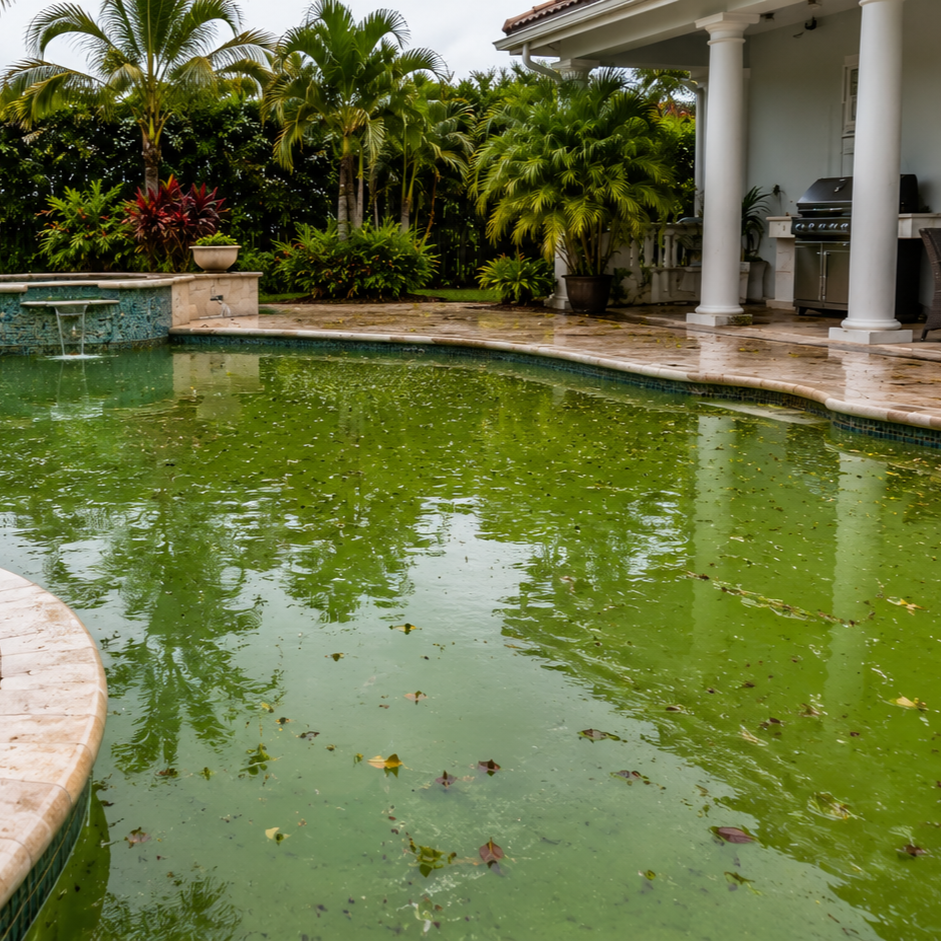
Quick Answer: Rain doesn't make a pool green — it sets the stage. A storm dilutes your chlorine, drops the pH and alkalinity, and washes in debris, phosphates, and nitrates that feed algae and burn through whatever sanitizer is left. With the chlorine knocked down, algae can double in as little as 3 to 8 hours, so the water goes from clear to green almost overnight. The fix is to rebalance, shock and hold the chlorine until it sticks, brush, and run the filter.
You went to bed with a clear pool and woke up after the storm to something the color of a pond. It feels like the rain itself turned the water green, but rain is just the trigger. What actually greened your pool is algae, and the storm handed it everything it needed in a single night. Once you see the chain of events, both the speed and the fix make sense.
What "Green" Actually Is
Green water is an algae bloom. Algae spores are always drifting into a pool — on the wind, off swimsuits, in rainwater — and the only thing keeping them from taking over is a sanitizer level high enough to kill them faster than they reproduce. Tip that balance, and they explode. Under the right conditions, an algae population can double in roughly 3 to 8 hours, which is exactly why a pool can look fine at dusk and look like a swamp by morning.
There's one thing worth ruling out first, though. Not every green tint is algae. Water that's heavy in dissolved metals like copper can flash green right after you shock it, and runoff or overhanging trees can tint a pool with pollen and leaf tannins. The tell is texture: algae makes the water dull, cloudy, and sometimes slick on the walls, while a metal or pollen tint usually stays comparatively clear. If it's slick and cloudy and getting worse, it's algae.
Why Rain Hits the Chemistry So Hard
Rain attacks pool chemistry from several directions at once, and that pile-up is what makes the greening so fast.
First, dilution. Heavy rain is a flood of mineral-free, slightly acidic water dropped straight into a balanced system. It thins out the chlorine and can knock total alkalinity down by 5 to 10 ppm in a day while pulling pH down with it. Rainwater falls in the acidic 5.5 to 6.5 range, so your carefully set pH drifts low, and chlorine behaves erratically when the water is out of balance.
Second, contamination. Stormwater doesn't arrive clean. It carries leaves, dust, and organic debris that create immediate chlorine demand — the sanitizer gets used up oxidizing all that material instead of guarding against algae. Worse, runoff washes in phosphates and nitrates. Those don't attack chlorine directly, but they're fertilizer for algae: more food means algae reproduce faster, which means chlorine burns down faster trying to keep up. The result is a sanitizer that's diluted, distracted, and outpaced all at once.
The Sunlight Multiplier
Here's the part that makes a Gulf Coast pool especially vulnerable. Unstabilized chlorine breaks down fast in direct sun, and a pool gets plenty of that here year-round. The buffer against it is cyanuric acid — stabilizer — which works like sunscreen for your chlorine and should sit around 30 to 50 ppm in an outdoor pool. Heavy rain dilutes that stabilizer right when you need it, so the sun strips chlorine even faster in the days after a storm. Combine relentless sun, summer heat, and a fresh dose of algae food, and you have the recipe for the fastest blooms of the year.
This quick guide maps what you're seeing to what's driving it:
| What you notice | Likely cause | First move |
|---|---|---|
| Cloudy green, worse by the hour | Algae bloom; chlorine bottomed out | Test, then shock and hold |
| Clear-ish green right after shocking | Dissolved metals oxidizing | Test for metals; use a sequestrant |
| Yellow-green dust on the bottom | Mustard/algae plus storm debris | Brush, vacuum, shock |
| Water level over the skimmer mouth | Rain overflow; skimmer can't skim | Drain to mid-skimmer first |
How to Clear a Green Pool After a Storm
Work in order, because skipping steps just wastes chemicals. Start by getting the basics back: skim and remove debris, and if the rain pushed the water above the skimmer opening, drain or backwash it down to the middle of the skimmer so it can actually pull surface water again.
Next, test and rebalance. Bring pH and total alkalinity back within range before relying on chlorine, since chlorine is far less effective in unbalanced water. Then shock the pool — and this is the step people get wrong. A single dose rarely wins, because dying algae release more phosphates that feed the next generation. You have to raise the chlorine high and keep it there, retreating as needed, until the level finally holds overnight. Brush the walls and floor daily so the chlorine can reach algae clinging to the surfaces, and run the pump and filter continuously. Be patient with the filter: a cartridge or D.E. filter may clear the water in a day, while a sand filter can take several days of running and backwashing.
Keep free chlorine high and steady until it still reads strong the next morning — that "holds overnight" test is how you know the bloom is actually dead, not just stunned. The CDC's floor is 1 ppm free chlorine (2 ppm if you use stabilizer), with pH between 7.0 and 7.8.
Staying Ahead of the Next Storm
You can't stop the rain, but you can blunt it. Before a storm rolls in, it's worth boosting the chlorine a little and making sure your stabilizer is in range, so the dilution starts from a stronger position. Clear the deck of leaves and loose debris that would otherwise wash in. And know that a salt-chlorine system, while convenient, may not generate chlorine fast enough to outrun a post-storm bloom on its own — adding a manual dose of chlorine after a big rain gives the cell a fighting chance. Keeping phosphates low during the season removes the fuel that lets a small slip become a green pool.
For a pool that's already deep green, or one that keeps coming back no matter how much you shock it, that's usually a sign the phosphates or the filtration need professional attention rather than another bag of shock. A green-pool recovery service can clear it in days and reset the chemistry, and regular weekly service is what keeps the storm season from turning into a summer of green.
Frequently Asked Questions
It depends on how far gone it is. A light green tint caught early can clear in a day or two of balanced water, shocking, and filtering. A deep, dark-green bloom can take several days and multiple shock treatments, especially if you're running a sand filter, which clears slowly. The key is holding the chlorine high until it stops dropping overnight.
Algae reproduce quickly once chlorine drops, doubling in as little as a few hours. A storm dilutes your sanitizer, throws off the pH, and washes in algae food all at once, so the bloom takes off while you sleep. Clear at night and green by the morning is entirely possible after a hard rain.
It's best to stay out until it's cleared. Green water means the sanitizer has bottomed out, so the pool isn't being disinfected, and you can't see the bottom, which is a safety hazard on its own. Get the chlorine back up and the water clear before anyone gets in.
Almost never. The vast majority of green pools are cleared chemically — rebalance, shock, brush, and filter. Draining is a last resort for water that's chemically unrecoverable, and it carries its own risks to the pool shell, so treat the water first.
Not by itself. Algaecide is a backup that helps prevent and slow algae, but chlorine is what kills an active bloom. Use shock to knock the algae down and hold the level until it sticks; algaecide afterward helps keep it from returning, but it's not a substitute for getting the chlorine right.
Usually, phosphates or filtration. Dying algae release phosphates that feed a new bloom, so if you shock once and stop, the green comes back. High phosphate levels or an undersized or dirty filter let it keep cycling. Breaking that loop often means removing phosphates and making sure the filter is doing its job.
A green pool after a storm isn't bad luck — it's chemistry knocked off balance and algae moving fast to fill the gap. The rain diluted your chlorine, fed the algae, and let the sun finish the job, all in a night. Rebalance the water, shock it and hold, brush, and keep the filter running, and the blue comes back. Stay a step ahead before the next storm, and you may never see the green at all.
Pool already green or turning green every time it rains? — Get it cleared fast and the chemistry reset so it stays blue through storm season. Dog Days Pools serves Clearwater and Pinellas County. CPC1460480. Call (727) 205-0566.
