
How to Rescue a Swamp-Green Pool Without Draining the Water
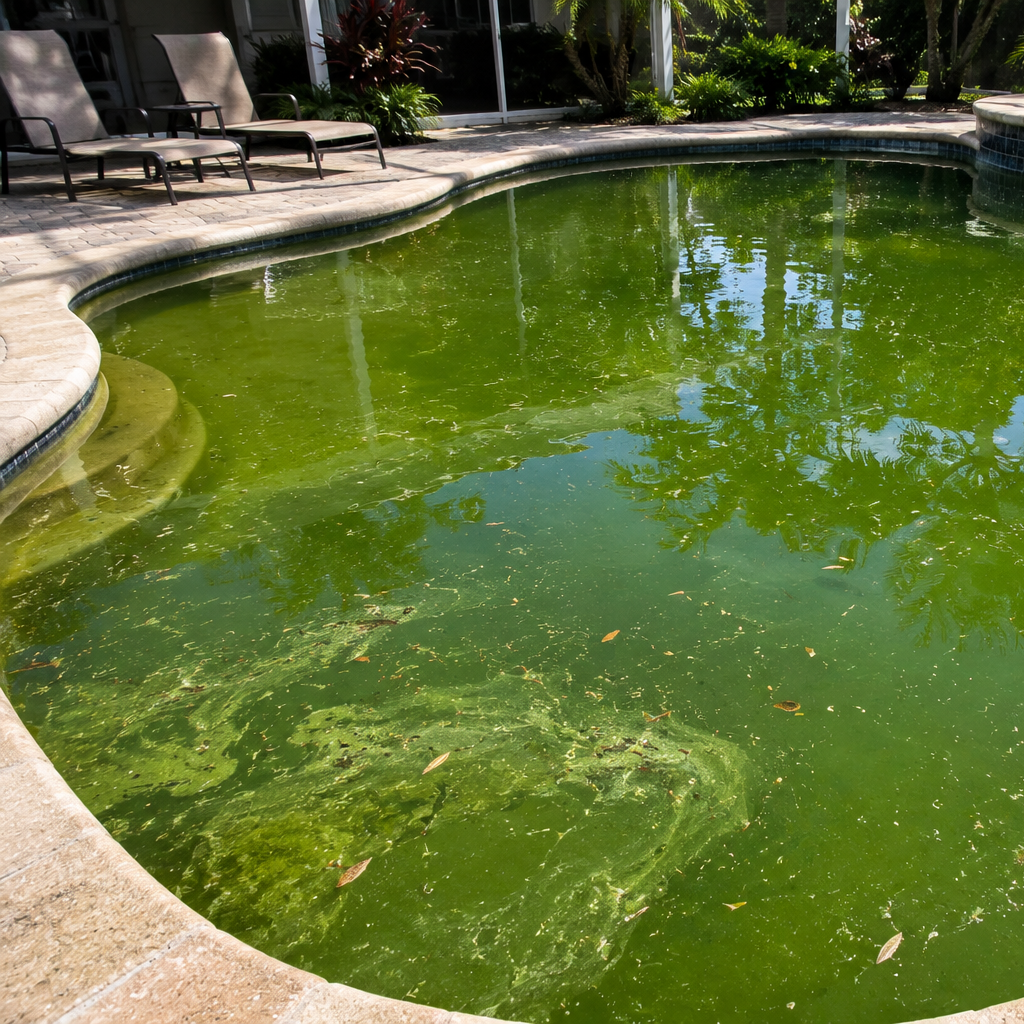
The pool looked fine when you left for vacation. Two weeks later, you are standing at the edge looking at something that belongs in a bayou. The water is opaque dark green, there's a slick film on the surface, and whatever scent it's giving off isn't chlorine. Your first instinct is to start draining.
Stop. For most Florida pools, draining is the wrong call — and in parts of Pinellas County where the water table runs high, an empty pool shell can float right out of the ground. What you're looking at is a heavy algae bloom. It's fixable without draining, and the process, done correctly, produces clear water in three to seven days.
Why a Pool Turns Swamp Green — and Why It Snowballs
Algae is always present in outdoor air. Spores land in the water constantly, and chlorine eliminates them before they can gain a foothold — as long as the chemistry is working. When free chlorine drops below the threshold needed for active sanitation (typically below 1 ppm), algae finds an opening and multiplies fast. In Florida's heat and direct sun, algae populations can double every few hours. A pool that goes a week without attention can shift from slightly hazy to visibly green. Another few days, and it's swamp green.
What makes a swamp-green pool so stubborn to treat is that the algae creates its own chlorine demand. As chlorine contacts algae cells and starts killing them, the dying organic matter consumes more chlorine in the breakdown process. The more algae there is, the faster any sanitizer you add gets eaten up. A gallon of liquid chlorine poured into a heavily infested pool can be fully consumed within hours, leaving the water looking exactly as green as before. Breaking this cycle is what the rescue process is designed to do.
Assess the Pool Before You Add Anything
Before the first chemical goes in, take five minutes to understand what you're dealing with. Run your hand along the pool wall just below the waterline. A slimy, biofilm-coated surface means algae has anchored to the shell — not just floating in the water. Dark, almost black water in the deep end signals a pool that's been stagnant for weeks, not days, and means the treatment timeline is longer.
Also check the pump basket and the filter pressure gauge. A neglected pool almost always comes with a partially clogged filter and a basket packed with debris. If the filter can't flow, treating the water is a losing battle — dead algae has no way out of the system. Cleaning the equipment before you shock makes everything that follows significantly more effective.
The Rescue Process, Step by Step
Step 1: Remove large debris first- If the pool has visible leaves, sticks, or accumulated organic matter sitting on the bottom or floating on the surface, remove it before adding chemicals. A leaf net handles surface debris. For material on the floor of a pool where you can't see the bottom, a fine-mesh leaf bagger connected to the suction line will pull it up. Every pound of organic material in the water is a pound of chlorine demand waiting to happen. Removing it before shocking means your treatment works on algae, not decomposing leaves.
Step 2: Brush every surface- Algae anchors to pool walls, steps, and floor surfaces with a thin biofilm layer that acts as a chemical barrier against chlorine. Physically breaking that layer before adding chemicals gives the sanitizer direct contact with the algae cells. Use a nylon brush on plaster or pebble surfaces, or a stainless steel brush on concrete. Pools treated without brushing often see the same algae patches return a week later from growth that was never fully exposed.
Step 3: Adjust pH to 7.2–7.4 before shocking- Chlorine's effectiveness drops dramatically as pH rises. At pH 8.0, chlorine delivers roughly 20% of the sanitation power it has at pH 7.2. Most algae-infested pools have high pH because algae growth naturally raises it. Test pH first and if it's above 7.6, bring it down with muriatic acid before adding shock. Adjusting pH after shock is added wastes product and extends the recovery.
Step 4: Shock heavily — much heavier than the label says- Standard shock dosing is designed for maintenance, not rescue. For a swamp-green pool, you need to reach breakpoint chlorination — the point where free chlorine is high enough to overwhelm the algae's demand and start killing cells faster than they consume sanitizer. For a heavy bloom, that means 3 to 4 times the standard dose. For calcium hypochlorite granular shock, the baseline is 1 lb per 10,000 gallons. A swamp-green pool needs 3–4 lbs per 10,000 gallons. Add shock in the evening to prevent UV degradation before it can do its job.
Step 5: Run the pump continuously- Keep the pump running around the clock until the water clears. Circulation is what carries treated water through the filter and distributes chemicals evenly. A pump that shuts off for 8 hours overnight creates 8 hours of stagnant, undertreated water. For a severe algae bloom, 24-hour circulation is non-negotiable for the first several days.
Step 6: Clean the filter repeatedly- As chlorine kills algae and dead cells get pulled into the filtration system, the filter loads up quickly — sometimes within a few hours of the first treatment. Watch the pressure gauge and clean the filter whenever pressure rises 8–10 PSI above the starting baseline: backwash for sand or DE filters, rinse the cartridge for cartridge filters. Multiple cleanings per day during the first 48 hours of a serious rescue are normal. That's the process working.
Step 7: Retest and re-shock as needed- Check free chlorine and pH every 12 hours. If the water is still opaque green after 24 hours and free chlorine reads zero, the algae demand consumed the entire shock dose and another round is needed at the same concentration. With heavy blooms, two or three full-dose shock treatments are common before the water begins to visibly shift. Don't read a zero chlorine result as failure — it means the algae was there to consume it, and you add more.
Step 8: Add algaecide only after the water starts to clear- Algaecide is not a substitute for chlorine and it doesn't work in heavily chlorinated water — the shock destroys it before it can do anything. Wait until the water has moved from opaque green to a hazy teal or murky blue-green, then add a copper-free or PolyQuat 60-type algaecide as a finishing treatment. This addresses any trace algae remaining and discourages regrowth during the final clearing stage.
What Clearing Actually Looks Like
Pools don't snap from swamp green to clear. The process moves through distinct stages, and knowing what each stage looks like prevents you from stopping treatment too early or assuming the process isn't working.
| Stage | What You'll See | What It Means |
|---|---|---|
| Opaque dark green | Can't see the bottom; walls barely visible at waterline | Heavy live algae; maximum chlorine demand |
| Hazy green to teal | Floor faintly visible in shallow end | Chlorine gaining ground; algae partially dead |
| Milky white or gray | Pale, cloudy water; no green tint | Algae mostly dead; fine particles still suspended |
| Cloudy blue | Blue tint visible; 2–3 ft visibility | Nearly there; particles filtering out |
| Clear | Full bottom visibility; no haze | Treatment complete |
The milky-white stage trips up most people. The water turns pale and opaque because dead algae particles are too fine for the filter to catch all at once. This is progress, not a setback — those particles will filter out over the next day or two, or settle to the floor where they can be vacuumed to waste. Vacuuming to waste (bypassing the filter so the material exits the system directly) speeds this final stage considerably.
A pool that was moderately green typically shows visible clearing within 24–48 hours when treated correctly. A true swamp-green pool — the kind where the first step is invisible — usually takes 3 to 7 days of continuous treatment. Florida's summer heat accelerates the die-off chemistry, but it also promotes faster regrowth if chlorine drops, which is why maintaining that elevated level throughout the entire process matters.
When the Pool Won't Clear
If the pool remains green after two or three rounds of heavy shock, something beyond algae is working against you.
High cyanuric acid (CYA) is the most common culprit in Florida pools. CYA stabilizes chlorine against UV breakdown — which is necessary — but when it builds up above 80–100 ppm, it chemically ties up so much chlorine that the free, active fraction drops too low to kill algae even when total chlorine reads normal. Pools that have used trichlor tablets as their primary chlorine source for years often carry CYA levels of 150 ppm or higher. At that point, the only fix is a partial drain and refill to dilute the stabilizer back into range. This is the one scenario where a controlled, partial drain makes sense — not a full drain, and not the first move, but the right move once chemistry confirms the problem.
A failing salt cell is another common scenario. If the chlorinator isn't producing effective chlorine between manual treatments, the pool will go green again regardless of how well the rescue went last time. The shock fixes the bloom; the broken equipment creates the next one.
Green water that persists despite correct chlorine and pH sometimes points to dissolved metals — copper, in particular — rather than live algae. Copper-tinted water reads blue-green but responds to metal sequestrants, not more shock. If everything tests normal but the water won't clear, metals testing is worth running before adding another shock dose.
Frequently Asked Questions
For a dark or swamp-green pool, plan on 3 to 4 times the standard shock dose. For a 10,000-gallon pool, that's typically 3–4 lbs of calcium hypochlorite (granular) or an equivalent amount of liquid chlorine at 10–12% concentration. You may need to repeat this dose after 12–24 hours if the water is still green and free chlorine has dropped back to zero.
In most cases, yes. In-ground pool shells in Florida — particularly in Pinellas County and along the Gulf Coast — face significant hydrostatic pressure from the high water table. An empty shell can crack or float out of the ground when that pressure has no water weight to counteract it. A partial drain to dilute high CYA or total dissolved solids is sometimes the right call, but it's done slowly and carefully, not as the first response to a green pool.
Recurring algae almost always comes from one of three places: CYA levels high enough to neutralize chlorine before it can maintain residual protection between treatments, a malfunctioning salt cell or chemical feeder that can't keep chlorine up on its own, or a gap in weekly brushing that lets algae reattach to surfaces before chlorine reaches it. Re-shocking without finding the root cause is a cycle, not a solution.
No — algaecide added to a heavily chlorinated pool gets destroyed by the shock before it can work. Use it as a finishing treatment after the water begins to clear. The one thing worth adding early in the process is a phosphate remover if phosphate levels are high. Phosphates are a food source for algae, and reducing them before shocking removes fuel from the bloom even as chlorine kills the existing growth.
Wait until free chlorine has dropped back to 3–5 ppm and the water shows visible clarity before allowing anyone in. Don't estimate based on time — test the water before swimming. During the active rescue phase with chlorine at shock concentrations (often 10–15 ppm), the water will cause eye and skin irritation and should be avoided.
Yes, and vacuum to waste — meaning route the water directly out of the system rather than through the filter. Dead algae that gets vacuumed through the filter re-suspends in the water and extends the cloudy phase. Vacuuming to waste sends it out of the pool entirely and is the fastest way to get from cloudy-white to genuinely clear.
The Pool Will Get There
The milky haze and slow progress can make it feel like nothing is working. But the chemistry is consistent: remove the organic load, overcome the algae's chlorine demand with a dose large enough to actually hit breakpoint, keep the water moving, and let the filter work. The pools that don't recover are usually the ones where the dose wasn't heavy enough, the filter wasn't cleaned often enough, or the pump was turned off too soon. Stay with it, and a pool that looked like a Louisiana bayou last week will be clear enough to swim in by the end of the week.
Dog Days Pools offers a complete, one-stop solution for professional pool services in Clearwater, Safety Harbor, and surrounding areas, including green pool clean-up, algae treatment, and pool chemical maintenance. Our experienced team services residential pool systems with a focus on clean water, safe swimming conditions, and long-term performance. Whether you need routine pool maintenance or an urgent pool repair, we provide reliable service and responsive care. Schedule your pool service today — call (727) 205-0566.
