
Why High Cyanuric Acid Makes Pool Chlorine Stop Working
You have been adding chlorine for days. Your test strip shows 3 or 4 ppm — fine on paper — but the water has that familiar haze to it, the steps are getting slippery, and a faint green tinge is spreading across the shallow end. You shock the pool. Nothing changes the next morning. The pool just shrugs you off.
Before you blame the product or start pulling equipment apart, test one more number: your cyanuric acid level.
High cyanuric acid — CYA, also called pool stabilizer or conditioner — is one of the most common and least understood reasons a well-dosed pool stops responding to chlorine. From the deck, it looks like the chlorine isn't working. What's actually happening is more specific: your chlorine is there, chemically, but most of it's been neutralized before it can do anything.
What Cyanuric Acid Is Supposed to Do
CYA was introduced to outdoor pool chemistry as a fix for one of Florida's most persistent maintenance headaches: sunlight. UV radiation destroys free chlorine fast. An unstabilized pool in Clearwater can lose 90% of its chlorine within a few hours of direct sun — which means every morning dose is mostly gone by noon.
Cyanuric acid acts as a sunscreen for chlorine. It forms a temporary bond with chlorine molecules and shields them from UV degradation. The bond is reversible — the CYA releases chlorine slowly into the water as the pool needs it. Your chlorine actually lasts through the day instead of burning off before anyone jumps in.
At the right concentration — 30 to 50 ppm for a standard chlorinated pool — CYA earns its place. It cuts chlorine consumption, holds chemistry steadier between service visits, and keeps costs from running away. Without any stabilizer in a Florida pool during summer, you'd be adding chlorine multiple times a day just to maintain a basic sanitizing level.
The problem is that CYA doesn't leave the water on its own.
How CYA Ties Up Your Chlorine
Here's the part most pool guides skip.
Chlorine dissolved in water exists in two main active forms: hypochlorous acid (HOCl) and hypochlorite ion (OCl⁻). HOCl is the one that actually sanitizes — it destroys algae cells, oxidizes bacteria, and tears through organic contaminants. The hypochlorite ion is about 80 times weaker. It's essentially inactive by comparison.
When CYA is present, it binds to a large portion of the free chlorine in your pool, forming cyanurate complexes. Those bound molecules aren't available to sanitize anything. The fraction that stays as active HOCl — the part actually doing the killing — shrinks as CYA climbs.
Think of CYA as a waiting room where chlorine sits while it queues for work. A reasonable amount means enough chlorine gets called off the bench to handle what the pool needs. But pack the waiting room full? Barely anything gets through.
At 30 ppm CYA and a pH of 7.5, roughly 25% of your free chlorine is in the active hypochlorous acid form. At 80 ppm, that drops to around 10%. At 150 ppm — a level many residential pools quietly reach — you might have less than 5% of your stated chlorine actually doing anything. A test reading of 5 ppm of "free chlorine" could mean barely enough active sanitizer to matter.
| CYA Level (ppm) | Active Chlorine (HOCl) Fraction | Practical Effect |
|---|---|---|
| 0 | ~50% | High sanitizing power — but chlorine degrades fast in sunlight |
| 30–50 | ~25% | Recommended range — good balance of stability and activity |
| 80–100 | ~10% | Reduced effectiveness — borderline, manageable with higher chlorine targets |
| 150+ | <5% | Severely diminished — algae-prone even with normal chlorine readings |
That's why a pool can test at a completely normal chlorine level and still go green. The number on your test strip is total free chlorine — it says nothing about how much of that chlorine is actually active. CYA determines that ratio. And once the ratio tilts far enough, no amount of chlorine you add through the skimmer will fix it.
How CYA Builds Up in Florida Pools
CYA builds for one simple reason: most residential pools run on stabilized chlorine products, and every dose adds more CYA to the water.
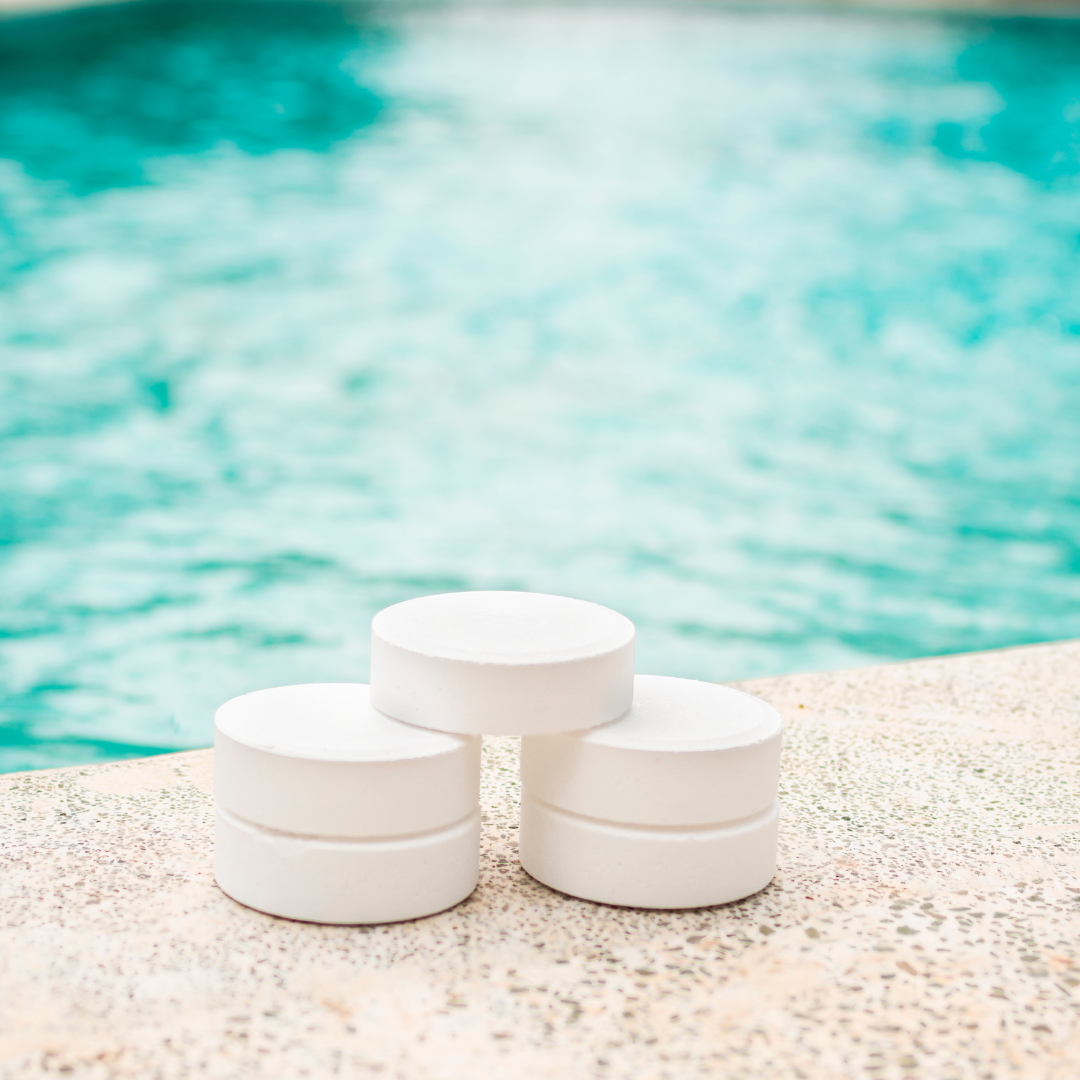
Trichlor tablets — the three-inch pucks in floaters and automatic chlorinators — are the biggest source. Each tablet is roughly 54% chlorine and 47% cyanuric acid by weight. Every time you chlorinate with tabs, you're raising your CYA level. A pool running exclusively on trichlor can see CYA climb by 5 to 10 ppm per month under normal conditions.
Dichlor shock — the granular product sold at most hardware stores as "instant shock" — contains around 57% cyanuric acid by weight. If you've been using dichlor regularly after heavy rain or swim parties, you've been stacking CYA along with every dose.
Florida pools face this faster than pools in cooler climates. Year-round operation means 12 months of stabilized products instead of five or six. Clearwater's intense sun and heat push chlorine demand higher, which means you add more product. And the afternoon thunderstorms that dilute the water a bit don't come close to offsetting what's being added week after week.
The CYA has nowhere to go. It doesn't evaporate. It doesn't break down under UV the way chlorine does, and it doesn't precipitate out on its own. Splashing and backwashing shave it down slightly — but each new dose adds more. Unless you're replacing water, the level only climbs.
Testing for CYA and Reading the Results
Standard test strips do a poor job measuring CYA, particularly at higher levels. If your strip shows anything above 100 ppm, treat that as an approximation and retest with a proper reagent kit or bring a water sample to a pool supply store. The Taylor K-2006 test kit includes a turbidimetric CYA test — it works by measuring how cloudy the water turns when mixed with a melamine reagent, and it gives you a real number at the upper end of the range.
A full water panel at a pool supply store will include CYA as part of the analysis. For a pool that's been running on trichlor for a few seasons without a partial drain, the actual number is often a surprise.
Ideal targets: 30–50 ppm for a standard chlorinated pool. Saltwater pools typically run 60–80 ppm because the salt cell generates chlorine continuously and needs slightly more stabilizer to protect it. Above 100 ppm in any pool, you've got a problem. Above 150 ppm, the chemistry simply won't hold regardless of what you add.
The Only Real Fix Is Dilution
There's no chemical that will lower your CYA. Not reliably, not in a residential pool, not fast enough to matter.
Products marketed as CYA reducers do exist. They use an enzymatic process to break down cyanuric acid, and independent testing hasn't found them effective enough to count on — especially in warm Florida water, where competing reactions slow everything down. They might inch the number down over weeks. For a pool sitting at 150 ppm or higher, that's not a solution.
The actual fix is draining a portion of the pool and refilling with fresh water. Drain 20 to 40%, refill, retest. A pool at 150 ppm that loses a third of its water and gets refilled should land around 100 ppm. You may need to do it twice to get into the target range. For pools that have crossed 200 ppm, a more substantial drain is the only path back to workable chemistry.
Do this carefully in Florida. Pinellas County's water table is high, and draining too much of a vinyl-liner or older plaster pool — especially after heavy rain — can create pressure under the shell and cause movement or cracking. A 20–30% partial drain is generally safe for most pools in solid condition. Anything beyond that deserves a professional's eyes on it before you start dropping the water level.
After the refill, rebalance your full chemistry. Fresh water dilutes pH, alkalinity, and calcium hardness along with the CYA, so plan to test and adjust everything once the pool is back to normal level.
Going forward: switch as much routine chlorination as you can to liquid chlorine — sodium hypochlorite, sold at 10–12% concentration. It adds zero CYA. Shorter shelf life, more frequent application, but for a pool that's spent seasons watching CYA creep up, that's a fair trade. Calcium hypochlorite (cal-hypo) is another unstabilized option. Reserve trichlor tablets for situations where you need them, rather than using them as your primary chlorine source year-round.
Frequently Asked Questions
Yes. Without any stabilizer, chlorine burns off fast under direct sun — particularly in a Florida pool with eight or more hours of UV exposure per day. A pool with zero CYA can lose most of its chlorine within a few hours of peak sunlight, leaving you with an effectively unchlorinated pool by mid-afternoon. The goal is balance: enough CYA to protect chlorine from UV loss, but not so much that the active fraction is too small to sanitize. For most outdoor pools in Clearwater, 30–50 ppm is the sweet spot.
Your test is measuring total free chlorine, not the active fraction that kills algae. At 150 ppm CYA, a reading of 4 ppm might mean less than 0.2 ppm of active hypochlorous acid — which isn't enough to hold algae off under Florida sun. The number on the strip looks normal. But almost all of that chlorine is sitting idle in cyanurate form, unavailable to do anything useful.
Every time. Trichlor tabs are roughly half cyanuric acid by weight, so regular use is how CYA builds up in most residential pools. Pools that have run on trichlor exclusively for several seasons often sit well above 100 ppm without the owner knowing it. Switching to liquid chlorine for routine dosing adds no CYA and stops the climb.
Once a month during the swimming season is usually enough to catch a rising trend before it becomes a problem. If you're using trichlor tablets or stabilized shock regularly, testing every two to three weeks gives a better picture. Don't wait until you notice an algae problem — it's much easier to hold CYA at 60 ppm than to bring it back down from 180.
A 20–30% partial drain is generally safe for in-ground pools in good structural condition. Vinyl-liner and older plaster pools need more care — draining too much, especially after rain when the water table is high, can create pressure under the shell and cause movement or cracking. If you plan to drain more than a third, or if your pool has existing structural concerns, get a professional's eyes on it first.
Liquid chlorine (sodium hypochlorite) adds zero CYA — it's unstabilized and only introduces free chlorine. Calcium hypochlorite is also free of cyanuric acid. Both are good choices when CYA management matters. Trichlor tablets and dichlor granular shock add significant CYA with every dose and are the products to cut back on when levels start climbing.
Dog Days Pools offers a complete, one-stop solution for professional pool services in Clearwater, Safety Harbor, and surrounding areas, including pool chemical maintenance and balancing, green pool clean-up, and pool troubleshooting. Our experienced team services residential pool systems with a focus on clean water, safe swimming conditions, and long-term performance. Whether you need routine pool maintenance or an urgent pool repair, we provide reliable service and responsive care. Schedule your pool service today — call (727) 205-0566.
