
Why Does My Pool Keep Turning Green Even After Treatment?
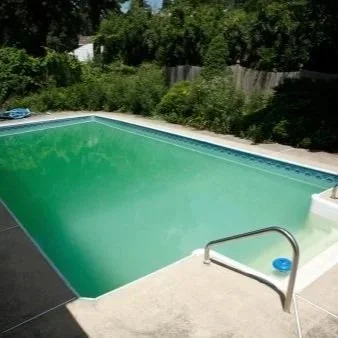
You shocked the pool on Saturday, brushed the walls, and ran the pump overnight. By Tuesday, the water looked clear. By the following weekend, you are standing at the edge of the same green water you started with.
This is one of the most frustrating patterns in pool ownership — especially in Florida, where year-round heat and humidity create conditions where algae can repopulate faster than most homeowners expect. When a pool keeps turning green after treatment, the shock itself is almost never the problem. Something in the pool's chemistry, circulation, or maintenance routine is giving algae exactly what it needs to come back.
Here's what's actually happening — and why standard treatment keeps failing.
The Six Root Causes: Quick Reference
| Root Cause | Signal You'll Notice | What Needs to Change |
|---|---|---|
| High CYA (cyanuric acid) | Chlorine reads fine, algae returns in 3–7 days | Partial drain and refill to bring CYA below 60 ppm |
| High phosphates | Algae regrows fast, even with balanced chemistry | Phosphate remover treatment, then rebalance |
| Dirty or bypassed filter | Pool clears briefly, then clouds and greens again | Deep filter clean or full media replacement |
| Dead circulation zones | Green patches persist in corners or behind steps | Reposition return jets; commit to weekly brushing |
| Mustard algae | Pale yellow-green tint, clings to walls, resists shocking | Specialized mustard algae treatment protocol |
| pH creeping above 7.8 | Chlorine present, but not holding | Lower pH to 7.4–7.6 before each shock treatment |
| Shock underdosing or expired product | Algae dies partially, rebounds in 3–4 days | Recalculate pool gallons; use fresh shock at full kill dose |
| Dissolved copper or iron | The pool turns green within minutes of adding shock | Metal sequestrant; this is not algae |
High Cyanuric Acid Is the Cause Most Homeowners Miss
Cyanuric acid, or CYA, is the stabilizer built into most chlorine tablets. Its job is to protect chlorine from Florida's UV rays — without it, an outdoor pool in direct sunlight can lose most of its free chlorine within a few hours. That protection is real and necessary. But CYA has an upper limit, and most pools in regular tablet use quietly exceed it without anyone noticing.
The problem is that CYA doesn't evaporate. Every trichlor tablet you drop in the floater adds a small amount of stabilizer. It builds up week after week. Once CYA climbs above 80–90 ppm, the chlorine in your water becomes progressively less effective as a sanitizer — a condition sometimes called chlorine lock. You can test the water, see 3 ppm of free chlorine, and assume the pool is protected. But at 100 ppm CYA, that chlorine is working at a fraction of its capacity.
This is why the pool looks great right after a shock treatment. You've temporarily overwhelmed the algae with a massive chemical dose. But within a week, the residual chlorine can no longer hold the line, and algae repopulates from whatever spores and fragments survived. The cycle repeats every time you treat, as long as the CYA stays high.
There is no chemical that lowers CYA. The only fix is a partial drain and refill — typically draining one-third to one-half of the water and replacing it with fresh water. In Clearwater, FL, where pools run year-round and stabilizer builds up continuously, checking CYA every 60–90 days and planning a partial drain if levels exceed 70 ppm is basic maintenance discipline. Pool chemical maintenance performed by a professional will include a CYA check as part of diagnosing why treatment isn't holding.
Phosphates: The Fuel Algae Keeps Finding
Algae doesn't just need sunlight and warm water to thrive — it needs food. The primary food source is phosphates, which enter pool water through leaves, lawn fertilizer runoff, bather waste, and some pool chemicals. In Florida, where lawns are fertilized frequently and surrounded by dense landscaping, phosphate loading can be higher than in most other parts of the country.
Phosphates don't appear on a standard water chemistry test. Your pH, chlorine, alkalinity, and calcium hardness can all test perfectly balanced while high phosphate levels still drive algae back within days of treatment. Anything above 500 ppb starts to favor aggressive regrowth — the chlorine kills the existing colony, but the nutrients remain for the next wave of spores that arrive on wind or rain.
A phosphate remover precipitates those dissolved nutrients out of solution, turning them into a particulate your filter can capture. It doesn't replace proper chlorination, but it removes the food source that's been giving algae a running start every time you treat.
What a Dirty Filter Does to Your Treatment Results
When you shock a pool, you are killing live algae and oxidizing the organic material suspended in the water. That dead algae — billions of microscopic particles — has to go somewhere. It goes into the filter. A filter that's heavily loaded before a green pool treatment may not have the capacity to capture all of it. One that hasn't been cleaned in several months may be routing water around the filter media rather than through it, meaning debris passes straight through the system and back into the pool.
Sand filters can develop channeling — water carves a path through compacted sand rather than distributing evenly. The pressure gauge reads normal, the pump sounds fine, but very little actual filtration is happening. A pool running with a channeling sand filter will clear for two or three days after heavy shock, then cloud and green again as residual debris recirculates.
Cartridge filters can fail at the pleats — collapsing or tearing under the pressure spikes of a heavy algae treatment. A torn element looks intact from the outside but bypasses filtration at the damaged fold. If your pool clears briefly and then greens within the week, filter condition belongs high on the inspection list. A thorough cartridge cleaning, sand backwash, or full media replacement, depending on filter type, is often the piece that was missing from every previous treatment.
Where Algae Hides: Dead Zones and the Seeding Problem
Every pool has areas where water movement is slower — behind steps, in deep corners, near the main drain, behind fixed ladders. When the rest of the pool is fighting an active algae bloom, these low-flow zones can harbor colonies that survive the treatment. Think of it like clearing weeds from a yard while leaving one patch in the corner untouched. That patch throws seeds back across the lawn all summer. A surviving algae colony in a stagnant corner is doing the same thing on every turn of the pump cycle.
Return jet positioning matters here. If yours are aimed directly at the wall rather than angled to push water in a sweeping rotation, there are almost certainly dead spots on the opposite end of the pool. Adjusting jet angle is simple and free. Brushing walls, steps, and the floor every day during an active treatment — not just once — physically disrupts algae before it can anchor and pushes material into the circulation stream where the filter and sanitizer can reach it.
Mustard Algae: When Shock Keeps Failing Despite Doing Everything Right
If the algae in your pool tends toward pale yellow or olive rather than bright green, clings to walls rather than clouding the whole water column, and returns within days of a full shock treatment, you may be dealing with mustard algae. Mustard algae — also called yellow algae — is a chlorine-resistant strain that can withstand shock doses that would eliminate common green algae without much difficulty.
Mustard algae can also survive on equipment, brushes, and pool toys when they are out of the water, which means it can reintroduce itself to a freshly treated pool every time someone swims or uses equipment that was in the pool before treatment. Standard green pool protocols are insufficient for this strain. It requires a higher shock dose — typically two to three times the normal green algae rate — along with a specific algaecide formulated for mustard algae. Brushes and pool accessories that contacted the water during an active infestation should be treated with diluted shock solution before reuse.
Underdosing: When the Shock Never Reaches Killing Concentration
Every shock product has a dosing rate based on pool volume — typically measured in gallons. Homeowners who estimate their pool volume (or use the builder's original number without confirming it) often find they've been underdosing every treatment they've run. A dose that would kill algae in a 10,000-gallon pool does almost nothing in a 20,000-gallon pool. Algae sustains damage, retreats, and rebounds.
Expired shock is a related issue. Calcium hypochlorite and sodium dichloro products both lose potency over time, especially when stored in warm garages or sheds through a Florida summer. A bag of shock that's been sitting open for six months may test at a fraction of its labeled strength. If your treatments have never fully cleared the pool, recalculating pool volume — length × width × average depth × 7.5 gives gallons — and checking the age of your chemicals is worth doing before the next treatment.
A Diagnostic Note: When Green Appears Within Minutes of Shocking
Not every case of green water after treatment is algae. If your pool turns green within minutes of adding shock — rather than over the course of days — the cause is almost certainly dissolved metals, typically copper or iron. When oxidizers contact copper or iron in solution, those metals precipitate out and give the water a greenish tint. This is common in pools that draw from well water, have aging copper equipment, or have been treated with copper-based algaecides.
The fix for metal oxidation is a metal sequestrant, not more shock or algaecide. Adding more oxidizer when metals are the cause makes the discoloration worse. If you're seeing green appear within minutes of treatment, have the water tested for metals before treating further.
pH Creep and Why It Makes Every Shock Treatment Work at Half Strength
Chlorine's effectiveness is tightly tied to pH. At 7.4–7.6, free chlorine converts primarily to hypochlorous acid, which is the active sanitizing form. At pH 7.8 or above, the proportion of hypochlorous acid drops sharply. At pH 8.0, chlorine is operating at roughly 20–25% of its ideal effectiveness — meaning you'd need four to five times as much chemical to do the same sanitation job.
Florida's rainfall, bather load during summer months, and the gradual off-gassing of CO₂ from the water all tend to push pH upward. If you're shocking a pool that's running at pH 7.9, you're essentially delivering a fraction of the treatment dose, regardless of what the label says. The water clears briefly, the sanitizer depletes, and algae comes back.
Before any algae treatment, test the pH. If it's above 7.6, add pH decreaser and retest before adding shock. This is a short extra step that can dramatically extend how long a treatment holds.
Frequently Asked Questions
The most common cause is high cyanuric acid, which makes residual chlorine too weak to suppress algae between treatments. Other causes include high phosphate levels, a filter that can't capture dead algae, and dead circulation zones where colonies survive the initial shock and reseed the pool. Testing CYA is the first place to check if treatments aren't lasting.
Depending on the root cause, often yes. High phosphates respond to phosphate remover treatments. Filter problems can be resolved with cleaning or media replacement. pH drift is correctable with standard chemistry adjustments. But if CYA has climbed above 80–100 ppm, a partial drain and refill is the only reliable solution — no chemical treatment removes stabilizer from water.
The standard recommended range is 30–50 ppm. Many pool professionals are comfortable up to 70 ppm for outdoor pools with heavy direct sun exposure. Above 80 ppm, chlorine effectiveness drops enough to create persistent algae problems. Florida pools that rely on trichlor tablets year-round often reach this threshold within a single season without regular CYA testing.
A standard test panel (pH, free chlorine, alkalinity, calcium hardness) doesn't measure everything relevant. Phosphates require a separate test. CYA requires a separate test. And high CYA can make a chlorine reading look adequate while actual sanitizing capacity is far below what's needed. If all standard parameters are normal and algae keeps returning, a full water analysis that includes CYA and phosphates is the next step.
Mustard algae tends to be pale yellow or olive rather than vivid green, clings to walls and shaded surfaces rather than clouding the full water column, and returns unusually fast after standard shock treatments. It also tends to reappear in the same spots — typically low-flow areas or shaded surfaces. If you've shocked twice and the same yellowish patches keep coming back in the same locations, mustard algae is the likely cause.
Getting Off the Green-Pool Treadmill
Treating the symptom — green water — without identifying what's feeding it puts you on a loop. The pool clears, something in the chemistry or circulation lets algae reestablish, and you're back to treating in a week. The way out of that loop is a complete diagnosis: test CYA and phosphates, check filter condition and media integrity, evaluate return jet angles and brushing frequency, and rule out mustard algae if the color or recurrence pattern fits.
In Clearwater's climate, where water temperature supports algae growth nearly every month of the year and summer rainstorms regularly destabilize pool chemistry, a pool that keeps turning green is rarely a one-chemical fix. It's a system problem — and it needs a system answer.
Dog Days Pools offers a complete, one-stop solution for professional pool services in Clearwater, Safety Harbor, and surrounding areas, including green pool clean-up, algae treatment, pool chemical maintenance, and pool troubleshooting & diagnostics. Our experienced team services residential pool systems with a focus on clean water, safe swimming conditions, and long-term performance. Whether you need routine pool maintenance or an urgent pool repair, we provide reliable service and responsive care. Schedule your pool service today — call (727) 205-0566.
